China chip insiders eye stronger global ties despite trade tensions / Photo: © AFP

 Indiana River Otters Make Comeback After Decades of Conservation Efforts

 Shruti Haasan Reveals Kamal Haasan’s Defense of Her Film Career

 Penrith Panthers Face Backlash Over Decision to Disband Pantherettes Cheerleading Squad

 Make-A-Wish Announces 2026 Starblazer Award Honorees; Allied World Becomes First Corporate Founder

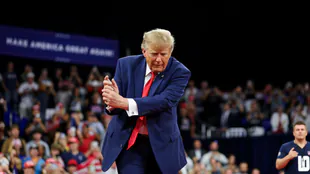 Lee-Trump Golf Diplomacy Faces Diplomatic Dilemma Ahead of G20 Summit

 Mavericks Defeat Jazz 112-100 Behind Washington’s 26 Points and Second-Half Surge
Industry insiders at a semiconductor trade fair in Shanghai urged more cooperation between the Chinese chip sector and the rest of the world, despite growing trade tensions with Washington.
Visitors thronged the Semicon expo as it opened on Wednesday, with exhibitors using loudspeakers and bright banners to advertise everything from silicon wafers and chip testing equipment to adhesives and glass pipes.
China's burgeoning semiconductor sector has faced pressure from the United States and some European governments in recent years, with Washington blacklisting dozens of companies this week over national security concerns.
US President Donald Trump has vowed to ramp up trade curbs on Chinese chip companies, while pressuring allies to restrict business with Beijing -- attempting to isolate the world's second largest semiconductor market.
Still, Xiao Jincheng, co-founder of Suzhou Zunheng Semiconductor Technology Company, told AFP "it is our dream to expand globally".
China has sought in recent years to become self-sufficient in the semiconductor industry, with Beijing pouring billions of dollars into a massive chip fund.
Xiao, whose company sells chip-making equipment, said he still believed that "in the future we may need cooperation across the global industrial chain".
- Self-sufficiency? -
Xiao's sentiment was echoed by Ram Trichur, a semiconductor specialist at German materials giant Henkel.
"Semiconductor innovation cannot happen in isolation," Trichur told AFP.
"The ecosystem has to work together to be productive," he said.
Across the cavernous halls that house the trade fair, Chinese companies showed off lists of foreign clients, while one put up a sign proclaiming its wish to "sincerely invite foreign agent".
Still, there were signs of unease at the fair on Wednesday, with multiple Chinese firms and one European group telling AFP the topic of curbs on China's semiconductor trade was too sensitive to discuss.
"The limitations from the United States do have a certain impact on us," Zhou Dongdong, a product manager at equipment supplier Wuxi Evergrand Electronic Scientific Technology Co., told AFP.
But Zhou said he believed restrictions could spur China's chip supply chain to make "breakthroughs".
Trichur told AFP the challenges faced by Chinese firms could result in "catalyzing their innovation to make some big gains in the front end technologies".
Computer chips -- used in everything from refrigerators and vacuum cleaners to smartphones and electric vehicles -- now occupy a crucial position in the global economy.
Experts have long considered China to be lagging behind the United States in the race to secure sufficient access to cutting-edge semiconductors.
But the shock release in January of an AI chatbot developed by Chinese firm DeepSeek, apparently at a fraction of the cost needed for US-based OpenAI to produce its ChatGPT tool, has suggested that US trade curbs have not been entirely successful.
Still, Chinese chipmakers face headwinds, with top firm SMIC saying last month that its 2024 profit had plunged significantly from the previous year on the back of souring trade relations between Beijing and Washington.
T.Germann--VB