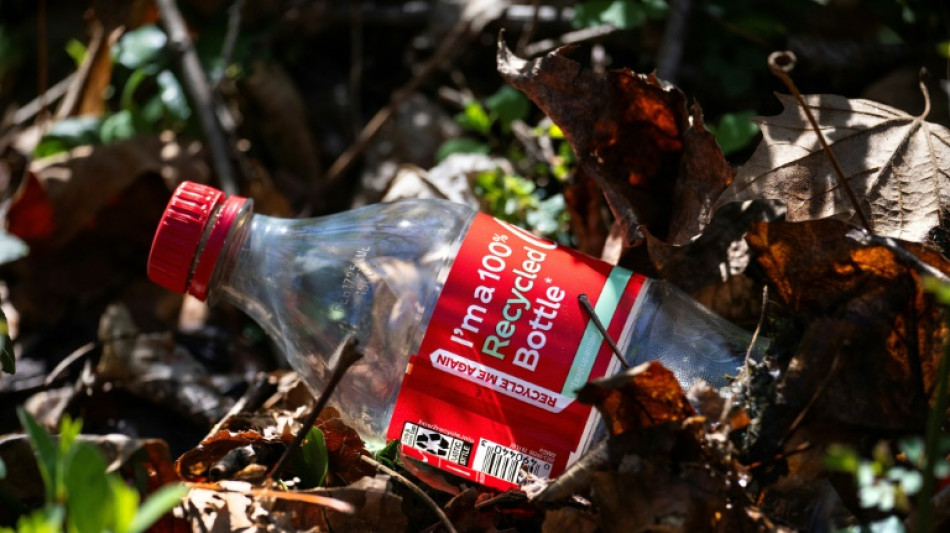
Over a billion pounds of Coke plastic waste to enter waterways: study / Photo: © AFP

 Stocks rise and oil slips as traders eye Iran threat, Nvidia results
 India in command despite Sooriyabandara half-century
 Hyundai reaches tentative deal with workers after strike

 Trees 'giving up': climate change hammers historic English gardens

 Malian songbird keeps age-old sounds alive at 88

 Canada to announce response to Trump's new tariffs
 Stocks stagger and oil rises as traders eye Iran threat, Nvidia results

 Families of detained Chinese Christians cling to faith in legal limbo

 Trump veers from boredom to denial after six months of Iran war

 Cool Japan: Human fridge chills workers in extreme heat

 Tens of thousands flee fire near US city of Reno

 Despair and anger erupt after deadly Guinea landfill collapse

 Tornado tears through French village, dozens injured

 Federer looks forward to brief return to Arthur Ashe stadium

 US removes Syria from state sponsor of terrorism list

 Facebook, TikTok promoted Colombian armed groups' content to recruit children: HRW

 Palmeiras agree to sell Allan to Manchester City: source

 US vows 'economic asphyxiation' of Iran with new sanctions

 French tourist dies after getting stuck in scorching Death Valley

 US proposes expanding UN Sudan arms embargo to entire country

 Ceasefire verification mission heads to east DR Congo

 Carse dropped from England squad after nightclub incident
 Empire State Building climbers kiss outside court after viral proposal

 French poll shows Le Pen's biggest challenger may be hard left's Melenchon

 Noosha Aubel: Πόση διοικητική αποτυχία μπορεί να αντέξει ακόμα το Πότσδαμ?

By 2030, Coca-Cola products will account for an estimated 1.33 billion pounds (602,000 metric tons) of plastic waste entering the world's oceans and waterways each year, according to a stark new analysis published Wednesday by the nonprofit Oceana.
That's enough plastic to fill the stomachs of 18 million whales.
The report arrives amid mounting concerns over the human health risks posed by the spread of microplastics, which scientists increasingly link to cancer, infertility, heart disease, and more.
"Coca-Cola is by far the largest manufacturer and seller of beverages in the world," said Matt Littlejohn, who leads Oceana's campaigns targeting corporate polluters.
"Because of that, they really matter when it comes to the impact of all this on the ocean."
Coca-Cola ranks as the world's top branded plastic polluter, followed by PepsiCo, Nestle, Danone, and Altria, according to a 2024 study published in Science Advances.
Oceana's estimate is based on Coca-Cola's publicly reported packaging data from 2018 to 2023, combined with sales growth forecasts to create a "business-as-usual" scenario.
The result: the company's plastic use is projected to exceed 4.13 million metric tons (9.12 billion pounds) annually by 2030.
To estimate how much of that plastic will reach aquatic ecosystems, researchers applied a peer-reviewed method developed by an international team of scientists and published in the academic journal Science in 2020 to arrive at the 1.33 billion pounds estimate, which is equivalent to nearly 220 billion half-liter bottles.
For Oceana, the clearest solution to reduce this staggering figure lies in bringing back reusable packaging -- whether in the form of returnable glass bottles, which can be reused 50 times, or thicker PET plastic containers, which are designed for 25 uses.
- Dropped reuse pledge -
Coca-Cola itself acknowledged in 2022 that reusable packaging was "among the most effective ways to reduce waste," and committed to a goal of reaching 25 percent reusable packaging by 2030.
But that pledge was quietly dropped in its latest sustainability roadmap, released in December 2024.
The company's updated goals instead focus on increasing recycled content in packaging and boosting collection rates -- while stressing the significant challenges in recycling soda bottles and shifting consumer habits.
Environmental advocates have long warned against overreliance on recycling, arguing that it often serves to shift blame onto consumers rather than addressing the root of the crisis.
"Recycling is great, don't get me wrong," said Littlejohn. "But if you're going to use recycled plastic to produce more single-use plastic, that's a problem."
Plastic production relies on oil, making corporate plastic use a direct driver of climate change.
Still, there is reason for hope: Coca-Cola already operates large-scale refillable systems in several countries, including Brazil, Germany, Nigeria, and even parts of the United States, such as southern Texas.
"They have the largest reusable infrastructure of any beverage company, and they have the ability to grow that and show the way for the rest of the industry," said Littlejohn.
In a statement to AFP, a Coca-Cola spokesperson said that while the company's efforts currently focus on using more recycled materials and improving collection systems, "we have been investing and remain committed to expand our refillable packaging options, and this work will continue as part of our consumer-centric strategy."
R.Flueckiger--VB