Filipinos see pathway from poverty with virtual assistant jobs / Photo: © AFP

 Stocks rise and oil slips as traders eye Iran threat, Nvidia results

 India in command despite Sooriyabandara half-century

 Hyundai reaches tentative deal with workers after strike

 Trees 'giving up': climate change hammers historic English gardens

 Malian songbird keeps age-old sounds alive at 88

 Canada to announce response to Trump's new tariffs

 Stocks stagger and oil rises as traders eye Iran threat, Nvidia results

 Families of detained Chinese Christians cling to faith in legal limbo
 Trump veers from boredom to denial after six months of Iran war

 Cool Japan: Human fridge chills workers in extreme heat

 Tens of thousands flee fire near US city of Reno

 Despair and anger erupt after deadly Guinea landfill collapse

 Tornado tears through French village, dozens injured

 Federer looks forward to brief return to Arthur Ashe stadium

 US removes Syria from state sponsor of terrorism list

 Facebook, TikTok promoted Colombian armed groups' content to recruit children: HRW

 Palmeiras agree to sell Allan to Manchester City: source

 US vows 'economic asphyxiation' of Iran with new sanctions

 French tourist dies after getting stuck in scorching Death Valley

 US proposes expanding UN Sudan arms embargo to entire country

 Ceasefire verification mission heads to east DR Congo

 Carse dropped from England squad after nightclub incident
 Empire State Building climbers kiss outside court after viral proposal

 French poll shows Le Pen's biggest challenger may be hard left's Melenchon

 Noosha Aubel: Πόση διοικητική αποτυχία μπορεί να αντέξει ακόμα το Πότσδαμ?

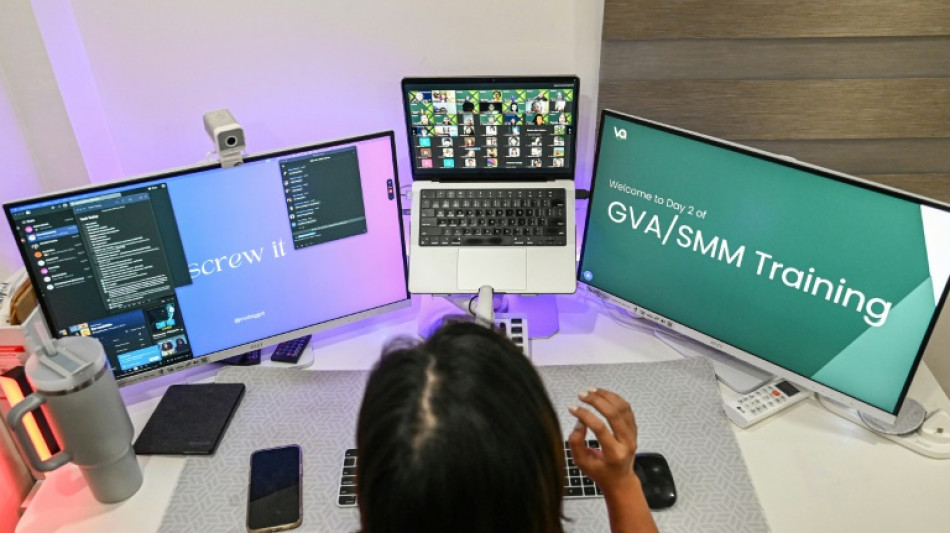
Nathalie Mago's work day begins after she's tucked her three daughters into bed and flicked off the lights in their house north of the Philippine capital Manila.
As her young family sleeps, she fires up her laptop and begins discussing the day's agenda with her boss -- an American half a world away.
A "virtual assistant", Mago is one of a growing number of Filipinos flocking to the booming but unregulated sector in the face of a tight job market, low wages and frequently hellish commutes.
"It literally saved me," Mago told AFP. "I was able to support myself and my family at the same time."
A former office worker, the 32-year-old said she's now earning five times as much serving as the "right hand" of employers for whom she writes copy, manages social media and even buys family birthday gifts.
Government figures for the sector are unavailable as the role falls into no recognised job category, meaning legal protections are also effectively non-existent.
But Derek Gallimore, of advisory firm Outsource Accelerator, estimates the number of Filipino virtual assistants at around a million -- a number he expects to grow.
"It's the assumption that they can call their own shots, have more freedom and earn more money," Gallimore said of the job's allure, adding the reality may not always meet expectations.
Job-seeking platform Upwork lists the Philippines among the top five countries churning out virtual assistants, alongside India, Nigeria, Pakistan and the United States.
"We expect the growth of virtual assistant work in the Philippines to continue," said Teng Liu, an economist at Upwork Research Institute.
Filipinos' English proficiency made them a "strong fit" for global clients, he added, with Australia, the United Kingdom and the United States among the biggest markets.
- Risks and rewards -
A recent TikTok video with tens of thousands of likes featured a virtual assistant slowly unveiling a screenshot of her pay for five days' work -- P29,400 ($512), more than double the monthly minimum wage in Manila.
Several Facebook groups for virtual assistants -- whose tasks can include everything from marketing to making travel arrangements -- boast hundreds of thousands of followers who view the job as a path to a better life.
But there are risks associated with the sector.
"I know a lot of people who got scammed. The last one got scammed for 50,000 pesos," said Mago, describing a scheme in which a virtual assistant was tricked into paying for access to jobs that never materialised.
Others complete work for clients who then simply disappear, she said.
Law lecturer Arnold de Vera, from the University of the Philippines, told AFP the industry lacks protections under Philippine law because it falls into no existing government category.
"They're invisible in the sense that they are generally treated not as Philippine employees," de Vera told AFP, noting most virtual assistants classify themselves as "self-employed".
No law forces employers outside the country to uphold agreements made with Philippines-based workers, he said.
"It's risky because there is no remedy involved but people are willing to take that risk because of the rewards they can reap."
- A path home? -
Lyann Lubrico is among those who think the reward is worth the risk.
The 33-year-old, who became a virtual assistant after losing her job as an office manager in the United Arab Emirates, believes remote work can be a path home for overseas Filipino workers, or OFWs.
Now the owner of her own agency, Lubrico calls it her "mission" to give OFWs, whose remittances account for nearly 10 percent of national GDP, a way to make that money at home instead.
"I know some cleaners who grew old being cleaners abroad... I thought to myself, Filipinos shouldn't settle for this all their lives," she said, noting the abuse and discrimination faced by many.
Through a Facebook group called "Balikbayan (Returning Home) For Good", Lubrico has so far offered informal training to about 200 OFWs hoping to become virtual assistants.
"My mission is to enable overseas Filipinos to come home -- one at a time," said Lubrico.
But while a true believer in the sector, she agrees legal protections remain a crucial step.
Renato Paraiso, spokesman for the Philippines' Department of Information and Communications Technology, told AFP one key challenge is the fact that virtual assistant work "is borderless".
"That is something we should address," he said, adding that forging labour partnerships with other countries could be a path forward in protecting the rights of Filipinos.
"If we have more protections I think more people will be encouraged to become virtual assistants," said Mago, working remotely for the American.
"I strongly believe if every household in the Philippines has (someone employed as) a virtual assistant, no one will be hungry."
F.Mueller--VB