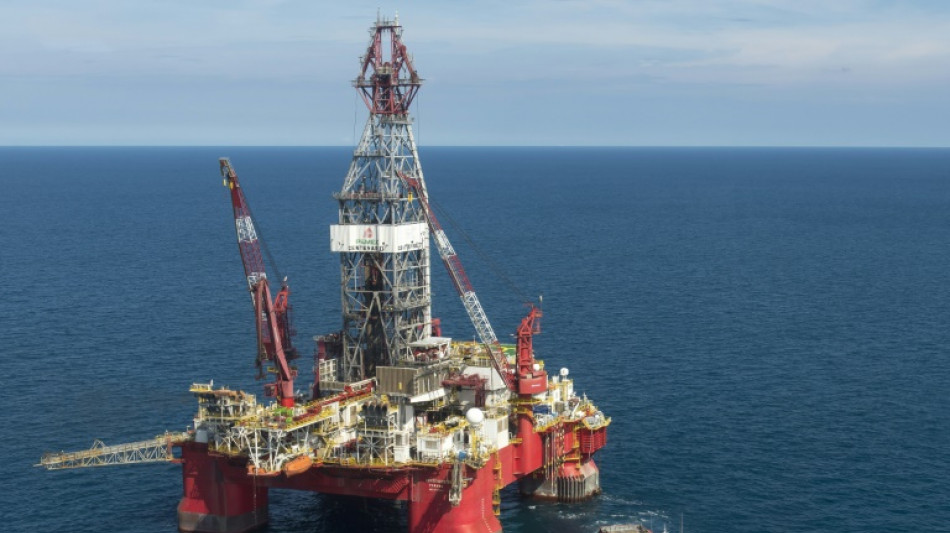
Mexico's energy reforms test relations with US / Photo: ©

 Macron welcomes Canada's Carney to French Atlantic territory

 Fiorentina frustrate Napoli with Serie A draw, Como upset

 Five-star Man City top Premier League after Sunderland thriller

 Ukrainian drones hit Moscow on last day of Russian elections

 Multi-Asset Trading Venue Monochrome Exchange Announces IEO of Its Native Token, $MCR

 South Korea break Japan hearts to win Asian Games basketball gold

 Acosta takes first victory at Austrian MotoGP

 PSG president Nasser al-Khelaifi under investigation in France for conflict of interest

 China swim sensation, 13, sets Games record after Japan win early

 Drones hit Moscow as Russians go to the polls

 New England boss Fleming says 'wrong' to ask Stokes to end retirement

 Germans vote in elections threatening fresh blow to Merz
 US fears rapid escalation in Mideast after Houthis attack Riyadh

 Japan triathlete Hojo wins first gold of Asian Games

 IOC president impressed by 'beautiful' Asian Games wooden huts

 First Asian Games gold goes to Japan as China's 13-year-old Yu lights up pool

 Data centre command hub keeps AI up and running

 Pope Leo in France: the issues on the table

 Packing for a pope: behind the scenes on foreign trips

 Republicans find transgender issues a powerful political weapon in midterm campaigning

 German state elections threaten new shock waves for Merz

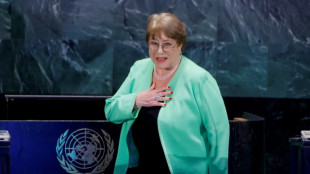 Chile's Bachelet quits race to be next UN chief

 Raphinha treble fires perfect Barca to win at Sevilla

 Thiam makes winning heptathlon return at Decastar meet

 Czechs beat USA to qualify for Davis Cup finals
Relations between the United States and Mexico are under strain as the Mexican government pushes ahead with planned energy sector reforms that have alarmed Washington and foreign investors.
President Andres Manuel Lopez Obrador wants to strengthen the state-owned electricity provider and roll back the effects of liberalization under previous governments that he says favored private companies.
That has prompted warnings that Mexico is in danger of violating its commitments under a North American trade deal with the United States and Canada by prioritizing state-run entities heavily dependent on fossil fuels.
In November, Lopez Obrador's ruling party pushed back its deadline for the approval of a constitutional reform bill until April, following a backlash from the United States, Canada and foreign investors.
The next few months "will be critical," a US diplomatic source in Mexico told reporters on condition of anonymity.
A row between the neighboring countries would have potential consequences for wider cooperation in key areas such as trade, migration and fighting drug cartels.
The reforms would ensure that the state-owned Federal Electricity Commission (CFE) has at least 54 percent of the electricity market -- compared with 38 percent now -- and the private sector no more than 46 percent.
The government says the move is to prevent soaring power prices -- a hot-button political issue given inflation has hit a 20-year high above seven percent.
The reforms also aim to move towards a state monopoly in the exploration and mining of lithium, a vital material in the production of electric car batteries.
In January several US Democratic party senators urged President Joe Biden's administration to "more forcefully express concerns about President Lopez Obrador's detrimental fossil fuel agenda."
The blunt call came in a letter to Secretary of State Antony Blinken and Secretary of Energy Jennifer Granholm from Senate Foreign Relations Committee chairman Bob Menendez and three other members of Congress.
"If enacted, the Mexican government would cancel renewable energy permits, contracts, and certificates," they warned.
The legislation would "threaten at least $44 billion in private investment in Mexico's energy sector, will negatively impact US private sector investment in Mexico, and is antithetical to the historically strong US-Mexico economic relationship," they said.
- Investments at stake -
"One of the most controversial points of the reform has been its proposal to cancel all the contracts that were signed with private companies for the generation and supply of electricity," said the Mexican branch of the international auditing and consultancy network Deloitte.
"This possibility is worrying different players in the market, because the private sector has invested a large amount of resources in the construction and start-up of modern facilities capable of producing cleaner and cheaper electricity," it added.
Following suggestions that the changes could even amount to a form of indirect expropriation, Mexico's Energy Minister Rocio Nahle said this week that "not a single screw will be expropriated."
The United States has found itself fighting on the same side as domestic opponents of the reforms, which must be approved by two-thirds of the members of Congress.
They include Senate ruling party heavyweight Ricardo Monreal, who wanted the bill to be amended, as well as the governors of northern states such as Baja California and Sonora bordering the United States.
Baja California wants to stay connected "to the fourth largest economy in the world, which is California," said the US diplomatic source.
Washington says it is also concerned that the reform will favor polluting coal-based energy, to the detriment of renewable energy.
Nahle has dismissed such suggestions as a "lie," saying that only three percent of Mexico's electricity comes from coal, compared with some 20 percent in the United States and more than 50 percent in China.
"Each country adapts to the resources it has, and on this point we are not going to criticize others," the minister said, in what was seen as a jab at Washington.
M.Furrer--BTB