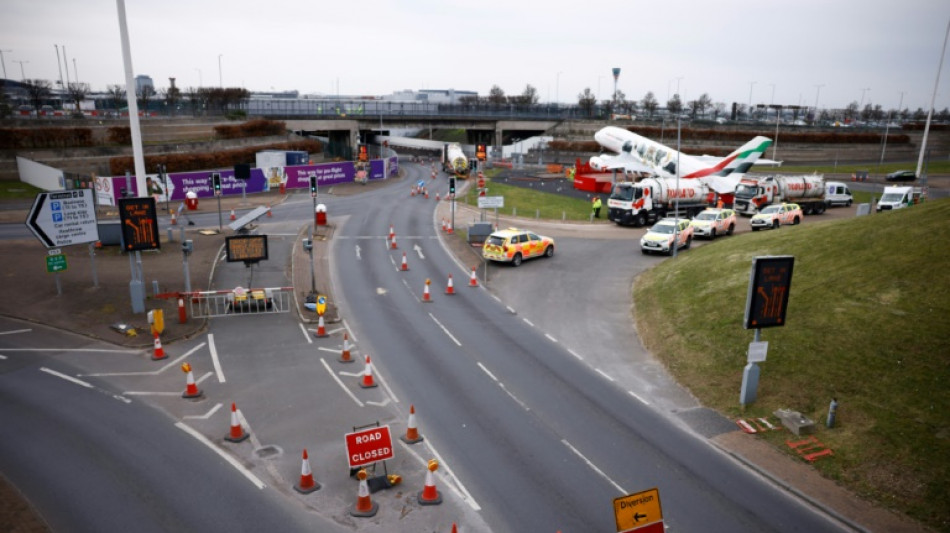
Heathrow closure could cost millions, disrupt flights for days / Photo: © AFP

 'Here to win': Xavi vows to restore pride in Dutch football

 Cameroon's Baleba joins as Man United boost midfield options
 'Shocking' book about Putin's private life wins French literary prize
 Pogacar storms to Vuelta a Espana stage four solo triumph

 Canada unveils counter-tariffs of 15-50% on US goods

 Volkswagen boss braces German workers for more job cuts
 Olympic champion Brignone to undergo new knee operation

 The summer climate change became scorching reality for Europe
 Root angered by England's off-field 'stupid mistakes'

 Welsh rugby league 'giant' Boston dies, aged 92
 Root annoyed by England's off-field 'stupid mistakes'

 One million Afghan children suffer 'life-threatening' malnutrition: UN

 Sri Lanka trail India by 238 runs in second Test
 West Bank settlers attack AFP journalists
 MEXC Kicks Off MOVE Carnival With 0-Fee Trading and 1M USDT in Rewards
 Human rights in Myanmar hitting a 'new low': UN

 Son of Luxottica founder quits after succession row

 One million Afghan children suffering 'life-threatening' malnutrition: UN

 Real Madrid's Mourinho happy with squad despite losing out on Rodri
 Sri Lanka slump to 216-7 at tea in second India Test

 US delays Lockerbie bombing trial over new evidence

 Rohingya refugees protest dire conditions in Bangladesh camps

 Lego net profit up 32% in first half, 'stronger than expected': CEO to AFP

 German GDP growth revised upwards, defying Iran war turmoil

 STARTRADER Adds 30 U.S. Stock and ETF CFDs as 2026 Product Expansion Accelerates

Huge travel disruption at London's Heathrow airport caused by a power cut Friday could take several days to remedy and cost millions of pounds, experts estimated.
Europe's busiest air hub was brought to a standstill after a fire at an electricity substation cut power to Heathrow, raising questions over the resilience of its infrastructure.
- Back to normal when? -
The reopening of the airport will not mean the immediate return of regular flights, as a backlog of planes return to correct locations and passengers are re-routed from cancelled flights.
"It's extremely complicated... the disruptions will last two to four days," Anita Mendiratta, an aviation advisor to the United Nations tourism agency, told AFP.
"It's not only airport operations, but passengers, crew, cargo, aircraft all of that are very much displaced if they've had to be relocated," she added.
According to aviation consultant Philip Butterworth-Hayes, the disruption could last longer, even "a good seven or eight days" for business as usual to resume.
- Is Heathrow resilient? -
UK Energy Secretary Ed Miliband promised that the government would do all it could to quickly restore power to Heathrow, as questions were raised about the airport's "resilience".
"There's obviously been a catastrophic fire at this substation, an unprecedented event... it appears to have knocked out a backup generator as well as the substation itself," Miliband told BBC radio.
"Obviously we will have to look harder at the causes and also the protection and the resilience that is in place for major institutions like Heathrow."
Butterworth-Hayes told AFP that "there should have been other generators that kicked in, so why they haven't is one of the big questions".
- How much will it cost? -
Several experts estimated that the cost of the incident for the airlines and the airport, which handles some 230,000 passengers a day, would total tens of millions of pounds.
Butterworth-Hayes estimated that the costs could stretch to "certainly more than 50 million pounds ($65 million)".
"It's a massive impact in lost revenues and disruption costs, primarily for the airlines (because of) all the follow-on costs involved in putting people in hotels, refunds, re-bookings etc," said independent airline analyst John Strickland.
Shares in British Airways parent IAG were down 1.6 percent in London afternoon trading, while Air France-KLM also retreated in Paris.
The UK's second busiest airport, Gatwick, said it would accept some flights from Heathrow. Others were diverted to European airports including Shannon in southwestern Ireland, Frankfurt, and Paris Charles de Gaulle.
- How rare are closures? -
Major airport closures are not uncommon worldwide, but occur mainly owing to weather events, such as storms or hurricanes, or following accidents or conflicts.
At the beginning of October, several international airports in Florida ceased operations because of Hurricane Milton.
South Korea's Muan International Airport, which is much smaller than Heathrow, was closed for more than 20 days between December and January following the deadly crash of Jeju Air Boeing 737-800.
In April 2010, the huge amount of ash blasted into the atmosphere by Iceland's Eyjafjallajokull volcano led several European countries -- including Britain, Norway and Denmark -- to close their airspace.
Following the 2001 September 11 attacks in New York, the United States closed its airspace to civilian traffic for two days.
E.Gasser--VB