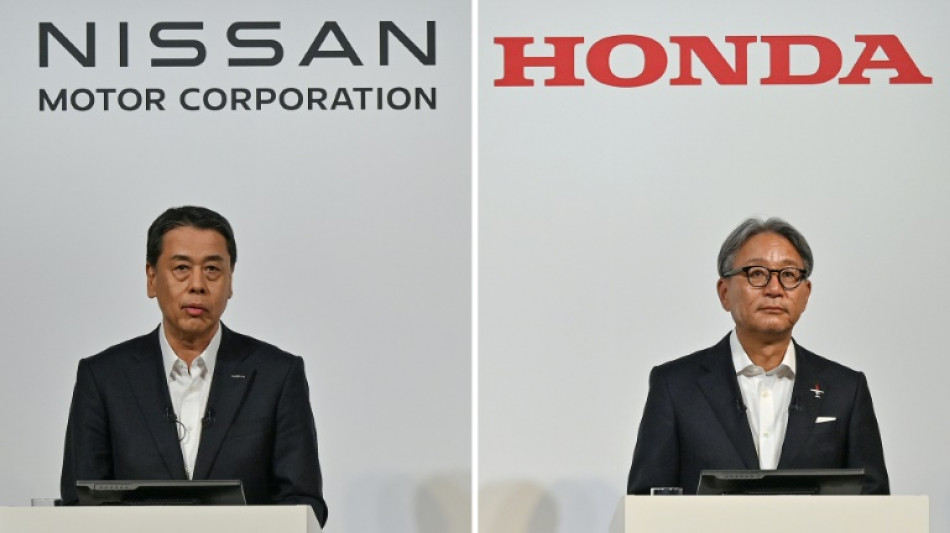
What next for Honda and Nissan? / Photo: © AFP/File

 Putin, Xi, Iran's Pezeshkian in Kyrgyzstan for summit

 Fully Permitted Tanzanian Gold Project Clears Path to Construction as Financing, EPCM Fall in Place (LVGLF)

 EdWealth Announces MoneyBench Benchmark Comparing AI Money Answers From Ed, ChatGPT and Gemini
 Root says new balls behind batsmen's struggles in England

 Swollen rivers, washed-out roads hamper Nepal rescue effort

 In France's north, winegrowers bet on a warmer future

 Deadly virus stalks South Africa's sardines

 South Korea women's football body probes 'period' insult

 Transitional Fashion Essentials for Autumn: Key Pieces from M&S and Joe Browns

 China's Xi and Iran's Pezeshkian in Kyrgyzstan, Putin expected

 Rescuers hunt for missing after deadly N.Cyprus ferry accident

 Ethiopia's Abiy could consolidate power as 'executive president'

 Crude prices rise on US-Iran strikes, equities mixed after Warsh remarks

 South Korea court gives Unification Church leader 2 years prison

 US hosts G20 finance talks with growth, Iran pressure on agenda

 African players in Europe: Wissa flick seals Newcastle victory

 Venice film preview: Clooney, Oasis and Musk

 Poorly Djokovic crashes out of US Open first round

 Djokovic falls in US Open first round, earliest Grand Slam exit in 20 years

 Chinese guitar capital's stairway to export heaven

 Stocks drop as Warsh fans US rate hike bets, crude up on US-Iran strikes

 Injuries cloud tennis as US Open gets under way

 Iran retaliates after first US strikes in a month
 Itauma says 'I'll be back' after bruising heavyweight title loss
 Brilliant Palou clinches fourth straight IndyCar crown
Honda and Nissan on Thursday announced the scrapping of merger talks that would have created the world's third-biggest auto company by unit sales behind Toyota and Volkswagen.
Here are some key points about why the Japanese companies explored a tie-up, the reasons for their failure, and where this leaves them in a difficult global auto industry.
- What is their history? -
Honda was founded in 1948 as a small factory making motorcycles and is now the world's biggest producer of the two-wheelers. It also makes 3.7 million four-wheel vehicles annually.
More than 40 percent of these were sold in North America last year, roughly 20 percent in China, 18 percent in Japan and three percent in Europe.
Nissan, founded in 1933, produced 3.1 million cars last year. North America accounts for 38 percent of its global sales, China 20 percent, Japan 14 percent and Europe 10 percent.
French automaker Renault took a 36.8 percent stake in the then loss-making firm in 1999 and Mitsubishi Motors joined the alliance 17 years later, with Nissan taking a 34-percent stake in its struggling Japanese rival.
But tensions emerged, stoked by the French state increasing its stake in Renault in 2015, followed by the 2018 arrest of Nissan boss Carlos Ghosn in Japan on suspicion of financial misconduct and his subsequent flight from the country.
In 2023, Renault sold part of its stake in Nissan as part of an alliance overhaul that saw them retain 15 percent cross-holdings.
- Why did they try to merge? -
Nissan has been struggling, last year reporting a 93-percent plunge in first-half net profit and axeing 9,000 jobs in November. It is also saddled with billions of dollars of debt.
For both companies, achieving economies of scale would have served to "enhance R&D capabilities, and better compete" in the areas of "advanced technologies including electrification and software-defined vehicles", said Tatsuo Yoshida, senior auto analyst at Bloomberg Intelligence.
Japanese carmakers have long lagged in the electric vehicle sector, especially against Chinese firms, with the country's leading EV-maker BYD last year selling more vehicles globally than Honda and Nissan.
The pair had already agreed on talks over partnership in electrification technologies and software development, and were later joined by Mitsubishi Motors.
- Why did merger talks fail? -
When the merger talks were announced in December the plan was that the two automakers along with Mitsubishi Motors would integrate their businesses under a new holding company.
But local media reports have said Honda, frustrated by its rival's slow decision-making on restructuring, wanted to make it a subsidiary, which Nissan's leadership found unacceptable.
"Nissan appears to be stressing its independence and freedom of (decision-making on) its strategy," which "for Honda's eyes may not maximise benefit of economy of scale," Mizuho Securities analyst Yoshitaka Ishiyama said.
- What happens next? -
In the long term at least, both firms will need to seek alternative partners as they look to get a leg-up in the technology race, analysts say.
"For Honda, there remains a concern about how to beef up its four-wheel vehicle business," said Seiji Sugiura, auto analyst at Tokai Tokyo Intelligence Laboratory.
"The fact that Honda executives had wanted to merge with Nissan means that they needed a close collaboration in R&D at a deeper level than an alliance, (which) involves sharing confidential company information," he added.
Nissan's position is worse, as it "faces significant challenges, including financial instability and the need to strengthen its position in the advanced technology battlefield", said Bloomberg's Yoshida.
Sugiura added that tech firm Foxconn "remains to be an option for Nissan".
Recent reports have said the Taiwanese giant, also known as Hon Hai, had been in talks with Renault over buying the French automaker's stake in the Japanese firm.
However, Sugiura added that a Foxconn-Honda tie-up was also possible "as it has technologies Honda wants".
And he added: "If Honda really wants Nissan's technology, it can launch a hostile takeover bid of Nissan."
M.Vogt--VB