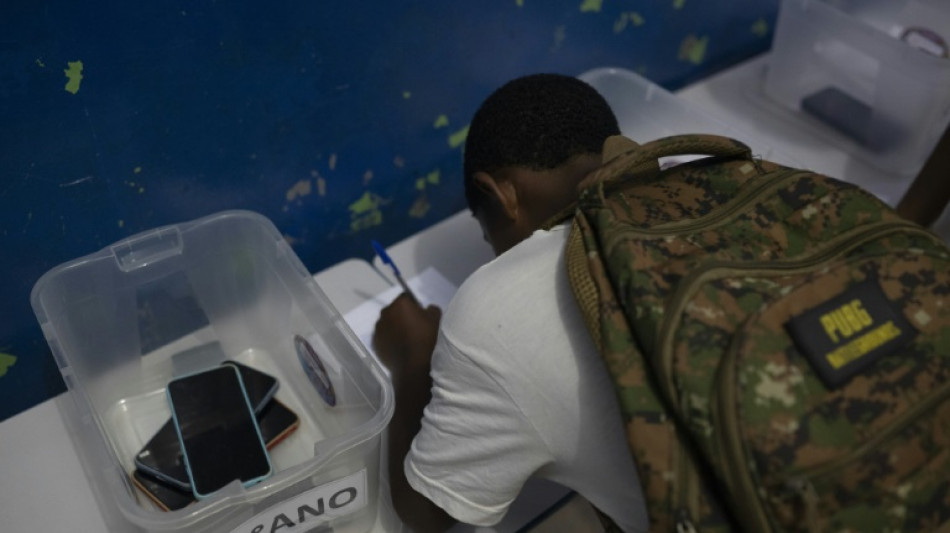
Playgrounds come alive again with Brazil school phone ban / Photo: © AFP

 Oil prices surge on renewed fighting in US-Iran war

 Cycling superstar Pogacar has surgery after Vuelta crash

 Man City agree deal for Everton's Ndiaye

 Apple CEO Tim Cook gives nod to founder Steve Jobs in final memo

 Russian finance minister makes unexpected appearance at G20
 Happy to be back in NY, Sabalenka advances
 Naomi Watts to receive lifetime award at top Spain film fest

 Jury hears closing arguments in Tupac Shakur murder trial

 Pakistan sack coach, send seven players home after England defeats

 New storms threaten Grand Canyon flood search, 2 bodies recovered
 France takes aim at ultra-fast fashion with new levy

 Tribunal says India cannot withdraw from water treaty with Pakistan

 John Galliano pulls US exhibition after antisemitism backlash

 French Top 14 boss offers 'no guarantees' for first Club World Cup

 Munoz reunites with Glasner after joining Forest from Palace
 Liverpool sign Barcola from PSG for £124 million

 Putin, Xi hold talks in Kyrgyzstan as regional summit begins

 ChatGPT becomes first AI chatbot to face tougher EU rules

 Man City sign Palmeiras winger Allan on five-year deal
 More flooding feared at Grand Canyon after storm leaves 15 missing

 RedHill Divests Talicia® to Apotex for $18 Million Cash Upfront Plus Milestones to Fuel Strategic Growth Opportunities
 MEXC Data: BTC Breaks $80,000, Major-Asset Spot Trading Volume Surges 300%
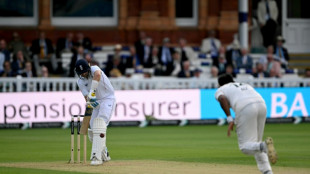
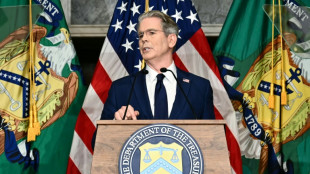 G20 finance talks open as US seeks to ramp up pressure on Iran

 Solving Agent Sprawl: The Case for Enterprise Orchestration

 Springboks switch Kolbe to full-back for third All Blacks Test

In Rio de Janeiro, children are playing again "like in the old days," and their focus in class has improved after a school cellphone ban pioneered in the city that has now gone national.
Students across the country of more than 200 million people are starting the school year with phones banned from classes and break time after a new law signed by President Luiz Inacio Lula da Silva in January.
Brazil, which has more smartphones than people, joins a growing number of nations using such bans to pry devices from the hands of children hooked on social media.
"It was difficult because we get addicted and ... it ends up causing a certain withdrawal ... but after the habit passes, we interact more," said Kamilly Marques, 14.
A student at the Reverend Martin Luther King public school in Rio de Janeiro, Marques told AFP she didn't even bother bringing her phone to school anymore, a year after the city first implemented the ban.
She is not alone. Only a few students now stop under a large mural of the US civil rights hero to place their devices in plastic boxes before heading to class.
Marques said that while she first thought the ban was "annoying" and "boring", she is happier with her improved grades and social life.
"There was a classmate who was cyberbullied, and we didn't even know, because we were more focused on our phones than on our friends, you know?" she said.
- Addicted and anxious -
UN culture and education body UNESCO said that at the end of 2024, 40 percent of global education systems had some sort of ban on smartphone use in schools, up from 30 percent a year earlier.
Rio's municipal education secretary, Renan Ferreirinha, told AFP that officials had noticed children returning to classrooms after the Covid pandemic "more agitated, more impatient, more addicted to cell phones and much more anxious."
A 2024 survey of parents by digital research company Opinion Box and mobile industry platform Mobile Time showed most Brazilian children got their first cellphone at an average of 10 years old.
While children under the age of three were spending almost an hour and a half a day on smartphones, this rose to almost four hours for those between 13 and 16.
A study carried out by the Rio de Janeiro municipality in September showed improvements in concentration, class participation and student performance since the school ban was implemented.
Ferreirinha, who is also a federal lawmaker, acted as rapporteur for the law which took the ban nationwide.
If moderating cellphone use "is difficult for an adult, imagine what it's like for a child. It doesn't make any sense for a teacher to be trying to teach a class while the child is watching a video on social media or playing a game on their phone," he said.
On a recent school visit, one child told him they were back to playing like kids did "in the old days."
- 'Much happier' -
Fernanda Heitor, 46, the deputy director of the Reverend Martin Luther King school -- which has students aged six to 16 -- said classes had become unsustainable before the ban.
"There was resistance. Even today, some still hide their cell phones when they enter the school," she said.
She described break time previously as "islands" of children sitting glued to their phones.
"They didn't interact, there wasn't much play, they didn't talk. Now they play... It's transformed the school. It's become much happier, much more lively."
Brazil's new law allows cellphone use for educational purposes, emergencies and health purposes.
Fabio Campos, an expert on education and technology, told AFP that while he believed the law was necessary, students should be taught how to use technology responsibly.
"Brazil is a country of inequality. Many students only have access to technology at school. So, if this means that schools will become less technological, it is a failure."
Ferreirinha said parents also need to impose more limits at home.
At the Reverend Martin Luther King school, Pedro Henrique, 11, still brings his smartphone to school every day and uses it a lot at home.
"I miss the cellphone a little," during breaktime, he admits, adding that at the end of the day "I feel happy, because I'll be with my cell phone and using it."
A.Kunz--VB