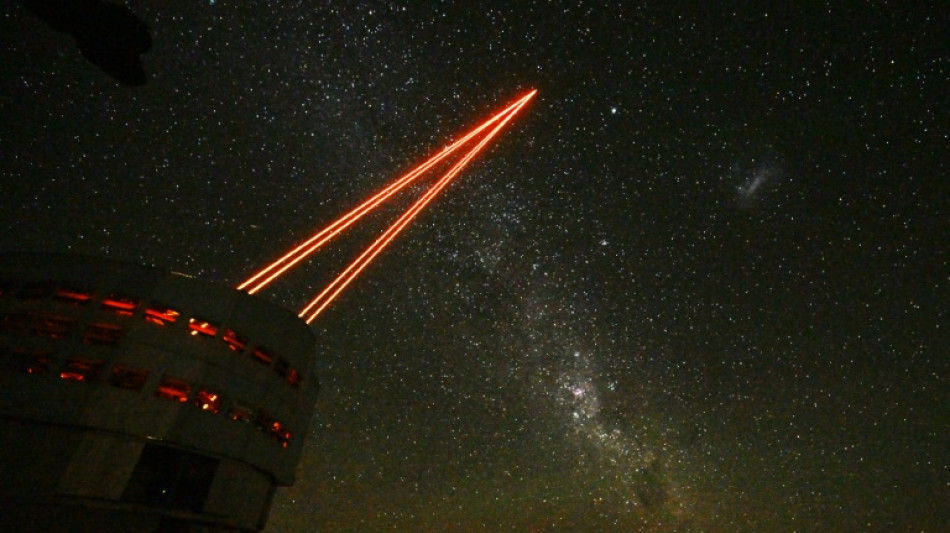
Could a climate megaproject cloud Chile's unparalleled views of universe? / Photo: © AFP

 Oil prices surge on renewed fighting in US-Iran war

 Cycling superstar Pogacar has surgery after Vuelta crash
 Man City agree deal for Everton's Ndiaye

 Apple CEO Tim Cook gives nod to founder Steve Jobs in final memo

 Russian finance minister makes unexpected appearance at G20

 Happy to be back in NY, Sabalenka advances

 Naomi Watts to receive lifetime award at top Spain film fest
 Jury hears closing arguments in Tupac Shakur murder trial

 Pakistan sack coach, send seven players home after England defeats

 New storms threaten Grand Canyon flood search, 2 bodies recovered

 France takes aim at ultra-fast fashion with new levy

 Tribunal says India cannot withdraw from water treaty with Pakistan

 John Galliano pulls US exhibition after antisemitism backlash

 French Top 14 boss offers 'no guarantees' for first Club World Cup
 Munoz reunites with Glasner after joining Forest from Palace

 Liverpool sign Barcola from PSG for £124 million

 Putin, Xi hold talks in Kyrgyzstan as regional summit begins

 ChatGPT becomes first AI chatbot to face tougher EU rules

 Man City sign Palmeiras winger Allan on five-year deal

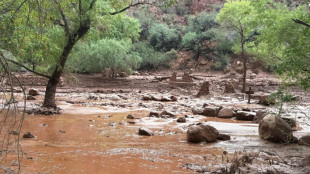 More flooding feared at Grand Canyon after storm leaves 15 missing

 RedHill Divests Talicia® to Apotex for $18 Million Cash Upfront Plus Milestones to Fuel Strategic Growth Opportunities

 MEXC Data: BTC Breaks $80,000, Major-Asset Spot Trading Volume Surges 300%

 G20 finance talks open as US seeks to ramp up pressure on Iran

 Solving Agent Sprawl: The Case for Enterprise Orchestration
 Springboks switch Kolbe to full-back for third All Blacks Test
As night falls on the Atacama desert in northern Chile four giant telescopes turn their gaze towards the star-strewn heavens.
The driest place on Earth is the best place to observe the universe, with darkness offering dazzling spectacles of cosmic wonder.
The area is home to the Paranal Observatory, which houses the European Southern Observatory's Very Large Telescope, used by astronomers to search the Milky Way with "unparalleled clarity," according to Spanish astrophysicist Itziar de Gregorio.
Perched at 2,635 meters (8,645 feet) above sea level, and located dozens of kilometers (miles) from the nearest town of Antofagasta, Paranal's unique atmospheric conditions make it one of the most productive observatories in the world.
The Very Large Telescope -- made up of four individual telescopes -- produced the first ever image of an exoplanet (a planet outside our solar system) in 2004.
But a huge green energy project, part of Chile's plans to become carbon neutral, risks clouding the view, scientists say.
Latin America's fifth-largest economy aims to phase out fossil fuels by 2050, replacing them with renewable energy sources, which can also be used to produce green hydrogen.
Green hydrogen, a clean method of generating electricity, has been touted as a means to help decarbonize Chile's crucial copper mining sector, among other industries.
AES Andes, the Chilean subsidiary of US energy company AES Corporation, has submitted proposals for a 3,000-hectare (7,400-acre) site in the Atacama desert near Paranal to harness solar and wind energy, which in turn can be used to produce green hydrogen and ammonia, a gas used in making fertilizers.
But scientists say the artificial light from such a facility could obscure some of the celestial phenomena observed at Paranal, such as eclipses and meteorite showers.
They worry it could also endanger the functioning of the ESO's Extremely Large Telescope, billed as the world's "biggest eye on the sky," currently under construction near the Paranal Observatory.
The stadium-sized telescope is slated to be completed by 2028.
De Gregorio, the ESO's representative in Chile, warns that the country's unique "window onto the universe" could close, hampering scientists' quest to answer the great question of our time: Are we the only intelligent life form in the universe?
- Like 'a tap running' -
Chile, home to around 70 percent of the world's telescopes, has long been seen as a hub for stargazers.
By day, astronomers at Paranal crunch numbers. By night, they explore the galaxy.
The observatory's research covers almost all celestial phenomena, from planets and exo-planets to black holes and near-Earth comets, Steffen Mieske, the head of the site's scientific operations, said.
That work could be jeopardized if the night sky brightens, even a fraction.
"Light pollution is the main threat to astronomy because it affects the quality of the observable sky," the Skies of Chile Foundation, which works to preserve the quality of the country's night skies, argues.
"When you see a tap running, you realize you're wasting water. But if you see a place lit up brightly at night, you don't think of it as pollution," the foundation's director Daniela Gonzalez said.
AES Andes, in a statement, assured that its hydrogen and ammonia project, codenamed Inna, conformed to the "highest norms in terms of lighting," including a new Chilean rule aimed at protecting astronomy sites from skyglow.
It has rejected Paranal's claim that it would be within 11 kilometers of the observatory, saying the distance would be around twice that.
A group of 40 astronomers, scientists and poets have called for the establishment of a "light exclusion zone" around Paranal, to keep it pitch-black at night.
The Inna project, which is currently awaiting an environmental permit, is not expected to be licensed for another two or three years.
F.Stadler--VB