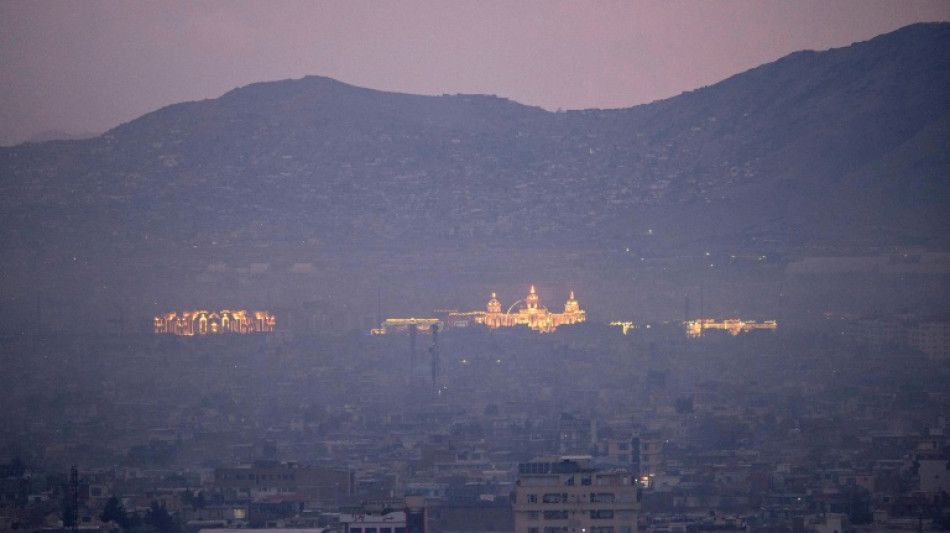
Afghan wedding halls light up sombre Kabul nights / Photo: © AFP

 Australia axe Labuschagne for Zimbabwe, South Africa ODI series

 Heavy rain at Grand Canyon after flood kills 2, dozen missing

 Kushner blames soccer power struggle for World Cup plan collapse

 Buoyant Alcaraz shakes off nerves to advance at US Open
 US draws European pushback with Russia G20 finance invite

 Jury begins deliberations in Tupac Shakur murder trial

 US Supreme Court allows Trump ballroom project to proceed

 Trump says US reviewing position on Falkland Islands

 Saka strikes as flawless Arsenal punish troubled Villa

 Oil prices surge on renewed fighting in US-Iran war

 Cycling superstar Pogacar has surgery after Vuelta crash
 Man City agree deal for Everton's Ndiaye

 Apple CEO Tim Cook gives nod to founder Steve Jobs in final memo

 Russian finance minister makes unexpected appearance at G20

 Happy to be back in NY, Sabalenka advances
 Naomi Watts to receive lifetime award at top Spain film fest

 Jury hears closing arguments in Tupac Shakur murder trial
 Pakistan sack coach, send seven players home after England defeats

 New storms threaten Grand Canyon flood search, 2 bodies recovered

 France takes aim at ultra-fast fashion with new levy

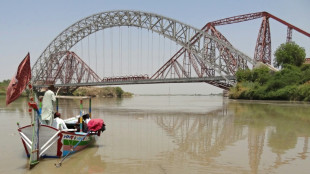 Tribunal says India cannot withdraw from water treaty with Pakistan

 John Galliano pulls US exhibition after antisemitism backlash

 French Top 14 boss offers 'no guarantees' for first Club World Cup
 Munoz reunites with Glasner after joining Forest from Palace

 Liverpool sign Barcola from PSG for £124 million

As night settles over Afghanistan's capital, only a few small lights and neon signs pierce the darkness and thick blanket of winter pollution.
But on some street corners, glittering colossal wedding halls loomout of the gloom, a rare display of opulence in the Afghan capital.
The city of more than six million people is often plunged into shadow due to ubiquitous power outages, whichonly the wealthiest can remedy with expensive generators or solar panels.
Apart from a few vendors, the streets are deserted, a stark contrast with the chaotic hustle of the daytime.
People huddle at home to shelter from the cold and for lack of nighttime activities.
Since the Taliban took power in 2021 and imposed their strictversion of Islamic law, a veil of sadness has enveloped the capital.
There is no music spilling out from restaurants because it is forbidden, women are banned from parks, and walls decorated with colourful pro-peace graffiti have been splashed with calls to holy war.
The only bright lights emanate from the wedding halls that dot the city centre and escape some of the Taliban's scrutiny, as marriage is prized in Afghan culture.
The high-ceilinged halls are segregated by gender, with music only tolerated on the women's side.
"In Afghanistan, the marriage ceremony is the most important event for girls and boys. It's a once-in-a-lifetime event -- we don't have much divorce," said Mohammad Wassil Qaumi, director of the Imperial Continental, a palatial white-and-gold hall that shines with a glitz reminiscent of a Las Vegas casino.
"It's the start of a new life so the light should be everywhere, that's why the city is bright, it should have a little bit of luxury!" he told AFP.
- 'Weddings are a necessity' -
Bunches of plastic flowers, throne-style sofas, gilded trimming and neon lights fill the complex's four halls, some of which can accommodate up to 7,000 guests.
Qaumi, 32, says he spends $25,000 to $30,000 per month for municipal electricity, which provides a few hours of power per day.
To keep the lights on, he also pays just under $15,000 for generators.
To recoup his costs, he charges up to $20,000 for a wedding, in a country where 85 percent of the population lives on less than a dollar a day, according to the United Nations Development Programme.
"Weddings are a necessity in the Afghan culture, you have to invite more and more people" even if it means going into debt, said Haji Safiullah Esmafi, owner of the Stars Palace hall.
In another district of the capital, the City Star welcomes its guests with a beige and gold facade topped with three sculpted domes and a huge sparkling arch out front.
"Electricity is very expensive," admits the owner, 24-year-old Siyer Paiman.
But, he added, "people in Afghanistan like bright colours".
- 'Brightness of the city' -
He has invested in solar panels and spends the equivalent of $12,000 to $19,900 on generators and electricity, which only covers six to seven hours a day, "and not always at night".
Afghanistan depends on its Central Asian neighbours for imported electricity.
With the hopes of increasing supply, the country is involved in several regional interconnection projects, but progress is slow.
"The current demand in Afghanistan is about 7,000 to 8,000 megawatts but they currently produce locally about 1,000 megawatts and import the rest from Central Asia," a sector expert who asked for anonymity told AFP, adding that renewable energy sources should be developed but that funding was lacking.
Power cuts also affect heating, with temperatures easily dropping below 0 degrees Celsius (32 degrees Fahrenheit).
Kabul's residents use stoves, burning almost anything from coal and wood to plastic or household waste, creating a fog of pollution in the city slung between mountains 1,800 metres (5,900 feet) above sea level.
In the nighttime gloom, wedding halls are "the brightness of the city", said Qaumi. "Here, everyone is very happy."
"People come here to meet friends and family, (they) wear new clothes, jewellery... showing off so much," he said of patrons enjoying one of the only places left in Kabul where this is still possible.
G.Schmid--VB