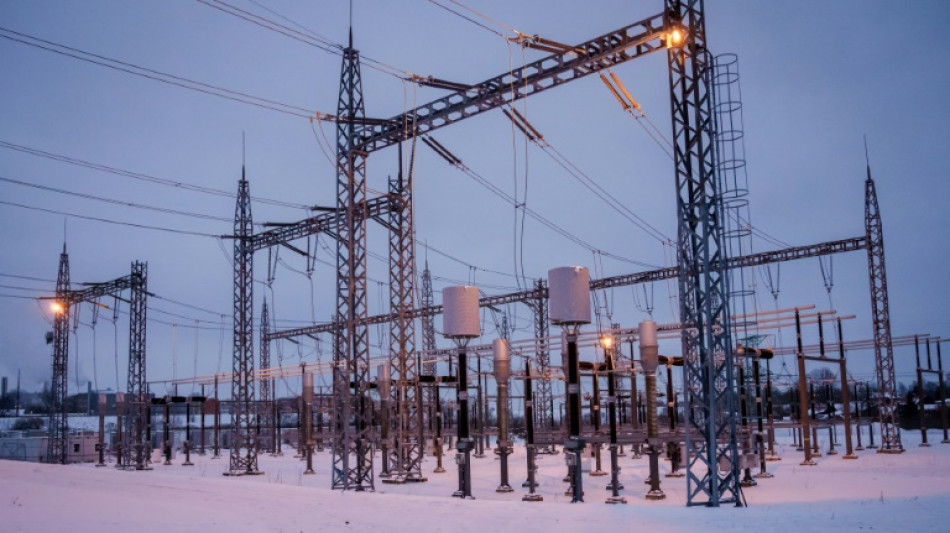
Baltic nations 'successfully' link with European power grid / Photo: © AFP

 Australia axe Labuschagne for Zimbabwe, South Africa ODI series
 Heavy rain at Grand Canyon after flood kills 2, dozen missing

 Kushner blames soccer power struggle for World Cup plan collapse

 Buoyant Alcaraz shakes off nerves to advance at US Open

 US draws European pushback with Russia G20 finance invite

 Jury begins deliberations in Tupac Shakur murder trial

 US Supreme Court allows Trump ballroom project to proceed

 Trump says US reviewing position on Falkland Islands

 Saka strikes as flawless Arsenal punish troubled Villa
 Oil prices surge on renewed fighting in US-Iran war

 Cycling superstar Pogacar has surgery after Vuelta crash
 Man City agree deal for Everton's Ndiaye

 Apple CEO Tim Cook gives nod to founder Steve Jobs in final memo

 Russian finance minister makes unexpected appearance at G20

 Happy to be back in NY, Sabalenka advances

 Naomi Watts to receive lifetime award at top Spain film fest

 Jury hears closing arguments in Tupac Shakur murder trial
 Pakistan sack coach, send seven players home after England defeats

 New storms threaten Grand Canyon flood search, 2 bodies recovered

 France takes aim at ultra-fast fashion with new levy

 Tribunal says India cannot withdraw from water treaty with Pakistan

 John Galliano pulls US exhibition after antisemitism backlash

 French Top 14 boss offers 'no guarantees' for first Club World Cup
 Munoz reunites with Glasner after joining Forest from Palace

 Liverpool sign Barcola from PSG for £124 million

The three Baltic states successfully connected to the European power grid Sunday after severing Soviet-era links with Russia's network, a shift that EU chief Ursula von der Leyen hailed as "freedom from threats and blackmail".
Estonia, Latvia and Lithuania -- former Soviet states that are now EU and NATO members -- have been planning the switch for years but had been particularly keen to do so since Russia invaded Ukraine in 2022.
The small Baltic countries fear that they too could be targeted. The staunch Ukraine supporters had also worried that Russia would weaponise the electricity grid against them.
"Moments ago, I received great news," Lithuanian President Gitanas Nauseda told reporters in Vilnius, alongside his Estonian, Latvian and Polish counterparts and von der Leyen.
"The synchronisation of the Baltic states' electricity system with the continental European system has been successfully completed... We have achieved full energy independence," he said.
Nauseda also posted a video to X of the moment he received confirmation of the grid connection. "Goodbye Russia, goodbye Lenin," he said on the phone, before von der Leyen and others applauded.
Von der Leyen told reporters 'today history is made".
"Electricity lines with Russia and Belarus are being dismantled. These chains of power lines linking you to hostile neighbours will be a thing of the past," she said.
"This is freedom, freedom from threats, freedom from blackmail."
A total of 1.6 billion euros ($1.7 billion) -- mostly EU funds -- have been invested in the synchronisation project across the Baltic states and Poland.
The Baltics integrated into the European grid via Poland.
- 'Emancipation' -
Polish President Andrzej Duda called the synchronisation "a milestone development... for the entire European Union".
"It is the final step towards emancipation from the post-Soviet sphere of dependence," he added.
Nauseda called for "substantial action at the European Union level" to improve the resilience of the Baltic states' critical infrastructure.
"Now is the time to secure our achievements. Russia's war against Ukraine has radically transformed the perception of the threats to the critical infrastructure in Europe," he said.
"Recent incidents involving undersea infrastructure in the Baltic Sea provide a matter of great concern. And a call for resolute action, as well."
Several undersea telecom and power cables have been severed in the Baltic Sea in recent months.
Some experts and politicians have accused Russia of waging a "hybrid war", including the unconventional targeting of energy supplies, an allegation Moscow denies.
The Baltics had long planned to integrate with the European grid but faced technological and financial issues before the Ukraine war gave the project a jolt of urgency.
They stopped purchasing Russian gas and electricity after the invasion but their power grids remained connected to Russia and Belarus, and so controlled from Moscow.
This left them dependent on Moscow for a stable electricity flow, which is crucial for factories and facilities requiring a reliable power supply.
- 'No surprises' -
The Baltic states disconnected from the Russian grid on Saturday morning.
They then operated as a so-called "energy island" while running tests to assure Europe their system was stable.
The Baltic grid operators said all tests had gone as planned.
Ukrainian Energy Minister German Galushchenko hailed the disconnection as a "significant event for the whole of Europe".
"Such steps deprive the aggressor of the opportunity to use the electricity sector for blackmail and political games," he said Saturday.
Authorities had warned of the potential for sabotage or other disruptions linked to the grid switch, but the disconnection went off without a hitch.
The Baltic grid operators said Russia had cooperated during the process.
Latvian operator AST told AFP the biggest surprise Saturday was "that there were no surprises".
Latvian police said they had recorded no incidents related to the grid switch.
Lithuanian engineer Aras Valiukas, 45 called the event "symbolic".
"We have disconnected from the Soviet Union," he told AFP in downtown Vilnius.
U.Maertens--VB