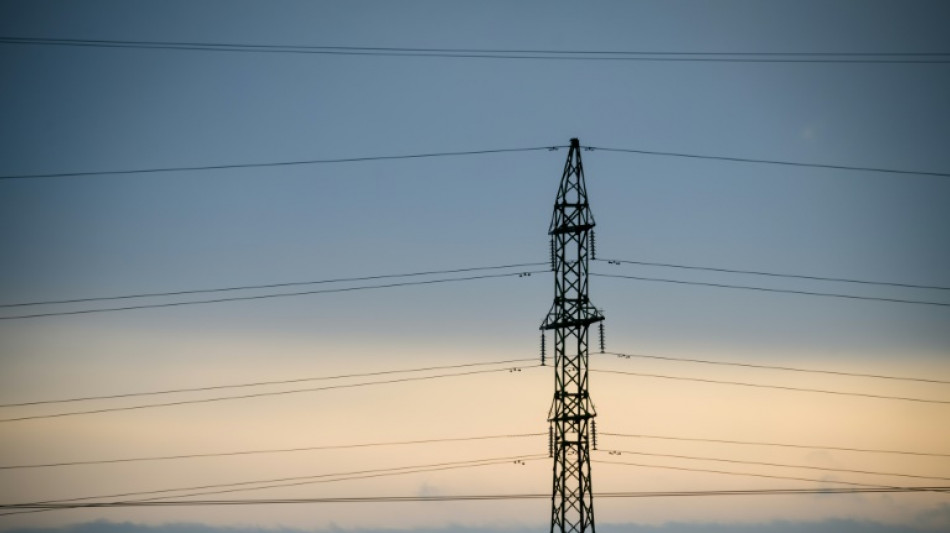
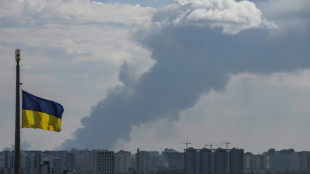
Baltic nations disconnect from Russian power grid / Photo: © AFP

 Two dead after stabbing in New York's Times Square

 Anthropic signs $35B computing deal with startup backed by Nvidia

 Drones in Ithaca: Azov's Odyssey turns Ukraine war into modern myth
 Boat builders keep Pakistan's fishing heritage afloat
 Australia axe Labuschagne for Zimbabwe, South Africa ODI series

 Heavy rain at Grand Canyon after flood kills 2, dozen missing

 Kushner blames soccer power struggle for World Cup plan collapse

 Buoyant Alcaraz shakes off nerves to advance at US Open

 US draws European pushback with Russia G20 finance invite

 Jury begins deliberations in Tupac Shakur murder trial

 US Supreme Court allows Trump ballroom project to proceed

 Trump says US reviewing position on Falkland Islands

 Saka strikes as flawless Arsenal punish troubled Villa
 Oil prices surge on renewed fighting in US-Iran war

 Cycling superstar Pogacar has surgery after Vuelta crash
 Man City agree deal for Everton's Ndiaye

 Apple CEO Tim Cook gives nod to founder Steve Jobs in final memo

 Russian finance minister makes unexpected appearance at G20

 Happy to be back in NY, Sabalenka advances

 Naomi Watts to receive lifetime award at top Spain film fest

 Jury hears closing arguments in Tupac Shakur murder trial
 Pakistan sack coach, send seven players home after England defeats

 New storms threaten Grand Canyon flood search, 2 bodies recovered

 France takes aim at ultra-fast fashion with new levy

 Tribunal says India cannot withdraw from water treaty with Pakistan

The three Baltic states on Saturday cut ties with Russia's power grid to join the European Union's network, the culmination of a years-long process that gained urgency with Moscow's invasion of Ukraine.
Estonia, Latvia and Lithuania -- all former Soviet republics that are now in the European Union and NATO -- had wanted to block Russia's ability to geopolitically blackmail them via the electricity system.
"We have removed any theoretical possibility of Russia using energy (grid) control as a weapon," Lithuanian Energy Minister Zygimantas Vaiciunas told AFP on Saturday.
The European Commissioner for Energy, Dan Jorgensen, said: "This is indeed a historic day."
"I like the light better when there's no Russian electrons involved," he told reporters in Estonian capital Tallinn.
"It's important to underline that this is about security... No European country should be dependent on Russia for anything," he added.
Vaiciunas said the Baltic states had completed the disconnection process at 9:09 am (0709 GMT).
Latvia later physically cut a power line to Russia.
"Now we have complete control over our power grid," Latvian Energy Minister Kaspars Melnis told reporters while holding a piece of the dismantled wire.
Vaiciunas said the Baltics were now operating in so-called "isolated mode" before they integrate with the European grid on Sunday.
A total of 1.6 billion euros ($1.7 billion) -- mostly EU funds -- have been invested in the synchronisation project across the Baltic states and Poland.
European Commission president Ursula von der Leyen was to attend a ceremony with Baltic leaders in Vilnius on Sunday.
The Baltics have long prepared to integrate with the European grid but faced technological and financial issues.
The switch became more urgent after Russia invaded Ukraine in 2022, spooking the Baltic states into thinking they could be targeted.
They stopped purchasing Russian gas and electricity after the invasion but their power grids remained connected to Russia and Belarus, controlled from Moscow.
This left them dependent on Moscow for a stable electricity flow, which is crucial for factories and facilities requiring a reliable power supply.
Several undersea telecom and power cables have been severed in the Baltic Sea in recent months.
Some experts and politicians have accused Russia of waging a hybrid war, an allegation Moscow denies.
- Russia cooperated -
Authorities were on guard on Saturday for any potential sabotage or other risks linked to the grid switch.
Latvian grid operator AST said no disruptions had been recorded so far, showing no provocation from Russia.
"They disconnected power to the same line also from their side, with the biggest surprise today being that there are no surprises," AST CEO Rolands Irklis told AFP.
Lithuania's state-run grid operator Litgrid also said Russia fully cooperated during the disconnection process.
Litgrid head Rokas Masiulis pointed out that "when you are part of the same (electricity) system, you cannot harm the other without harming yourself".
Masiulis said Russia had to ensure the energy security of the Russian exclave of Kaliningrad, "which was in part dependent on us".
Because of the Baltic decoupling, the energy system in Kaliningrad will no longer have grid connection to mainland Russia.
The exclave is located between Lithuania and Poland and has not border with the rest of Russia.
Kaliningrad has been building up its power generation capacity for years and Kremlin spokesman Dmitry Peskov dismissed all concerns.
Asked about the cut-off last week, he said: "We have taken all measures to ensure the uninterrupted reliable operation of our unified energy system."
The Baltic states will operate in "isolated mode" for about 24 hours to test their frequency, or power levels, according to Litgrid.
"We need to carry out some tests to assure Europe that we are a stable energy system," Masiulis said.
"We'll switch power stations on and off, observe how the frequency fluctuates and assess our ability to control it."
The states will then integrate into the European power grid via Poland.
Poland's power grid operator PSE had said it would use helicopters and drones to patrol the connection with Lithuania.
In Estonia, police and volunteer defence corps will man critical electrical infrastructure until next weekend because of the perceived sabotage risk.
Lithuania was also guarding infrastructure. This week its armed forces launched drills in a region bordering Poland to secure the energy link.
H.Kuenzler--VB