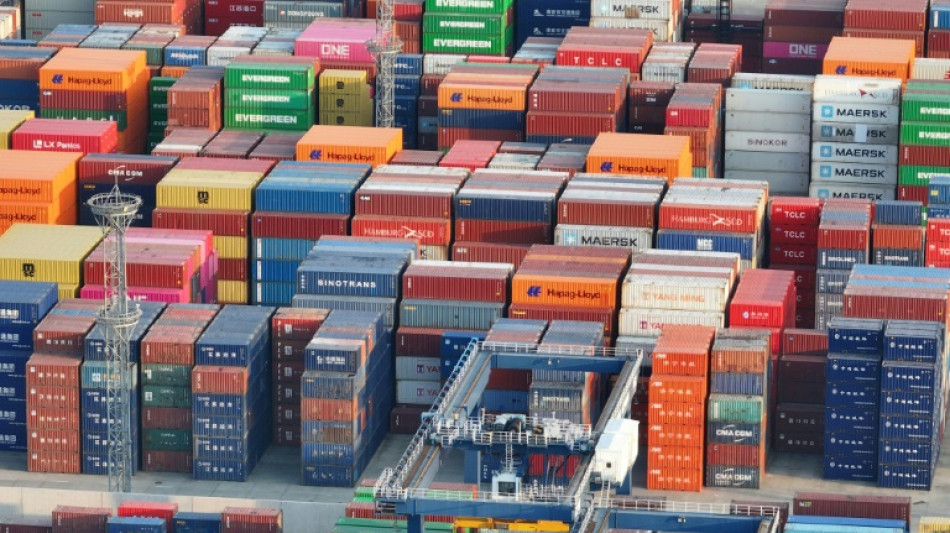
China holds out hope last-minute deal can avert US trade war / Photo: © AFP

 UK chalks up hottest summer on record for second year running
 China's Xi visits Egypt as US sanctions threat looms over Iran links

 RISE Robotics Awarded $100,000 MassVentures Grant to Accelerate Commercialization of Beltdraulic Technology

 Global bond sell-off deepens on inflation concerns

 Germany's far-right AfD promises 'boom' but economists fear worst

 Former England captain Stokes signs for Adelaide Strikers

 Pakistan selector and ex-captain Misbah resigns after coach sacked
 Shein flattens on Hong Kong debut facing global headwinds

 Eurozone inflation hits three-year high at 3.3% in August
 Man City chase Fernandez, Arsenal eye Alvarez on deadline day

 El Nino hammering Peru anchovy fishing: industry officials
 Mass Russian barrage kills 12 in Kyiv

 PineX Capital Launches MetaTrader 5 as Prop Firm Expands Trading Platform Offering
 Women survivors face sanitation woes in Nepal relief camp

 Oil extends gains, stocks mixed as Trump issues fresh Iran warning
 Thai resort readies for US carrier's 5,000 sailors
 AI startup Manus says resumes independent operations
 'Massive' Russian missile, drone attack on Kyiv kills 8
 Defence tech hub Munich booms as Europe rearms
 Nigeria rethinks criminalisation of suicide

 Osaka channels NBA icon Iverson to reach US Open second round

 Fast-fashion giant Shein plunges 10% on Hong Kong debut

 South Korea hire former Spain boss Moreno as interim coach
 China-Taiwan friction clouds Pacific summit
 Two dead after stabbing in New York's Times Square

China's new tariffs on US imports like oil, coal and cars are relatively modest in scale, suggesting that Beijing is hoping for a last-minute deal but also giving them the option to inflict more pain if needed, analysts say.
China on Tuesday fired a return salvo in its escalating trade war with the United States, slapping fresh tariffs on everything from American crude oil to agricultural machinery.
The moves hit roughly $20 billion worth of US goods per year -- roughly 12 percent of total American imports into China, according to calculations by Capital Economics.
Over a third of that is energy: according to Beijing customs data, imports of oil, coal and LNG totalled more than $7 billion last year.
Beijing has also slapped fresh export controls on rare metals and chemicals including tungsten, tellurium, bismuth, indium and molybdenum, used in everything from mining to phone screens.
China dominates global supply chains for rare metals.
The countermeasures came as a surprise to some -- analysts at UBS this week told AFP they had expected Beijing to keep its powder dry.
But they are a far cry from the 10 percent tariffs slapped on all Chinese imports by US President Donald Trump this week that will affect some $450 billion worth of goods.
"The measures are fairly modest, at least relative to US moves," Capital Economics's Julian Evans-Pritchard said.
They "have clearly been calibrated to try to send a message to the US (and domestic audiences) without inflicting too much damage," he added.
- Limited room for manoeuvre -
That restraint can in part be explained by China's reliance on many US imports for its industries and its longstanding economic woes at home, Agatha Kratz at the Rhodium Group told AFP.
"Given the current economic downturn, China cannot afford -- and does not want -- to impose excessive trade barriers," she said.
"China's economy is in a fragile state, and this limits its ability to act freely," she explained.
"Beijing cannot afford to take reckless actions, and I don't think it wants to."
Far from inflicting deep pain, analysts say Beijing's goal is to send a message to Washington: that China can and will retaliate to swingeing tariffs.
"These tariffs are structured to signal China's capacity to endure prolonged economic confrontation while forcing the US to deal with internal economic pressures," Mingzhi Jimmy Xu, an assistant professor at Peking University, to AFP.
- 'Serious damage' -
And Beijing can do "serious damage" to the United States should it decide to, Shehzad Qazi from China Beige Book told AFP.
The US remains heavily reliant on China for critical minerals needed to produce electric vehicles, their batteries and other key industrial applications.
Washington has had a flavour of this. In December, Beijing banned exports of metals gallium, antimony and germanium, key components in semiconductors.
That it had chosen not to, analysts say, suggests Beijing is keen to leave the door open to negotiations with Washington that could see the tariffs reversed.
Trump on Monday indicated a call with Chinese counterpart Xi Jinping could be imminent, hinting that a similar volte-face could be in the works.
But he later rolled back that claim, saying he was in "no rush" to speak with the Chinese leader.
Both Mexico and Canada -- hit with 25 percent tariffs over the weekend -- succeeded in securing a 30-day stay in last-minute deals with the US.
Beijing may be hoping for the same kind of agreement -- likely tied to a further commitment to crack down on the trafficking of fentanyl and the ownership of social media app TikTok.
"The Chinese tariffs do not go into effect until five days from now, a long time in Trump world," Wendy Cutler, a former US trade official, said in a note.
But "the question is whether Trump will react in the same way to such threats" from China, Alicia Garcia Herrero at Natixis told AFP.
"If he doubles down, China will have a problem."
I.Stoeckli--VB