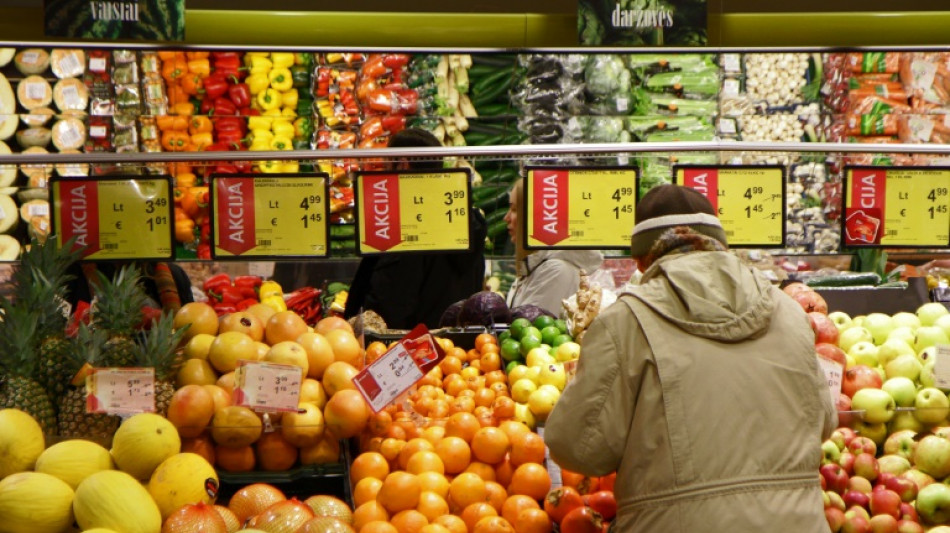
Eurozone inflation edges up in January to 2.5% / Photo: © AFP/File

 US Mortgage Rate Falls for Fourth Week but Remains Above 7%

 13 Native American-Owned Restaurants in Arizona to Experience Indigenous Culinary Traditions

 Best Digital Photo Frames 2026: Aura, Skylight, and Amazon Compared

 UK Economy Grows 0.7% in Third Quarter as Services Lead Expansion

 India's Retail Inflation Reaches 6.09% as Food Prices Accelerate

 China's October Activity Data Reveal a Weak Start to the Fourth Quarter

 South Korea Launches Probe into NewJeans Contract Controversy

 Helen Rees Reflects on Four Decades of South Africa's HIV Journey

 Foreign Investors Return to Indian Equities with ₹84,290 Crore Inflow

 Interactive Map Reveals 1,000 Unsolved Murders Across UK
Eurozone inflation ticked up slightly in January to 2.5 percent, edging higher for a fourth consecutive month driven by energy price increases, official data showed on Monday.
Consumer prices were up from 2.4 percent in December 2024, slightly disappointing analysts' expectations. Financial data firm FactSet had predicted the rate would not move.
Inflation reached its lowest level in three and a half years in September, at 1.7 percent, but has since climbed back up above the two percent target set by the European Central Bank (ECB).
Core inflation -- which strips out volatile energy, food, alcohol and tobacco prices and is a key indicator for the ECB -- was stable at 2.7 percent, according to Eurostat, the EU's statistical office.
The central bank cut interest rates for the fifth time since June to 2.75 percent on Thursday, signalling more was to come as the eurozone economy flatlines.
The move stood in contrast to the latest decision by the US Federal Reserve, which left its key lending rate unchanged a day earlier, saying it was in no "hurry" to make changes, despite pressure from President Donald Trump for more cuts.
The US economy has been outpacing that of the eurozone.
The ECB had previously hiked borrowing costs aggressively to tame runaway energy and food costs, but is now bringing them back down as price rises slow and the eurozone economy falters.
Europe has been mired in economic stagnation for two years.
Growth slowed to a halt in the fourth quarter last year, dragged by contractions in major powers Germany and France which were held back by economic headwinds and political instability.
While the recent uptick in inflation has caused some jitters, policymakers believe price pressures will ease, and their focus has shifted to relieving the strain on the beleaguered 20-nation area.
The January rise in consumer prices was mainly down to energy costs, which were up 1.8 percent year-on-year, having increased only by 0.1 percent in December.
In the services sector inflation slowed by 0.1 percentage points to 3.9 percent.
Food, alcohol and tobacco prices were similarly up 2.3 percent, after a 2.6 percent hike in December, while industrial goods remained stable at 0.5 percent.
Europe has been hobbled by the spike in energy prices since Russia's 2022 invasion of Ukraine -- leading to painful cutbacks in a range of sectors from steel to chemicals to car manufacturing.
Germany is additionally suffering from weak demand for the country's exports, combined with a host of structural issues such as labour shortages.
Last week, the European Commission unveiled a blueprint to revamp the bloc's economic model, amid worries that red tape, low productivity and weak investments -- as well as high energy prices -- are leaving it behind its rivals.
D.Bachmann--VB