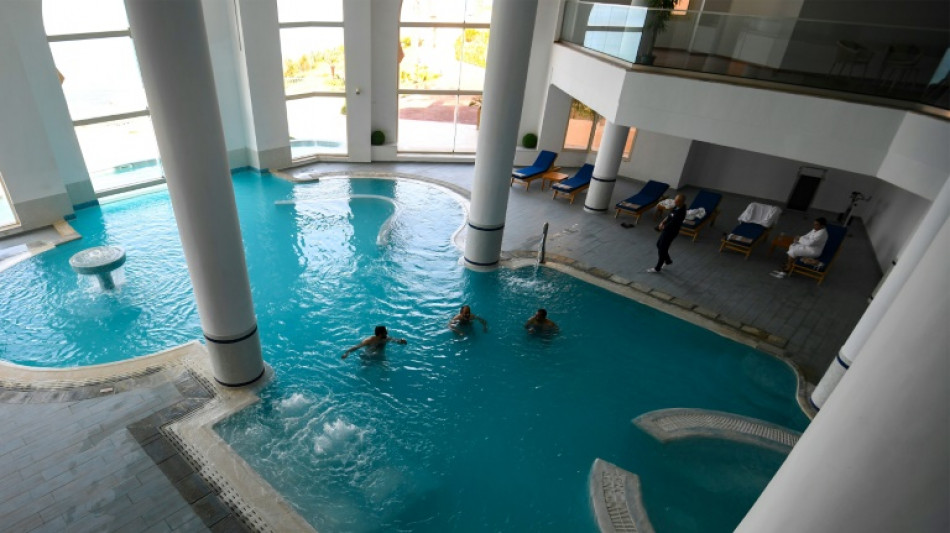
Tunisia sets sights on becoming world's top seawater therapy spot / Photo: © AFP

 US Mortgage Rate Falls for Fourth Week but Remains Above 7%

 13 Native American-Owned Restaurants in Arizona to Experience Indigenous Culinary Traditions
 Best Digital Photo Frames 2026: Aura, Skylight, and Amazon Compared
 UK Economy Grows 0.7% in Third Quarter as Services Lead Expansion

 India's Retail Inflation Reaches 6.09% as Food Prices Accelerate
 China's October Activity Data Reveal a Weak Start to the Fourth Quarter
 South Korea Launches Probe into NewJeans Contract Controversy

 Helen Rees Reflects on Four Decades of South Africa's HIV Journey

 Foreign Investors Return to Indian Equities with ₹84,290 Crore Inflow

 Interactive Map Reveals 1,000 Unsolved Murders Across UK
With a Mediterranean coastline, natural thermal springs, clement weather and affordability, Tunisia has become the world's second-largest destination for seawater-based treatments known as thalassotherapy.
Now, it is setting its sights on overtaking France to claim the top spot.
"The main advantage of Tunisia is its coast and thalassotherapy," compared with neighbouring countries, said Mario Paolo, an Italian, at the Korbous thermal spa, perched on a hill an hour's drive from the capital, Tunis.
A 78-year-old retiree who has lived in Tunisia for the past five years, Paolo said he frequently visits Tunisian thalassotherapy centres "to get back in shape".
"Enjoying sea water and natural springs is not just leisure but also a therapy," Paolo said after a thyme and rosemary oil massage.
Korbous, a coastal town on the Cap Bon peninsula, has historically been one of Tunisia's hot spots for the therapy, which uses sea water and other marine resources.
Thalassotherapy is an "ancestral heritage" for Tunisians, "since hydrotherapy has existed in Tunisia since antiquity, at the time of the Carthaginians and the Romans," Shahnez Guizani, the head of the National Office of Thermalism (ONTH), told AFP.
Other popular thalassotherapy destinations in the country include Sousse, Hammamet, Monastir, and Djerba, which Tunisian news agency TAP said was named the Mediterranean thalassotherapy capital in 2014 by the World Federation of Hydrotherapy and Climatotherapy.
Rouaa Machat, 22, said she travelled from France to Korbous for a three-day wellness retreat.
"I'm here to enjoy the types of water this beautiful town offers," she said, referring to the use of seawater, spring water, and desalinated water for therapy.
"But I am also here for this," she added, grinning and pointing to the Korbous sea and mountains.
Customers mainly come for the quality of spring water, said Raja Haddad, a doctor who heads the thalassotherapy centre at the Royal Tulip Korbous Bay hotel.
Today, Tunisia boasts 60 thalassotherapy centres and 390 spas, 84 percent of which are located in hotels, according to the ONTH.
Tourism accounts for seven percent of the country's GDP and provides nearly half a million jobs, according to official figures.
The sector has seen a decade of setbacks due to terrorist attacks and later the COVID-19 pandemic.
But it has been recovering again as the number of foreign visitors exceeded 10 million last year -- a record for the country of 12 million people.
- 'Palm trees and the sun' -
Guizani said thalassotherapy on its own draws about 1.2 million foreign visitors a year, with "70 percent coming from Europe, including 40 percent from France".
The industry generates approximately 200 million dinars ($63 million, 60 million euros) per year, she added.
That compares with a French thalassotherapy market valued at around 100 million euros last year, according to market research firm Businesscoot.
At a luxury hotel near Monastir, a thalassotherapy centre buzzes with customers despite the cold winter season.
Visitors have come from France, Germany, the United Kingdom, Canada, among other countries.
"As soon as you arrive, you find palm trees and the sun," said Monique Dicrocco, a 65-year-old French tourist. "It's pure happiness, and it's also worth your money."
"Here the therapy is much cheaper than in France, with 1,000 euros a week all inclusive instead of 3,000," she added.
Jean-Pierre Ferrante, 64, from Cannes, said he found "the quality of the water and the facilities just as good as in France".
Kaouther Meddeb, head of the thalassotherapy and spa centre at the Royal Elyssa Hotel in Monastir, said the number of clients has been growing lately.
Yet despite meeting international standards, the sector remains underappreciated in Tunisia, she said.
"There's a lack of communication and promotion," she added.
Experts say more investment is needed in infrastructure. This includes road improvements and air services, they say, as there are few low-cost flights.
But plans are already underway to develop eco-friendly thermal resorts in regions like Beni M'tir, a mountainous village in the northwest, and near Lake Ichkeul south of Bizerte, said Guizani.
"With all the advantages it has, Tunisia is poised to become the world leader in thalassotherapy," she added.
A.Zbinden--VB