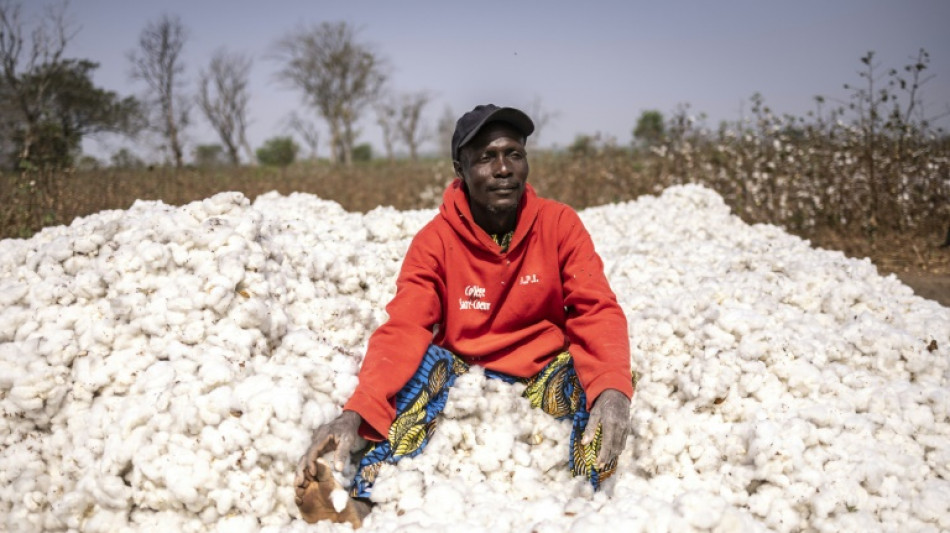
Benin seeks home-grown cotton 'revolution' / Photo: © AFP

 Alcaraz aims to step it up in round two of US Open title defense

 Honduran judge drops corruption charges against ex-leader Hernandez

 Mudryk joins Spurs on loan from Chelsea after doping ban ends
 What's next after judge strikes down New York's landmark climate fund law

 Cobolli claws out five-set victory at rain-hit US Open

 Ndiaye seizes 'chance of a lifetime' in Man City move

 Global bond sell-off, surging oil prices send markets into the red

 Zuckerberg, Musk make plea at G20 for more AI data centers

 'Discomfort' at G20 finance talks as US hosts Russian minister
 Man City set to sign Fernandez for record fee, Ndiaye on deadline day

 Back-to-school in Cuba a grim day with shortages of everything

 Canadian minister says Russia's G20 presence sparked 'discomfort'

 IMF reaches agreement with Senegal on new $2.2 bn loan programme

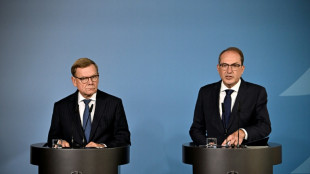 Germany blames Russia for airport drone incident, hits back with sanctions

 Iran president urges return to truce, hails Russian support

 Aster and World Liberty Financial Launch USD1 RWA Boost: Phase 1, Offering 125M $WLFI + 6.25M USD1 in Rewards

 Tronchon sprints to Vuelta stage 10 win, Mas keeps red jersey

 Germany defender Rudiger announces international retirement

 Musk defends AI data centers, slams EU rules at G20

 Activists blame Kenya for Ugandan opposition figure's plight

 Iran president offers US olive branch, hails Russian support

 TrustFinance Community Choice Awards 2026 Opens Global Voting

 Nepal disaster a climate 'warning signal': foreign minister

 France winger Diaby returns to Leverkusen until 2031

 Barcelona confirm Jesus arrival from Arsenal

Mathias Azonnoudo, a 50-year-old farmer in Benin, was taking a break sitting on a large pile of freshly picked cotton, which the government hopes will feed the country's nascent textile revolution.
Azonnoudo and other farmers in the West African country have benefited from a recent uptick in demand for cotton, with the government seeking to launch a "Made in Benin" clothing industry.
"I feel like the government has found business leaders that want more, so they are encouraging farmers to produce more," said Azonnoudo, who has been growing cotton for the past 16 years.
Benin has long vied with Mali for the title of Africa's largest cotton producer, exporting mostly raw fibres for processing abroad to countries like Bangladesh or China, the world's largest garment exporters.
But it now wants to process more of its "white gold" locally, to boost production and exports of 100 percent Beninese clothing.
Benin is expected to produce 669,000 tonnes of cotton during the 2024-2025 season, according to data from the Regional Program for Integrated Cotton Production in Africa.
Mali meanwhile is set to produce 569,000 tonnes in the season.
Under the initiative of Benin's President Patrice Talon -- who made his fortune from cotton in the 1990s and 2000s, earning him the nickname "King of Cotton" -- authorities are racing to consolidate the nation's lead.
- 'All the infrastructure we need' -
Those ambitions came to life in 2020 with the creation of the Glo-Djigbe Industrial Zone (GDIZ), a vast manufacturing district 45 kilometres (30 miles) from the economic capital Cotonou in the south of the country.
Samples of the various clothing made locally are now on display in the zone's showroom, including shirts, trousers, dresses and military and police uniforms. It also produces towels and sheets.
The industrial park, financed as a partnership between the government and Indian businessman Gagan Gupta, offers spinning, weaving, dyeing and knitting facilities.
Last year, GDIZ exported its first items of clothing to the French brand Kiabi.
"We have all the infrastructure we need to process agricultural products," said Letondji Beheton, managing director of the company running GDIZ, adding that it worked with around 21,000 farmers throughout the country.
"Today at GDIZ, we transform 40,000 tonnes of cotton a year and produce between seven and 10 million garments a year," he said.
With three new garment manufacturing units in the pipeline, production in the industrial zone is expected to grow further by year-end.
- Trust the process -
Upon ascending to the president in 2016, Talon took a number of measures to support the cotton industry, in particular by giving more room to the private sector at the expense of state-owned companies.
Benin "now processes a third of its cotton," according to Nestor Adjovi Ahoyo, an agro-economist.
The transformation is mainly taking place at the GDIZ but also to a lesser extent at smaller businesses.
At Couleur Indigo, a clothing and jewelry brand in the coastal town of Ouidah, 50-year-old Nadia Adanle said she opened her boutique in 2007 to "contribute to the diversification of Beninese craftsmanship" and offer "an authentic, purely Beninese cotton product".
In the short term, Beninese authorities say they are aiming to process "50 percent of the cotton produced in Benin and export the remaining 50 percent", Adjovi Ahoyo said.
To achieve this, he said, Benin must increase production capacity and attract investors, especially foreigners.
For his part, Beheton at the GDIZ said that within five to six years the country will have "about 30 integrated textile units in the zone to process almost all" of Benin's cotton.
R.Kloeti--VB