US Fed pauses rate cuts, resisting Trump pressure / Photo: © AFP

 Brazil Faces Debt and Inflation Test as Lula Prepares Fourth Term

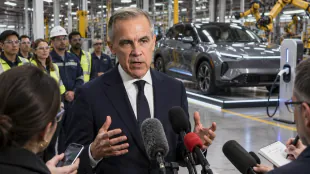 Canada Signals Openness to Chinese Automakers if US Trade Talks Fail
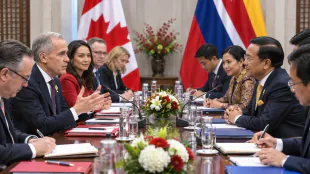
 US Mortgage Rate Falls for Fourth Week but Remains Above 7%

 13 Native American-Owned Restaurants in Arizona to Experience Indigenous Culinary Traditions

 Best Digital Photo Frames 2026: Aura, Skylight, and Amazon Compared

 UK Economy Grows 0.7% in Third Quarter as Services Lead Expansion

 India's Retail Inflation Reaches 6.09% as Food Prices Accelerate

 China's October Activity Data Reveal a Weak Start to the Fourth Quarter

 South Korea Launches Probe into NewJeans Contract Controversy

 Helen Rees Reflects on Four Decades of South Africa's HIV Journey

 Foreign Investors Return to Indian Equities with ₹84,290 Crore Inflow

 Interactive Map Reveals 1,000 Unsolved Murders Across UK
The US Federal Reserve left its key lending rate unchanged Wednesday, resisting pressure from President Donald Trump to continue with cuts in the first rate decision since his return to office.
Policymakers voted unanimously to keep the Fed's benchmark lending rate at between 4.25 percent and 4.50 percent, the Fed announced in a statement.
The decision marked a pause following three consecutive rate reductions which lowered the Fed's key lending rate by a full percentage point.
"The unemployment rate has "stabilized at a low level in recent months, and labor market conditions remain solid," the Fed said.
It added that inflation "remains somewhat elevated," while removing a reference in earlier statements to inflation making progress towards the bank's long-term target of two percent.
The US central bank has a dual mandate from Congress to act independently to tackle inflation and unemployment.
It does so primarily by raising or lowering its key short-term lending rate, which influences borrowing costs for consumers and businesses.
Most analysts agree that the US economy is going fairly well, with robust growth, a largely healthy labor market, and relatively low inflation which nevertheless remains stuck above the Fed's target.
Ahead of Wednesday's decision, the financial markets priced in a roughly 70 percent chance that the Fed would extend its pause at the next rate meeting in March, according to data from CME Group.
- 'Definitely inflationary' -
Since returning to office on January 20, Trump has revived his threats to impose sweeping tariffs on US trading partners as soon as this weekend and to deport millions of undocumented workers.
He has also said he wants to extend expiring tax cuts and slash red tape on energy production.
Last week, Trump also revived his criticism of the independent Fed and its chair Jerome Powell, whom he first appointed to run the US central bank.
"I'll demand that interest rates drop immediately," he said, later adding that he would "put in a strong statement" if the Fed did not take his views on board.
Most -- though not all -- economists expect Trump's tariff and immigration policies to be at least mildly inflationary, raising the cost of goods faced by consumers.
"I think those policies are definitively inflationary, it's just a question of what degree," said Zandi from Moody's Analytics.
"A big part of (the Fed's) job in calibrating monetary policy is responding to what lawmakers are doing, and if they can't get a fix on what they're doing, then that just argues for no change in policy, either higher or lower rates," he added.
- 'Meaningful odds' -
At the Fed's previous meeting, policymakers dialed back the number of rate cuts they expect this year to a median of just two, with some incorporating assumptions about Trump's likely economic policies into their forecasts, according to minutes of the meeting.
Given the uncertainty about the effect of Trump's policies on the US economy, analysts are now divided over how many rate cuts they expect the Fed to make this year.
In a recent investor note, economists at Goldman Sachs said their baseline forecast was for two quarter-point cuts, assuming a mild, one-time effect on inflation, "causing it to fall by less but not to rise and leaving the door open to rate cuts."
"We retain our baseline that the FOMC will cut rates 25bp (basis points) this year, in June," economists at Barclays wrote, pointing to the underlying strength of the economy.
Zandi from Moody's Analytics said he also expects two rate cuts later in the year.
But, he added, "there are meaningful odds that the next move by the Fed may not be a rate cut, it might be a rate increase."
R.Braegger--VB