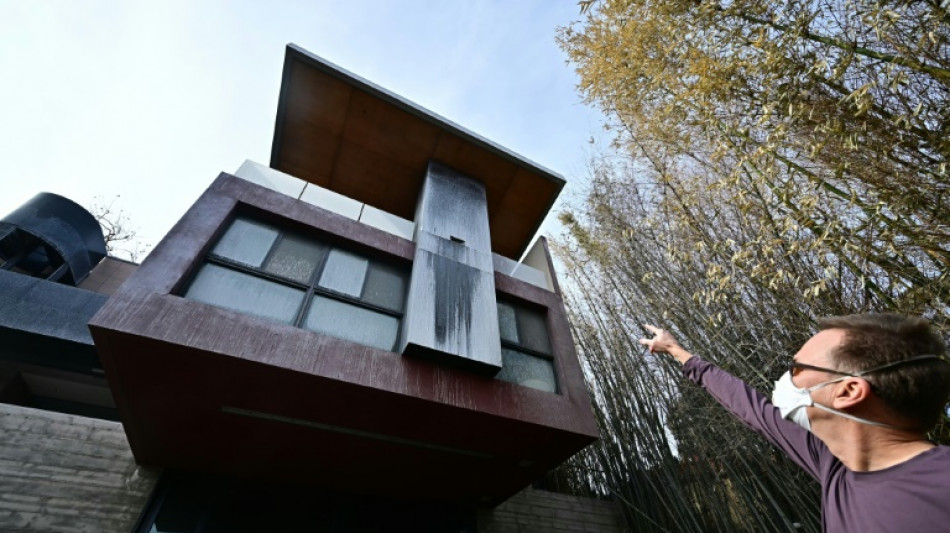
Fire-hardened house offers lessons on rebuilding Los Angeles / Photo: © AFP

 World record prize winner Romantic Warrior retires from horse racing
 5,000 US sailors arrive in Thailand after months at sea

 Joshua Wong, Hong Kong's pro-democracy poster child
 Nepal tunnel rescuers seek trapped workers but hit dead ends

 Zverev wins wild five-setter, Rybakina and Gauff ease through at US Open

 US energy secretary arrives in Venezuela to discuss oil deal

 Meloni government becomes Italy's longest-lasting

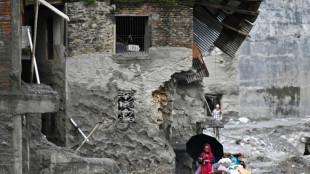 Funerals in Nepal for missing, a week after deadly floods

 US aircraft carrier arrives in Thailand after months at sea
 US aircraft carrier approaches Thai port after months at sea

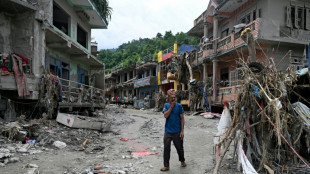 Nepal's young PM faces gravest test after flood catastrophe

 What rainbow? LGBTQ Indonesians on edge as hostility mounts

 O'Connor eyes Wallabies World Cup swansong after Force return

 Syria UXO causing death, injury every six hours: charity

 Tiger Woods set to change not guilty plea in DUI case: court documents

 Zelensky warns airlines Russian skies not safe due to Ukraine drones

 UK vows anti-settler measures as Israel warns of retaliation

 New pro Koivun among US Presidents Cup picks

 G20 finance leaders close talks marked by US welcoming Russia

 From Hollywood to big time tennis: teen makes US Open debut

 Man City secure Premier League record deal to sign Fernandez

 Kaepernick says NFL 'blackballing me' decade after protest

 Atletico loan David from Juve, send Lemar to Elche

 Chelsea 'keeper Sanchez makes deadline-day move to Como

 Kroenke to buy baseball's Los Angeles Angels: statement

The house that Michael Kovac built is the only one on his street still standing after a huge fire raced through his Los Angeles neighborhood.
Now this architect says the city needs to learn from homes like his as it begins to rebuild.
"I think we always knew a fire was coming here," he said of the ridgeline in Pacific Palisades where his house sits.
Kovac and his wife, Karina Maher, who describe themselves as "avid environmentalists," designed and constructed their home with that risk in mind.
The walls are covered with non-flammable cement fiber siding, the windows are insulated to have the highest degree of protection against heat, the vents are covered in metal mesh and the fireproof roof is topped with soil and vegetation.
Instead of a lawn, the garden is designed as a "defensive space," where a bed of volcanic rocks is dotted with agave, dwarf olive trees and mother-in-law's cushions -- a striking spherical cactus.
All of it is protected by a sprinkler system that can spray fire retardant to slow the spread of flames.
"If most of the houses were built to something closer to this standard, I think the fire could have been contained," Kovac told AFP of the blaze that erupted on January 7.
Like many in Los Angeles, the 62-year-old was astounded by just how destructive the wind-driven fires were, with two major blazes razing around 40,000 acres (16,000 hectares) and leveling thousands of buildings.
- Materials -
As the city gradually turns its attention towards the long, slow process of rebuilding, Kovac hopes it will do so with fire resiliance in mind.
Many houses in the western United States have timber frames, and a wholesale switch to something less vulnerable like brick is unlikely, as availability and cost are key drivers in construction choices.
But even if the frame stays the same, hardening its cover doesn't have to break the bank, says Kovac.
"The choice to use, say, a cement siding instead of a wood siding, that's almost a cost neutral thing," he said.
Footage from his home's security cameras shows red-hot embers spraying all over the property -- the same embers that allowed the fire to take hold of so many homes on his street.
But not Kovac's.
"At that point you have to dismiss too much of it being luck. I mean, when it's enveloped by embers and surrounded by flames... it's down to the material choices and the systems to protect the house," he said.
Maher, a doctor who specializes in the effects of climate change on human health, says the fire was an obvious consequence of the way we are messing with our planet.
"We know the solutions to slow it down, but we also know the solutions to adapt, and that's what we all need to do," she said.
The devastation wrought by the fires was awful, says Yana Valachovic, a specialist in fire-resistant construction at the University of California, but it now presents an opportunity.
Protecting a home from the ember showers that set so many houses ablaze is among the most pressing considerations, she said.
That means hardening or stopping any ingress points, like vents.
Other important considerations are using tempered glass -- which is heat-resistant -- and rethinking the way a garden is laid out.
"Fire adaptation doesn't require a huge investment, it just requires us living a little differently," Valachovic said.
C.Koch--VB