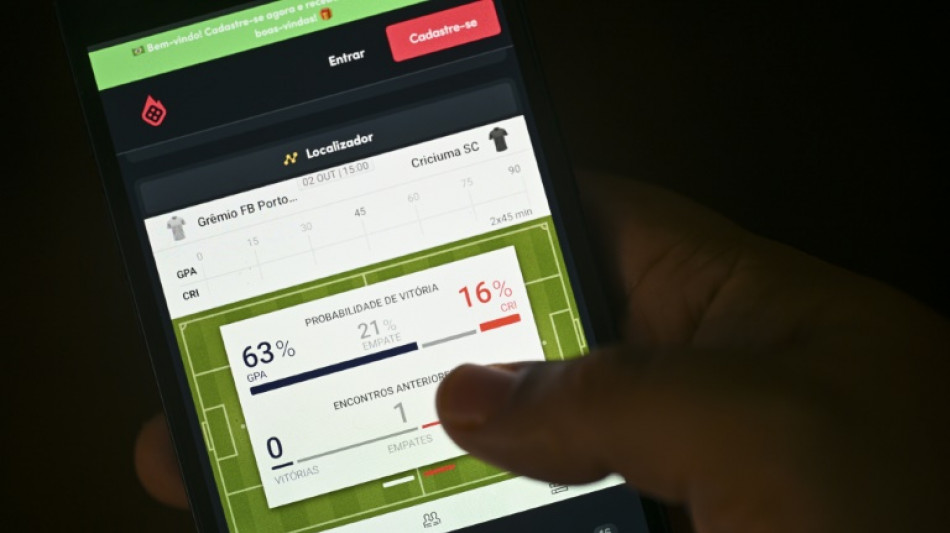
European watchdog takes aim at online gambling, gaming among youths / Photo: © AFP/File

 China expands Egypt investments in first Xi visit in a decade

 Messi departure leaves Argentina facing rebuild after golden era

 Ourbit SuperCEX Launches "Cosmic Wheel Season 3. Oracle Realm" on September 2 with 3M USDT Prize Pool

 Ebola death toll passes 3,000 in DR Congo: official data
 Hong Kong democracy activist Wong pleads guilty to foreign collusion

 World record prize winner Romantic Warrior retires from horse racing

 5,000 US sailors arrive in Thailand after months at sea

 Joshua Wong, Hong Kong's pro-democracy poster child

 Nepal tunnel rescuers seek trapped workers but hit dead ends
 Zverev wins wild five-setter, Rybakina and Gauff ease through at US Open

 US energy secretary arrives in Venezuela to discuss oil deal

 Meloni government becomes Italy's longest-lasting

 Funerals in Nepal for missing, a week after deadly floods
 US aircraft carrier arrives in Thailand after months at sea

 US aircraft carrier approaches Thai port after months at sea
 Nepal's young PM faces gravest test after flood catastrophe

 What rainbow? LGBTQ Indonesians on edge as hostility mounts

 O'Connor eyes Wallabies World Cup swansong after Force return

 Syria UXO causing death, injury every six hours: charity
 Tiger Woods set to change not guilty plea in DUI case: court documents

 Zelensky warns airlines Russian skies not safe due to Ukraine drones

 UK vows anti-settler measures as Israel warns of retaliation

 New pro Koivun among US Presidents Cup picks

 G20 finance leaders close talks marked by US welcoming Russia

 From Hollywood to big time tennis: teen makes US Open debut

Online gambling and gaming can cause depression and other mental health issues in young people, which the Council of Europe rights watchdog is trying to counter with a new project encouraging good policy and awareness raising.
The 46-member bloc, which launched its project at the start of a two-day conference in Rome on Tuesday, is seeking to help countries tackle the problem as online gambling and gaming grow in popularity among young people.
"It is only a minority (of adolescents) who experience addiction-like symptoms," Orsolya Kiraly, a researcher at the Eotvos Lorand University's Institute of Psychology in Budapest, told the conference.
"But in these cases these lead to severe negative consequences and functional impairment," she said.
Excessive online gambling and gaming are particularly dangerous for children, whose brains and personalities are still developing, she said.
The dangers include mental and physical health problems ranging from family conflict and sleep disturbances to bad eating habits and poor physical hygiene, Kiraly said.
The Council of Europe's Pompidou Group, which coordinates anti-drug and addiction policy and is in charge of the new project, said in a 2024 report that gambling and gaming products were deliberately crafted to make the activities "as immersive and addictive as possible".
Detailed research on the topic is not yet widely available, but the World Health Organization has already identified disorders from online gambling and gaming as public health concerns.
- 'Conflicts of interest' -
Gambling disorders could affect 26.4 percent of adolescents who are gambling on online platforms, and 16.3 percent of those gambling using sports betting, Kiraly said, citing recent research.
More video games, meanwhile, are incorporating gambling-like features, including "loot boxes" -- items that can be bought within video games that contain other unknown objects.
Boys are more affected, while girls are more at risk of addiction-like disorders from social media, Kiraly said.
"There is a great need for more research in this area," she said.
"The industry has a lot of data but they don't share it or they share it only with researchers who have conflicts of interest."
The global gaming industry could exceed $300 billion in revenue by 2028, doubling since 2019, according to a 2024 report by the consulting group PwC.
Italy is one of the largest gambling markets in the world, with 148 billion euros ($125 billion) spent in 2023, up from 89 billion euros in 2012, said Elisa Benedetti from Italy's National Research Council.
- Adults 'desperate' -
The Council of Europe hopes to help states to fix a problem that most of its members do not even have strategies for yet.
Experts said one of the issues was the contrasting ways in which people of different ages deal with the stigma and the difficulties.
Simona Pichini, director of the addiction centre at Italy's National Health Institute (ISS), pointed out that the national Italian gambling hotline most often received calls from adults.
"When do they call? When they're desperate, when they arrive with no money, no house, outside the family. They call at the end of the problem," she said.
It was a marked contrast with young people.
"Not youngsters. They don't perceive the problem," she said.
J.Sauter--VB