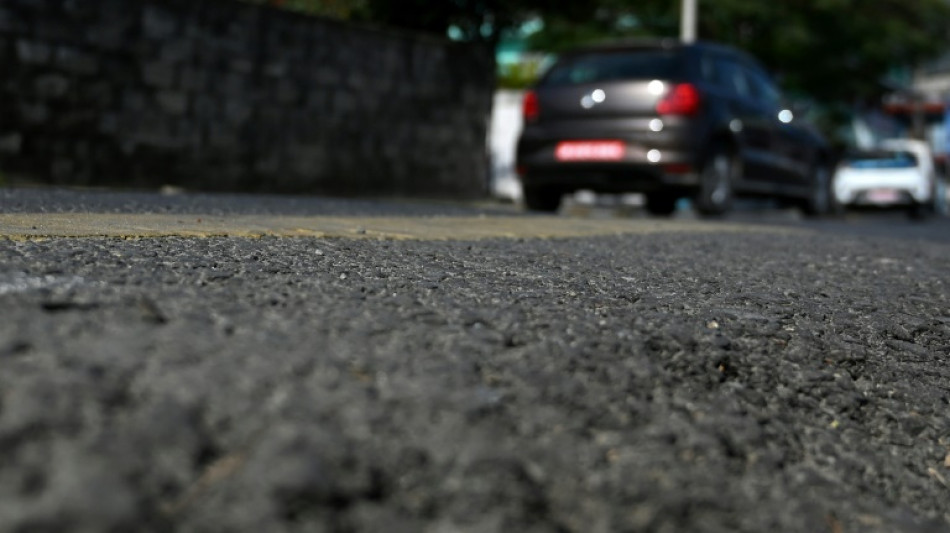
Rubbish roads: Nepal explores paving with plastic / Photo: © AFP

 Michelson shocks Nakashima in US Open clash of rising Americans

 Another body recovered after ferry capsizes off northern Cyprus: official

 Cupertino Chamber President Claudio Bono Invited to White House with GiveaRoof 3-Year Plan to End Homelessness

 Trump floats renaming Strait of Hormuz as 'Trump Strait'

 Man City, Chelsea fuel record-breaking Premier League transfer window

 Balogun rejected Everton move over transfer 'treatment'

 Northampton seek 'happy medium' in bid to keep England star Pollock

 US energy secretary in Venezuela to sign Trump's 'biggest' oil deal

 Branagh takes on action role in Apple's Cold War comedy 'Mayday'
 Lawson fills in again for injured Hadjar at Monza

 England omit Carse from squad for third Test against Pakistan
 Venice festival gets underway with Clooney taking swipe at US government

 DNA tests and funerals in Nepal, a week after deadly floods

 Iran threatens tougher strategy after US strikes kill 4 at wedding

 Chevron unveils deal to double Venezuela venture output in 5 years

 Uganda names its oil 'Pearl Sweet' as it prepares for first exports
 Tiger Woods driver's license suspended for five years after crash

 Germany probes latest sabotage attacks on power grid

 Wall Street stocks mixed as energy prices, bond yields turn lower

 Tiger Woods pleads guilty to reckless driving, license suspended
 Missing passengers likely went down with sunken ferry: N.Cyprus official

 Premier League clubs splash cash to smash transfer record

 Melting glaciers an 'immediate' climate risk: author of UN report

 Folarin Balogun's move to Everton collapses

 Pacific islands to face food shortages over global warming: scientists

Cars speeding along a smooth, black-coloured street in Nepal's Pokhara are also driving over heaps of discarded plastic, transformed into an ingredient in road construction.
Nepal's urban areas generate about 5,000 tonnes of solid waste per day, according to the World Bank, of which 13 percent is plastic waste dumped in landfills.
While high-value plastics, like bottles, are absorbed by the recycling industry, low-value plastics -- such as multi-layered packaging -- pose a significant challenge because they don't fit into a single recycling category.
For a group of young Nepali entrepreneurs, the vast accumulation of this low-value plastic waste presented an opportunity.
"A plastic road can use even low-value plastics," said Bimal Bastola, founder of Green Road Waste Management, the organisation leading the initiative in Nepal.
"We saw scope for such plastics to be utilised as a raw material, partially substituting bitumen in road construction."
Discarded packages of noodles, biscuits and other snacks move along a conveyor belt at their trash-sorting centre.
The divided plastic is then put into machines to be shredded into fine pieces.
Since the early 2000s, neighbouring India has been leading the world in building a network of plastic roads, even making the usage of plastic waste mandatory in roads near large cities in 2015.
A growing number of countries are experimenting with it, including nearby Bhutan and Bangladesh.
In traditional road construction, bitumen is the binding material, a tarry oil product mixed directly with hot aggregates before paving a road.
The plastic road method, however, first coats the aggregates with shredded plastic before adding bitumen.
"This method reduces the need for fresh raw materials, lowers costs, prevents water infiltration and increases road lifespan," Bastola said.
Studies show that roads paved with plastic waste can be twice as durable as normal roads.
- 'Scale up' -
Globally, only nine percent of plastic waste is recycled, while 19 percent is incinerated, and nearly half ends up in controlled landfills, according to the Organisation for Economic Cooperation and Development (OECD).
Left unchecked, the production of synthetic polymers -- the building blocks of plastics -— is expected to reach about 1.2 billion tonnes annually by 2060.
The plastic that accumulates in the environment is non-biodegradable, takes hundreds of years to decompose and breaks down into tiny microscopic particles.
And while Nepal banned single-use plastic bags thinner than 40 microns, that ban is not strictly implemented.
For Bastola, increasing plastic road construction is key to making the recycling of low-value plastics economically viable.
His organisation says about two tonnes of shredded plastic is used to build a kilometre of road.
So far, the organisation has completed about 10 projects totalling a little over 1.5 kilometres (one mile).
"It is happening at a small scale, we need to scale up," Bastola said. "We have to make government-level projects and we are trying to work closely with the department of roads."
A pilot project is planned this year in the capital Kathmandu at a major intersection.
"Nepal is keen on testing this technology through pilot projects," said Arjun Nepal, an engineer with the Kathmandu road department.
"But to take it forward, we need government-led standards to ensure quality."
The World Bank says life cycle analyses of plastic roads are limited and it is still not clear what environmental impacts -- if any -- recycled plastics may have when used in road construction.
"While initial anecdotes and pilot studies show promise, further research is needed to measure emissions during production, evaluate microplastic release over time and determine how these roads behave once they are decommissioned," said Valerie Hickey, global director of the World Bank's climate change group.
Despite these concerns, environmentalist Bhushan Tuladhar said that plastic roads present an important opportunity for Nepal.
"It is a low-hanging fruit to address two problems simultaneously -- the need for strong roads and the management of plastic waste -- for a developing country like Nepal," he said.
A.Ruegg--VB