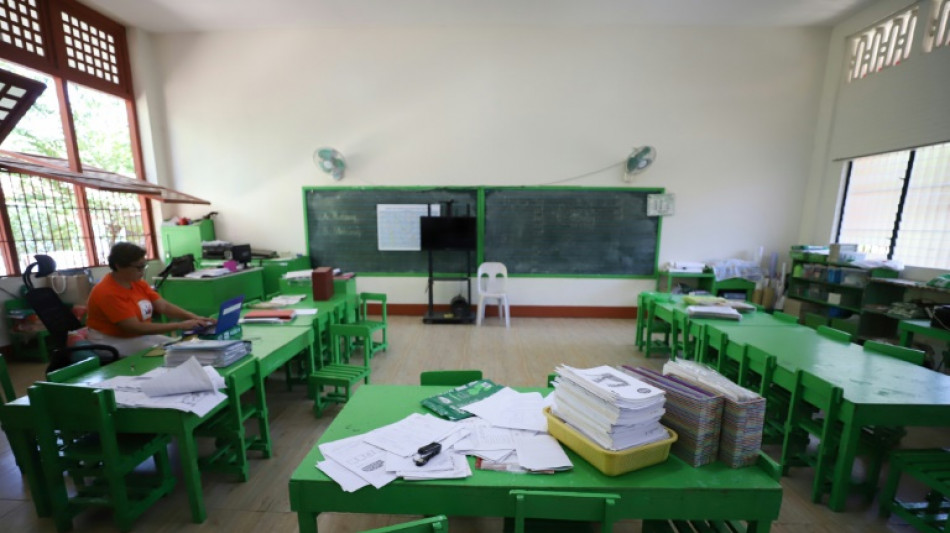
242 mn children's schooling disrupted by climate shocks in 2024: UNICEF / Photo: © AFP

 US Open under the influence: content creators spark debate

 NBA hammers Clippers over Leonard salary cap violations

 NBA strips five first-round draft picks from Clippers for Leonard salary cap violations
 Kane brace helps Bayern win German Cup opener
 Migrant plight, local anger divide Ceuta one month after influx

 Outrage as Maltese tycoon acquitted of reporter's murder

 Rare train of Pacific cyclones fueled by historic El Nino
 Macron, King Charles hail UK-France ties after viewing Bayeux Tapestry

 Fury hits out at 'coward' Joshua as 'Battle of Britain' talks go on

 Maltese tycoon acquitted of masterminding reporter's murder

 George Clooney: a Hollywood icon and campaigner

 Europe, US closer than they look on tech rules, says EU tech chief

 Clooney honoured as Hollywood-light Venice Film Festival kicks off

 Third-ranked Pegula, Medvedev power into US Open third round

 Davis-Woodhall a doubt for Ultimate Championship after car crash

 Third-ranked Pegula powers into US Open third round

 Uber says laying off 'about 10%' of workforce worldwide

 US judge rejects bid to break up Google's ad business

 Rupert Murdoch 'very happy' to be played by Guy Pearce in new film

 Wall Street stocks rise despite bond yields, oil rising

 Brennan claims third Vuelta victory in stage 11 sprint

 Nepal flood survivors cling to zipline to cross treacherous river

 US Treasury issues $1 coin with Trump's face on it

 Fernandez 'didn't hesitate' over record Man City move

 Dutch shift 86 tonnes of gold from US, Canada to UK

Extreme weather disrupted the schooling of about 242 million children in 85 countries last year -- roughly one in seven students, the UN children's agency reported Thursday, deploring an "overlooked" aspect of the climate crisis.
Heat waves had the biggest impact, the report showed, as UNICEF's executive director Catherine Russell warned children are "more vulnerable" to extreme weather.
"They heat up faster, they sweat less efficiently, and cool down more slowly than adults," she said in a statement.
"Children cannot concentrate in classrooms that offer no respite from sweltering heat, and they cannot get to school if the path is flooded, or if schools are washed away."
Human activity, including the unrestricted burning of fossil fuels over decades, has warmed the planet and changed weather patterns.
Global average temperatures hit record highs in 2024, and over the past few years they temporarily surpassed a critical 1.5 degrees Celsius warming threshold for the first time.
That has left the wet periods wetter and the dry periods dryer, intensifying heat and storms and making populations more vulnerable to disasters.
The 242 million figure is a "conservative estimate," the UNICEF report said, citing gaps in the data.
Students from kindergarten to high school saw classes suspended, vacations moved, reopenings delayed, timetables shifted and even schools damaged or destroyed over the year due to climatic shocks, the available data showed.
At least 171 million children were affected by heat waves -- including 118 million in April alone, as temperatures soared in Bangladesh, Cambodia, India, Thailand and the Philippines.
In the Philippines in particular thousands of non-air conditioned schools were closed, with children at risk of hyperthermia.
- Risk rises with temperatures -
September, which marks the start of the school year in many countries, was also heavily impacted.
Classes were suspended in 18 countries, notably due to the devastating typhoon Yagi in East Asia and the Pacific.
South Asia was the region hardest hit by climate-related school interruptions, with 128 million schoolchildren affected.
India had the most children affected -- 54 million, mainly by heat waves. Bangladesh had 35 million also affected by heat waves.
The figures are likely to rise in coming years as temperatures continue going up, with half the world's children -- around one billion -- living in countries at high risk of climate and environmental shocks.
If the emission of greenhouse gases continues on its current trajectory, eight times as many children will be exposed to heat waves in 2050 as in 2000, according to UNICEF projections.
More than three times as many would be exposed to extreme floods and 1.7 times more to wildfires, the projections showed.
Beyond the immediate impacts, UNICEF voiced fears that the damage could increase the risk of some children -- girls in particular -- dropping out of school altogether.
Already, some two-thirds of children around the world cannot read with comprehension by age 10, it said, adding: "Climate hazards are exacerbating this reality."
Education is one of the services most frequently disrupted by climate hazards, Russell said.
"Yet it is often overlooked in policy discussions," she warned. "Children's futures must be at the forefront of all climate-related plans and actions."
UNICEF called for investment in classrooms that are more resistant to climate hazards.
T.Suter--VB