Bangladesh student revolutionaries' dreams dented by joblessness / Photo: © AFP

 Sabalenka races into US Open third round

 Chinese lucky loser stuns Jodar at US Open

 US Open under the influence: content creators spark debate

 NBA hammers Clippers over Leonard salary cap violations
 NBA strips five first-round draft picks from Clippers for Leonard salary cap violations
 Kane brace helps Bayern win German Cup opener
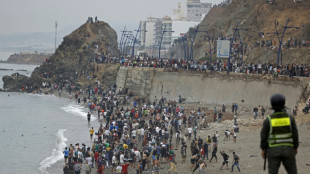
 Migrant plight, local anger divide Ceuta one month after influx
 Outrage as Maltese tycoon acquitted of reporter's murder

 Rare train of Pacific cyclones fueled by historic El Nino
 Macron, King Charles hail UK-France ties after viewing Bayeux Tapestry
 Fury hits out at 'coward' Joshua as 'Battle of Britain' talks go on
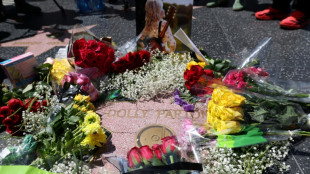
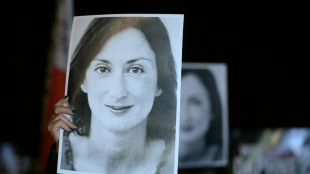 Maltese tycoon acquitted of masterminding reporter's murder

 George Clooney: a Hollywood icon and campaigner

 Europe, US closer than they look on tech rules, says EU tech chief

 Clooney honoured as Hollywood-light Venice Film Festival kicks off
 Third-ranked Pegula, Medvedev power into US Open third round

 Davis-Woodhall a doubt for Ultimate Championship after car crash
 Third-ranked Pegula powers into US Open third round

 Uber says laying off 'about 10%' of workforce worldwide

 US judge rejects bid to break up Google's ad business

 Rupert Murdoch 'very happy' to be played by Guy Pearce in new film

 Wall Street stocks rise despite bond yields, oil rising

 Brennan claims third Vuelta victory in stage 11 sprint

 Nepal flood survivors cling to zipline to cross treacherous river

 US Treasury issues $1 coin with Trump's face on it
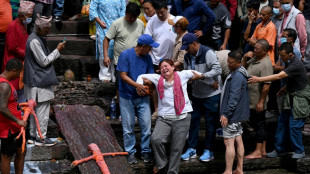
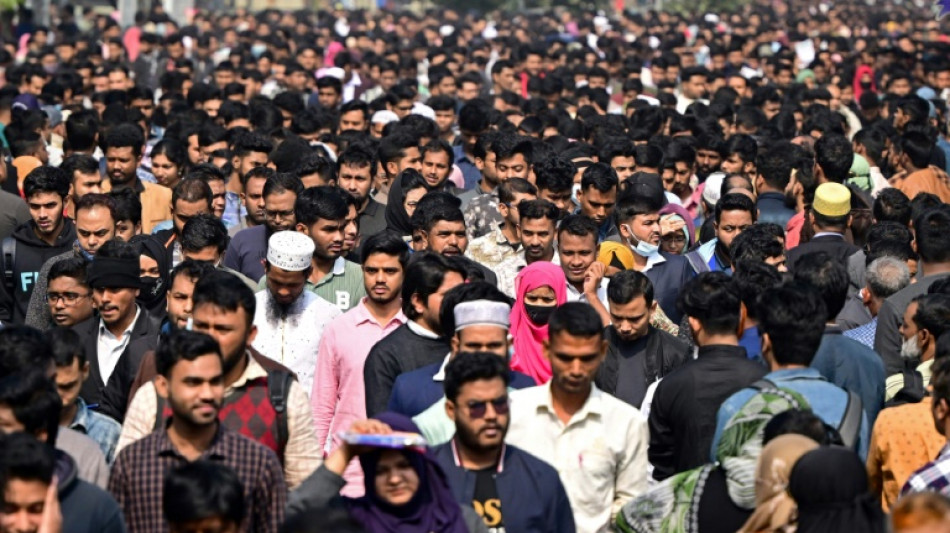
Bangladeshi students braved bullets to overthrow an autocratic government, but six months after the revolution, many say finding a job is proving a harder task than manning the barricades.
Dhaka University student Mohammad Rizwan Chowdhury's dreams of ample opportunities for youth have been badly dented, saying he had seen little action from the caretaker government of Nobel Peace Prize winner Muhammad Yunus.
"I can't see any fruitful initiatives taken by the government so far," Chowdhury grumbled, a25-year-old student who took part in the protests that drove autocratic ex-leader Sheikh Hasina into exile on August 5.
Unemployment was a key driver of protests last year. Since the revolution, it has only grown worse.
At the end of September 2024, the number of people seeking employment in the country of 170 million hit 2.66 million, a six-percent increase from 2.49 million the year before, according to the Bangladesh Bureau of Statistics (BBS).
The International Monetary Fund warned in September that economic activity had "slowed markedly, while inflation remains at double-digit levels", with tax revenues down while spending pressures had increased.
For many, the euphoria of Hasina's ouster is fading.
Chowdhury said that while Yunus handed cabinet posts to student leaders, he felt demands were being ignored.
"Although our representatives are part of the administration, I'm not sure whether our voices are being heard," the political science graduate said.
- 'Whatever jobs they can' -
Literature graduate Shukkur Ali, 31, scrapes by on odd jobs to support his elderly and sick parents.
"I do anything and everything just to cover the bare minimum," he told AFP, adding that newspaper job advertisements have dried up.
"I used to apply only for white-collar jobs in educational institutions or banks -- but failed," he said.
"Now, anything is good for me. I just want a job."
Independent analyst Zahid Hussain,71, former lead economist at the World Bank in Dhaka, said that around a third of the working labour force are "underemployed doing whatever jobs they can to pay the bills".
Bangladesh's economy grew dramatically after its independence in 1971.
That was largely due to its textile industry producing global brands in a multi-billion dollar business as the world's second-largest garment exporter.
But jobs outside the crowded clothing factories for university graduates are far fewer.
Educated Bangladeshis make up 87 percent of those without work, according to BBS figures.
The government says it is making every effort to address the issue.
Shafiqul Alam, Yunus' press secretary, said robust tax generation would allow the government to invest in the public sector and create a "huge" number of jobs.
"Ensuring better revenue collection is a priority, as the previous government left behind a broken economy," Alam said.
- 'Empty-handed' -
But Yunus, an 84-year-old microfinance pioneer, is also swept up in what he calls the "extremely tough" challenge of restoring democratic institutions ahead of elections slated for this year or early 2026.
Those reforms include an overhaul of the constitution and the public administration to prevent a return to autocracy.
"The interim government is preoccupied with managing the mess they inherited," said Hussain, adding there were only "sporadic attempts" to support the youth, such as hiring students to assist traffic police.
"The administration isn't functioning at full speed," he said. "I'd rate them 50 out of 100."
Challenges are daunting.
"The public sector can recruit no more than 20,000 to 25,000 graduates, while around 700,000 graduates leave colleges each year," said AKM Fahim Mashroor, chief of popular online job site Bdjobs.
The private sector provides around 85 percent of jobs, but there is little optimism there either.
"Both the public and private sectors have been slow in recruiting since August 5," he added.
And the unrest has spooked investors.
Bangladesh's central bank says foreign investment between July and November 2024 was $177 million -- less than a third of the $614 million secured under Hasina's iron-fisted rule during the same period the previous year.
Taskeen Ahmed, president of the Dhaka Chamber of Commerce and Industry, said the government should roll out programmes to support young job-seekers including "loan schemes for youth to start businesses".
Some like Subir Roy, a 31-year-old finance graduate who was nominated to a government job only for it to be rescinded without reason, said it was already too late for him.
"My father sold a small piece of land to send me to university... now I'm returning home empty-handed," Roy said.
"I'll join my father in the paddy field."
H.Gerber--VB