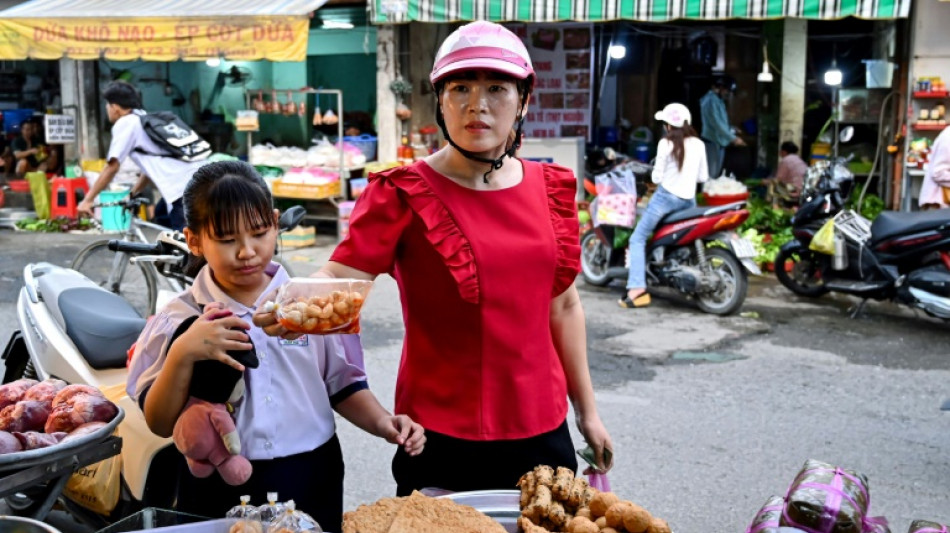
'Too hard': Vietnam's factory workers return to country life / Photo: © AFP

 In Ghana, larger-than-life coffins tell the stories of the dead

 Menoncello, Reece headline Top 14 new-season signings

 Families descend on Nepal in search of missing tourists

 Far-right AfD eyes huge win in east German state vote

 Brazil-Japan to play World Cup rematch at Singapore tournament

 Defence chiefs back boosting US military presence in Australia

 Nepal seeks climate justice after Himalayan disaster

 Stocks rise, yields ease as oil slips on Trump hint at short bombing campaign

 Brussels Diamond League finals Day 1 - five events to watch

 Thailand's 'Jurassic Park' shines light on dinosaur evolution

 'Role model' Stokes set to open for Adelaide Strikers

 Palau urges 'unified' Pacific response to China missile test

 Grinding away: in remote Appalachia, old mills fuel US clean food dreams

 Sabalenka races into US Open third round

 Chinese lucky loser stuns Jodar at US Open

 US Open under the influence: content creators spark debate

 NBA hammers Clippers over Leonard salary cap violations

 NBA strips five first-round draft picks from Clippers for Leonard salary cap violations

 Kane brace helps Bayern win German Cup opener

 Migrant plight, local anger divide Ceuta one month after influx

 Outrage as Maltese tycoon acquitted of reporter's murder

 Rare train of Pacific cyclones fueled by historic El Nino
 Macron, King Charles hail UK-France ties after viewing Bayeux Tapestry

 Fury hits out at 'coward' Joshua as 'Battle of Britain' talks go on

 Maltese tycoon acquitted of masterminding reporter's murder

Treading a familiar path for women in rural Vietnam, Nguyen Thi Hiep found a factory job in dynamic Ho Chi Minh City and spent 16 years helping make shoes for Western brands such as Adidas and Nike.
Vietnam is among the world's largest exporters of clothing, footwear and furniture and Ho Chi Minh City and its hundreds of thousands of migrant workers have for decades helped power its manufacturing boom.
The southern metropolis offered stable jobs with decent pay, and young women in particular flocked to garment and shoe factories, where the workforce is three-quarters female.
But as living costs surge, Hiep is joining a wave of workers rejecting the commercial hub for a quieter life back home -- leaving city businesses struggling to fill their ranks.
"I have stayed in this city long enough," Hiep, 42, told AFP after her shift at a factory owned by Taiwan's Pou Chen, one of the biggest and best-paying shoe manufacturers in the country.
"I work all day long, starting at sunrise and ending when it's dark," she said. "But I still struggle to pay my rent."
Despite earning 10 million dong ($400) a month, a third more than the national average, Hiep lives in a 10-square-metre, one-room apartment with her husband and eight-year-old daughter, buying the cheapest food she can find and saving nothing.
Housing, utility, healthcare and education costs are rising across the country, and workers in Ho Chi Minh City say their salaries can no longer meet their needs.
So Hiep and her husband, a motorbike taxi driver, have decided to leave.
This week, ahead of the Tet festival when Vietnam celebrates the lunar new year, the family will make the 1,000-kilometre (621-mile) journey home to a remote corner of mountainous Quang Binh province, 24 hours and a world away from the traffic and pollution of Ho Chi Minh City and its 10 million people.
They have no plans to return.
- Rapid departure -
In the decades since Vietnam's post-war "doi moi" economic transformation, Ho Chi Minh City and the capital Hanoi have been at the heart of the "from farm to factory" trend, said professor Pham Van Dai of the country's Fulbright University.
It is a pattern that has played out in many developing countries across the world.
But when the Covid-19 pandemic forced people out of factories and back to their homes, many found rural areas had developed, offering more opportunities than a decade earlier and a higher quality of life.
"The number of migrant workers (moving out) rose rapidly," Dai told AFP.
In Binh Tan, a popular migrant district where Hiep lives, the number of temporary residents dropped by almost a quarter -- more than 100,000 people -- between 2020 and 2023, Le Thi Ngoc Dung, vice chairwoman of the local people's committee, told state media.
And although new migrants are still arriving across the city, the number has fallen drastically -- from 180,000 in 2020 to 65,000 people in 2023, according to the city's population and planning department.
"When their income can no longer cover living costs" migrants will leave, Dai said. "The city has not shifted quick enough to create better jobs."
In 2022, more than 60 percent of Ho Chi Minh City's migrant population had decided to leave or were mulling it over, a survey by the Vietnam Chamber of Commerce and Industry and the UN's International Organization for Migration showed.
More than half blamed high living costs.
- Labour shortage -
Struggling to afford food and schooling, Truong Thi Le, also a Pou Chen worker, made the heartbreaking decision to send her six-year-old daughter to live with her uncle in Quang Binh.
After eight years in the city, she and her younger daughter will soon follow, leaving behind the poor air quality -- which regularly exceeds World Health Organization's guidelines by three to five times -- that she says is making her children ill.
"We can't make it work," said Le, who together with her husband earns roughly 16 million dong a month.
"And the environment in the countryside will be better for my kids."
Low income, small and dilapidated houses, separation from their children, overtime and night shifts: each contributes to migrant workers' "increasing feeling of insecurity and lack of stability", said Nguyen Thi Minh Ngoc, a manager at recruitment company ViecLamTot.
As stress levels rise and their health deteriorates, they leave despite knowing their income will drop, Ngoc told AFP.
Business is beginning to feel the effects.
An August survey by ViecLamTot showed around 30 percent of manufacturers in the city faced a labour shortage, while 85 percent said they were having trouble recruiting.
For the workers themselves, the future remains uncertain.
Le said she might return to farming, while Hiep has thought of finding a factory closer to home.
In any event, she envies the simple life of her neighbours back home, "playing volleyball, getting together to sing and dance".
In Ho Chi Minh City, she says, "life is too hard".
R.Kloeti--VB