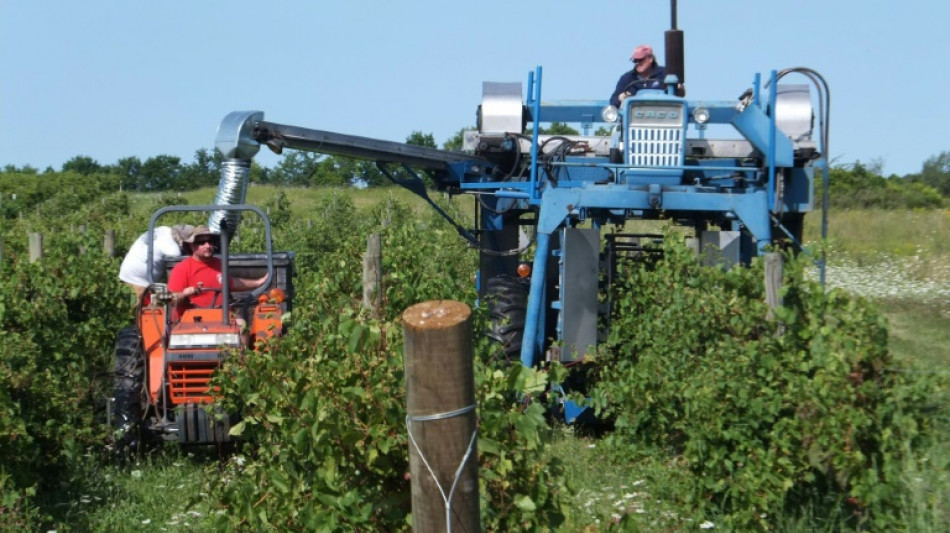
Herbicide under US scrutiny over potential Parkinson's link / Photo: © David Jilbert/AFP

 Haaland keeps Man City perfect in Premier League, blunt Spurs held

 Hamilton worried by Ferrari pace while Antonelli prepares for a fight

 Vuelta stage 15 shortened due to extreme heat, Mas consolidates lead

 Putin meets US envoys for Ukraine war talks

 Modric available for Croatia in Nations League

 Potapova upsets 2025 US Open runner-up Anisimova

 Gasly a 'class act' says Alpine boss after Monza pole

 Athletic Bilbao crush Simeone's flat Atletico

 Stay far from battlefield, warns Japanese director in Vietnam War film

 Tens of thousands of Croatians protest over hazardous waste

 Haaland heads unconvincing Man City top of Premier League

 US envoys in Moscow as Russia and Ukraine vow not to hit capitals during talks

 Motorsport governing body rejects Alpine boss's claims of bias

 US envoy on West Bank visit says Israel has responsibility for Palestinians

 Ethiopian Miss World contestant spotlights pain of sister's murder

 'Leader' Raphinha rising to Barca striker challenge

 Oasis fans gather in Venice for band reunion film

 Two Nepal rescues revive hopes 10 days after flood

 Pogacar to miss worlds after season-ending Vuelta crash

 Greenwood, Guendouzi handed bans after Fenerbahce-Lyon brawl
 In Iceland, the mystery of the poet, the tomb and the Danish grocer
 Ratko Mladic: Bosnian Serb commander to convicted war criminal

 Bolivian army base blasts kill two, wound dozens
 Alcaraz, Sabalenka into US Open last 16 as Williams sisters lose on return

 Williams sisters fall in thrilling return to US Open doubles

First came the slow hand movements, then the tremor, and now the looming fear of what lies ahead.
David Jilbert's devastating diagnosis of Parkinson's disease three years ago changed his life irrevocably -- and it's a condition the 65-year-old farmer believes he wouldn't have if it weren't for paraquat, a herbicide he once relied on to control weeds in his vineyard in the midwestern US state of Ohio.
"Now it's not just about me, I'm part of this community -- let's get something going," Jilbert said during a recent hearing in the US Congress on the issue.
Banned in more than 70 countries -- including Britain, where it is manufactured; Switzerland, home to the Syngenta company that owns the brand; and China, where the state-run conglomerate that owns Syngenta is based -- paraquat remains available in the United States.
The US Environmental Protection Agency (EPA) has long maintained that the herbicide is safe for use under strict regulations -- something Parkinson's advocates are hoping to change.
The agency is set to issue a final report on the issue by January 17, 2025, a date mandated by a court in response to 90 new scientific studies submitted by the Michael J. Fox Foundation and other groups.
- Industry denies causation -
"We have great sympathy for those suffering from the debilitating effects of Parkinson's disease," a spokesperson for Syngenta said in a statement to AFP.
"However, it is important to note that the scientific evidence simply does not support a causal link between paraquat and Parkinson's disease, and that paraquat is safe when used as directed."
Multiple credible studies have found that agricultural workers who handle paraquat -- or live near areas where it is applied -- face a higher incidence of Parkinson's disease, which can eventually turn even the simplest movements into daunting challenges.
Animal research further underscores paraquat's toxic effects on nerve cells, although proving direct causation for individuals remains difficult.
"I find it extraordinarily frustrating that the chemical companies have hidden behind the concept of being able to show causation, and they've used that as an excuse, because we haven't been able to come out and definitively say that," Australia-based neurologist David Blacker said in interview with Pesticide Action UK, an advocacy group.
"That's where the precautionary principle comes in," he added. "If there is a doubt, especially if there are alternatives, it then becomes, in my mind, ethically and even morally unsound to continue to pursue."
- 'It's scary' -
Jilbert, a longtime environmental engineer and environmental safety inspector, dreamed of becoming a farmer after retirement.
In 2011, he purchased his land and, over the following years, began using paraquat -- often sold as Gramoxone -- to manage his weeds. By the end of the decade, he noticed his hands moving slowly and his gait turning into a shuffle.
When his Parkinson's diagnosis finally came, he was horrified and wondered if he'd been condemned to a "death sentence." His condition is more manageable for now, thanks to medications, but he says he feels disappointed in his own government for not looking out for him.
"You think if you use the stuff in the way the label tells me to use it, then I'm not going to get sick," he said.
Like Jilbert, 85-year-old Charlene Tenbrink -- who owns a 250-acre farm in Dixon, California -- also trusted that the chemicals available to farmers were safe when handled properly.
She sprayed paraquat on her prune trees in the 1990s and was diagnosed with Parkinson's in 2020.
Tenbrink, Jilbert and thousands of others are now suing Syngenta in federal and California state courts.
Sarah Doles, a lawyer and co-lead for that federal litigation, compared it to the cases against Big Tobacco. She contends Syngenta had a legal duty to disclose harms its own teams knew about paraquat from research going back decades, but hid from consumers.
"It's a legal duty of what they knew and then failed to do -- they concealed the information," she told AFP.
Regardless of which direction the EPA rules, these legal cases will continue.
Tenbrink says it's vital to get the product off the market, and admits she's terrified for her own future.
"This is a terrible disease and we know there's no cure, we know it's going to get worse. It's scary," she says.
G.Schmid--VB