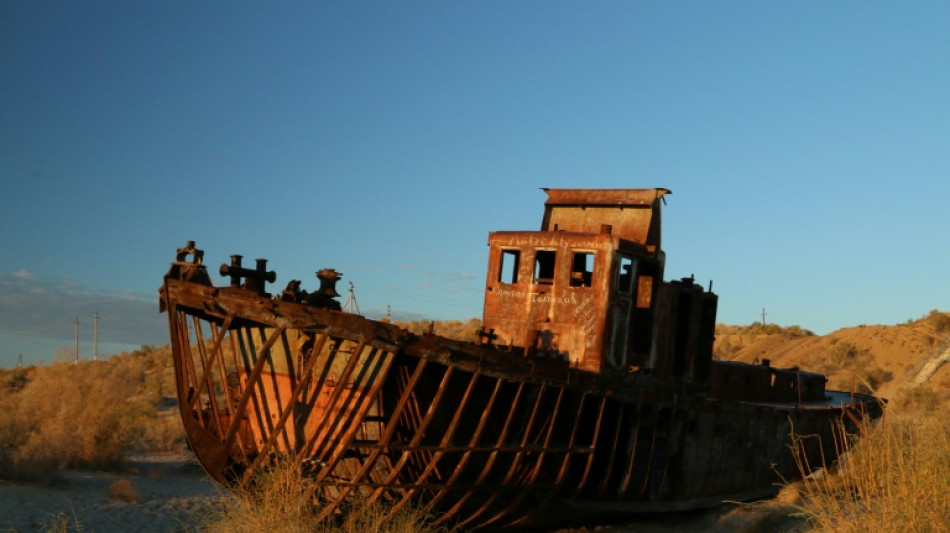
Kazakhstan says part of Aral Sea has nearly doubled in volume / Photo: © AFP

 COP31 Presidency Publishes First Draft Cover Decision on Climate Action

 EU Club Group Files Antitrust Complaint Against UEFA Over Prize Money

 Heat and El Niño Drive Surge in Preterm Births Across Southern Africa

 China's Factory Activity Contracts as Export Orders Weaken

 US Retail Sales and Fed Minutes Set Up a Critical Test for Consumers

 Oil Heads for Second Weekly Loss as Supply Surplus Emerges

 Brazil Faces Debt and Inflation Test as Lula Prepares Fourth Term

 Canada Signals Openness to Chinese Automakers if US Trade Talks Fail

 US Mortgage Rate Falls for Fourth Week but Remains Above 7%

 13 Native American-Owned Restaurants in Arizona to Experience Indigenous Culinary Traditions

 Best Digital Photo Frames 2026: Aura, Skylight, and Amazon Compared

 UK Economy Grows 0.7% in Third Quarter as Services Lead Expansion

 India's Retail Inflation Reaches 6.09% as Food Prices Accelerate

 China's October Activity Data Reveal a Weak Start to the Fourth Quarter
 South Korea Launches Probe into NewJeans Contract Controversy

 Helen Rees Reflects on Four Decades of South Africa's HIV Journey

 Foreign Investors Return to Indian Equities with ₹84,290 Crore Inflow
Kazakhstan said on Monday the northern part of the Aral Sea had nearly doubled in volume since 2008, a rare environmental success story in a region plagued by pollution.
The Aral Sea between Uzbekistan and Kazakhstan was once the fourth largest lake in the world, before Soviet irrigation projects caused most of it to dry up.
The transformation of the freshwater sea -- once 40 metres (130 feet) deep and spanning 68,000 square kilometres (176,000 square miles) -- has been dubbed one of the world's worst environmental catastrophes.
Since 2008, the volume of water in the northern, smaller part of the sea has "increased by 42 percent and reached 27 billion cubic metres (950 billion cubic feet)", the Central Asian republic's water resources ministry said.
This was "thanks to the implementation of Phase One of the (Northern) Aral Sea conservation project", the ministry told AFP.
The scheme, funded jointly by the Kazakh government and the World Bank, has involved constructing new infrastructure to prevent water flowing out of the sea.
In 2024 alone, authorities directed 2.6 billion cubic metres of water from the Syr Darya river into the northern part, reducing the salinity of the water by a factor of almost four and promoting aquatic life, it said.
Efforts to save the Aral Sea have required close cooperation between the five former Soviet republics of Central Asia, who set annual water quotas for the Amu Darya and Syr Darya, the two rivers that feed the Aral.
Under the Soviet Union, the rivers were diverted to use for agriculture -- mainly for cotton and rice cultivation, causing the sea to shrink by up to 90 percent in size from the 1960s to the 2010s.
By the late 1980s, the sea had split into two sections -- a larger section on the Uzbek side that has mostly dried out and a smaller section in the northern Kazakh side which has become the focus of conservation efforts.
The drying of the Aral Sea has caused multiple animal species to go extinct and virtually ended human activity in the area.
In addition, winds have carried tens of millions of tonnes of salt and toxic dust from the dried-up lake bed across Central Asia, causing cancer and respiratory diseases.
K.Sutter--VB