
Eurozone inflation rises, likely forcing slower ECB rate cuts / Photo: © AFP/File

 Redmi Note 18 5G Battery Specs Leaked: Larger Capacity in Chinese Variant

 COP31 Presidency Publishes First Draft Cover Decision on Climate Action

 EU Club Group Files Antitrust Complaint Against UEFA Over Prize Money

 Heat and El Niño Drive Surge in Preterm Births Across Southern Africa

 China's Factory Activity Contracts as Export Orders Weaken

 US Retail Sales and Fed Minutes Set Up a Critical Test for Consumers

 Oil Heads for Second Weekly Loss as Supply Surplus Emerges

 Brazil Faces Debt and Inflation Test as Lula Prepares Fourth Term

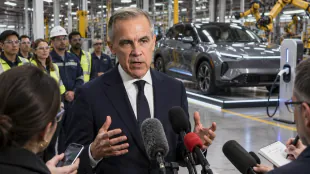 Canada Signals Openness to Chinese Automakers if US Trade Talks Fail

 US Mortgage Rate Falls for Fourth Week but Remains Above 7%

 13 Native American-Owned Restaurants in Arizona to Experience Indigenous Culinary Traditions

 Best Digital Photo Frames 2026: Aura, Skylight, and Amazon Compared

 UK Economy Grows 0.7% in Third Quarter as Services Lead Expansion

 India's Retail Inflation Reaches 6.09% as Food Prices Accelerate

 China's October Activity Data Reveal a Weak Start to the Fourth Quarter

 South Korea Launches Probe into NewJeans Contract Controversy

 Helen Rees Reflects on Four Decades of South Africa's HIV Journey

Eurozone inflation rose in December as energy prices slightly ticked up, official data showed Tuesday, which experts said will likely push the European Central Bank to pursue its rate-cutting cycle more cautiously.
Consumer prices picked up to 2.4 percent last month, as predicted by analysts for Bloomberg and financial data firm FactSet, and up from 2.2 percent in November.
Core inflation -- which strips out volatile energy, food, alcohol and tobacco prices and is a key indicator for the ECB -- was stable at 2.7 percent.
The ECB is still expected to cut interest rates at the next monetary policy meeting on January 30, but with price pressures still present in the eurozone it will need to tread carefully despite the signs of economic weakness, analysts say.
"We project that the ECB will only cut rates once in the first half of this year, with additional cuts concentrated in the latter half of 2025," said Charlie Cornes, senior economist at UK-based Centre for Economics and Business Research.
December's rise comes after inflation in the 20-nation single currency area fell to a three-year low of 1.7 percent in September. Consumer prices have since been inching back up to above the ECB's target of two percent, the exact figure hit in October.
The higher reading is due to energy prices rising by 0.1 percent in December, a significant uptick after a fall of two percent in November.
Tuesday's data showed food and alcohol prices were stable at 2.7 percent last month, while services inflation rose by four percent last month, up slightly from 3.9 percent in November.
- 'Hopefully on target' -
Inflation in the eurozone has been brought firmly back down from the highs of more than 10 percent reached in late 2022 following Russia's invasion of Ukraine.
With weak economic growth, the ECB had turned its attention last year to cutting rates to combat the signs of weakness in the European economy.
In December, the ECB reduced its key deposit rate by a quarter point to three percent, its third cut in a row and fourth since June, when it kicked off its current easing cycle.
Experts warned they expected inflation to accelerate further, which would encourage more prudence from the ECB.
"A further increase in the first quarter looks likely. This will keep the European Central Bank on a cautious easing path," said Peter Vanden Houte, an economist at ING Bank.
ECB chief Christine Lagarde insisted in a New Year's message that the bank would focus on further reining in inflation this year.
"We have made significant progress in 2024 in bringing down inflation and hopefully 2025 is the year when we are on target as expected and as planned in our strategy," Lagarde said in a January 1 video on social media platform X.
Inflation rose in the eurozone's two biggest economies, Germany and France, to reach 2.8 percent and 1.8 percent respectively in December.
Eurostat data also showed Ireland had the lowest rate of inflation in December at one percent.
Other official data published on Tuesday showed unemployment in the eurozone stood at 6.3 percent in November.
B.Baumann--VB
