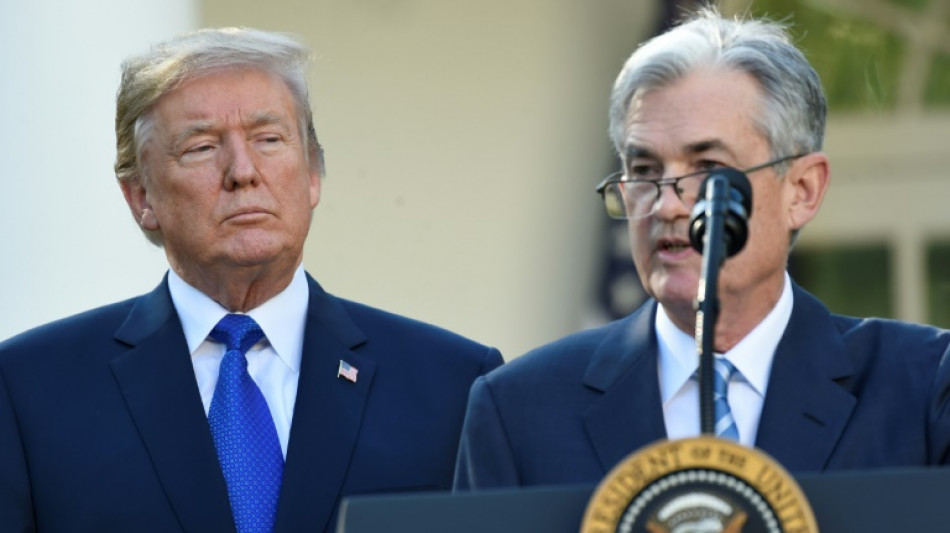
Trump victory poses challenges for the Fed's independence / Photo: © AFP

 Japan's Okinawa ousts anti-US base governor

 Tech firms hit by AI slowdown call with Fed expected to hike rates
 US hosts G20 'energy abundance' talks amid Iran war shock

 Migrant workers flock to Indian Kashmir despite militant threats

 Incubator shortages, premature births strain Gaza's hospitals

 Canada's Carney seeks closer Europe ties to counter hostile US

 Polls open in Philippine Muslim enclave after deadly shooting

 DC's Kennedy Center faces bankruptcy, closure: media

 Shelton hungry for more Grand Slam chances after US Open disappointment

 Bills edge Texans while Bears beat Panthers in NFL record-setting opener

 Zverev holds off Shelton to win US Open title

 Torres fires PSG to first win of Ligue 1 season

 Toulouse back on track after hammering Bordeaux

 Referee body admits 'error' for Haaland goal in Manchester derby

 Sweden's election too close to call as far right loses ground

 Is it possible to slow down the development of AI?

 Jefferson-Wooden bags searing sprint double, Dos Santos on fire

 'Practical Magic 2' breaks Spidey spell over N. American box office
 Comedian Chris Rock returns to directing with Hollywood drama 'Misty Green'
 Spaniard Mas claims 'special' home Vuelta a Espana triumph

 Jefferson-Wooden, Bednarek claim classy Ultimate sprint doubles

 Britain's Kerr wins men's Ultimate 1,500m

 Luckless Norris wants change in safety car rules

 Spaniard Enric Mas wins home Vuelta a Espana
 Mercedes boss Wolff says long future for 'cucumber cool' Antonelli

Donald Trump's return to the White House could put the independence of the US Federal Reserve under strain, potentially weakening its ability to fight against inflation and unemployment free from political interference.
The Fed has a dual mandate from Congress to act independently to tackle both inflation and unemployment -- primarily by raising and lowering interest rates.
Anything that undermines the Fed's independence could spook traders in the financial markets, who might come to question if it could effectively tackle inflation.
"The prevailing view for the past 30 years, with the exception of the first Trump administration, has been that it's best to give the Fed the widest possible latitude to conduct monetary policy," David Wilcox, a senior fellow at the Peterson Institute for International Economics (PIIE), told AFP.
"Monetary policy is complicated enough even without having to take that additional consideration," added Wilcox, a former senior advisor to three Fed chairs who is also Bloomberg's director of US economic research.
- Trump's 'better instincts'? -
The Federal Reserve System includes a decentralized network of 12 regional reserve banks and a seven-member Board of Governors in Washington.
Fed governors are nominated by the US president to serve staggered 14-year terms, and must be confirmed by the Senate.
The Fed chair and vice chairs are appointed from among these seven governors and, once appointed, cannot be removed without cause.
The Fed Board of Governors also plays a role in approving nominations to run the 12 regional reserve banks.
However, those nominations are made by the regional reserve banks' own directors, adding a layer of protection against too much meddling from the center.
Where a future President Trump can -- and very likely will -- have a significant influence over the Fed is in his choice of nominations.
Jerome Powell is scheduled to step down as Fed Chair in May 2026, and Trump is not expected to renominate him.
The president-elect is a fierce critic of Powell -- whom he first nominated to run the US central bank -- accusing him without evidence of supporting the Democrats, and once even questioning if he was a bigger enemy than Chinese President Xi Jinping.
The president-elect has also said he has "better instincts" on the economy than many Fed governors, and argued that the US president should have "at least" a say setting interest rates.
But once Powell steps down as Fed Chair, he will remain a governor until 2028, should he choose to stay on, complicating Trump's nomination process.
To replace him with someone not currently on the board, Trump must either pressure an existing governor to quit, or replace Fed governor Adriana Kugler when her term expires in January 2026, and then nominate her replacement to the top job.
- 'Outsized influence' -
Given the "outsized influence" wielded by the US central bank chair, the next Trump-appointed Fed chief "could change the dynamic and the independence of monetary policy," Nationwide chief economist Kathy Bostjancic told AFP.
"If someone is nominated and appointed and are seen to have political leanings, and it allows them to influence their monetary policy decisions, then that would become quite messy for the Federal Reserve," she said.
But even with Trump's Republican Party back in control of the Senate, the next Fed Chair is still likely to receive plenty of scrutiny, Steve Englander, Standard Chartered's head of North America macro strategy, told AFP.
"It's not like you can pick a name out of a hat and drop him into the Senate, he gets confirmed the next day, and he's voted in the day after," he said.
Senators "take their role very seriously," he added.
A final backstop also exists in the bond markets, which take into account expectations of where the Fed's interest rates will be in the future, and which impact borrowing rates on everything from mortgages to car loans.
"You can't appoint someone 180 degrees out of the mainstream...because the bond market will reject that immediately," Englander said.
"The bond market is a guardrail," he added. "There's a limit."
C.Kreuzer--VB