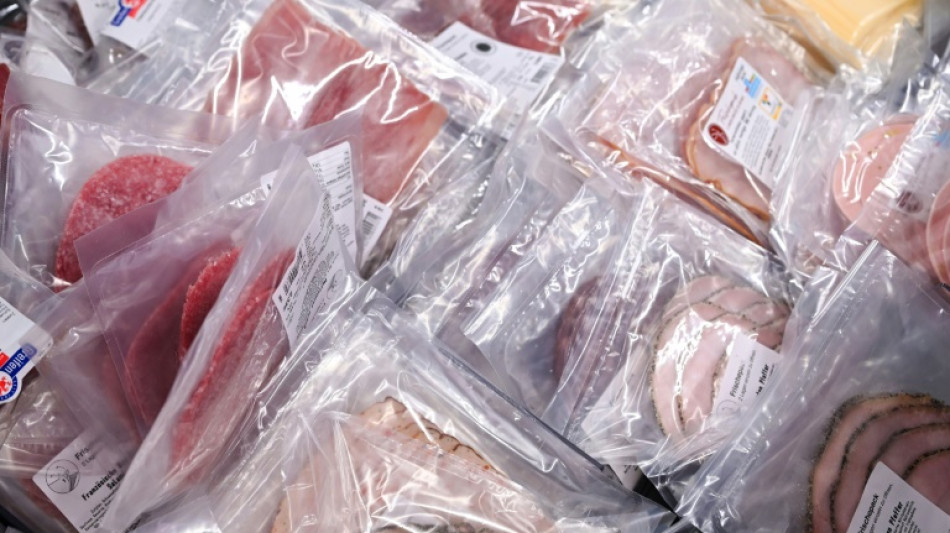
Plastics: navigating the maze of dizzying acronyms / Photo: © AFP

 Marchand 'stressed' about racing Japanese rivals at LA Olympics
 Mobile boat clinics bring healthcare to India's remote islands
 Former India paceman Zaheer Khan named Chennai coach in IPL

 Six-year-old Chinese girl sets world record with Rubik's Cube

 Swimming prodigy Yu, 13, says 'interviews way harder than racing'

 Star coaches make their bows as Nations League returns
 Rams bounce back as Giants reel from Dart injury

 In Bangladesh, Pakistan's Jinnah photo stirs anger

 Two New Zealand naval ships transit Taiwan Strait

 Zidane gets down to work as France start new era

 Inside the Venezuelan prison meant to 'drive you insane'
 UK king braces as memoir by Diana's brother goes on sale

 No green light to lift EU sanctions on Russian oligarchs, talks to resume

 UK agrees support for Saudi in struggle with Houthis: reports

 EU foreign policy chief calls for continued sanctions on Russia

 Flights scrapped, evacuations urged as Typhoon Dujuan wallops Japan

 Fonseca to take break from tennis

 A Cuban zoo, and its animals, in epic battle for survival

 Infantino proposes consulting federations to reform FIFA

 El Nino weather pattern enters record territory: scientist

 OpenAI calls for US to lead global effort on AI standards

 South African ostriches plucked alive for luxury fashion: report
 US networks halt Trump coverage in revolt over White House ban

 Paramount settles with US states to clear Warner Bros. mega-merger

 Climate crisis a job for world leaders, not just activists: UK FM

Plastics are all around us -- from food packaging and drinking bottles to the insulation in our homes.
They are mostly all derived from fossil fuels like oil and natural gas, but what are the key differences between each type of plastic?
Here is a brief guide to the most commonly used plastics and their acronyms, as classified by the Organisation for Economic Cooperation and Development (OECD).
- Three main families -
Thermoplastics are the most common plastics, because they are so malleable when heated, and can be remelted.
Elastomers, meanwhile, can be stretched to a great extent and then regain their original form.
And thermosets are resins that become irreversibly hard when heated.
Within each family, an infinite number of polymers are mixed with a wide range of additives that are sometimes harmful to the environment or health.
These additives can change the colour of plastics, prevent ageing, make them flexible, increase impact resistance, or reduce flammability.
- PP -
Polypropylene, or PP, is the most widespread plastic in the world (16 percent), developed in the mid-1950s and used for automobile parts and food packaging as well as disposable trays.
- HDPE and LDPE -
High and low density polyethylenes each represent 12 percent of global plastic use, according to the OECD.
HDPE, invented in 1933 by British engineers, is used for toys, shampoo bottles, pipes, engine oil cans and a variety of household objects.
LDPE, developed later in the 1950s, is widely used to manufacture flexible products such as reusable bags and food packaging film.
- PVC -
Polyvinyl chloride (PVC) is mainly used in construction for window frames, floor covering, pipes or cable insulation. It represents 11 percent of global plastic.
- PS -
Polystyrene (PS), invented in 1931 by IG Farben, represents five percent of the world's plastic and is mainly used for food packaging.
In its unexpanded form, it is used for yoghurt packaging or in construction.
Expanded, it is used to package fish or for insulation in construction.
- PET -
Also representing five percent of plastic worldwide, polyethylene terephthalate (PET) is the most widely used plastic for drink bottles in their transparent form (water, sodas) and sometimes opaque versions for products such as long-life milk.
- PUR -
Polyurethane (PUR), developed in 1937 by Otto Bayer, is used in insulation and mattresses and represents four percent of the world's plastic.
It is mainly used in refrigerator insulation, as padding foam in buildings, for adhesives, various coatings, shoe soles and in composite wood panels or surfboards.
- Other types -
In all, these represent 22 percent of all plastic and include ABS (acrylonitrile, butadiene, styrene) used for tires, PBT (polybutylene terephthalate), PC (polycarbonate), PTFE (polytetrafluoroethylene) and PMMA, another name for plexiglass.
- Bio-based plastics -
This group is made from biomass such as corn, sugar cane, wheat or other residues, and not from petroleum products.
Their production generates fewer greenhouse gas emissions than fossil-based plastics but while their volume is increasing, it isn't keeping pace with other types of plastic.
- Fibres -
Fibres made of different polymers are used in the textile industry and represent 13 percent of all plastics globally.
C.Kreuzer--VB