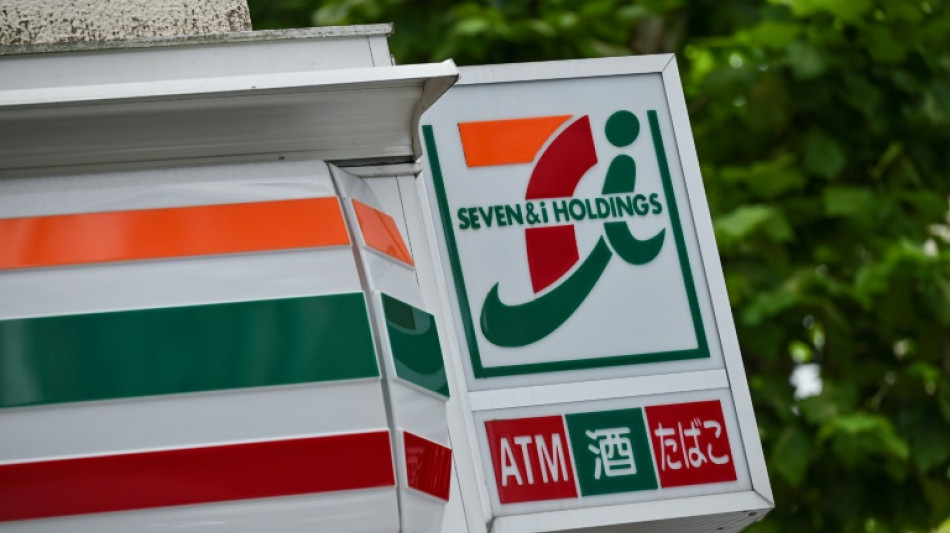
Japan ranks 7-Eleven owner 'core' industry, complicating takeover / Photo: © AFP

 Arizona Superintendent Tom Horne to Leave Office, Plans Law Practice and Charter School

 Japan and Peru Mark 150 Years of Diplomatic Ties Amidst Trade and Investment Talks

 Ian Jackson Scores Game-High 22 Points After Rick Pitino's Prank Suspension

 Khan Welcomes Milburn’s Youth Employment Reforms Amid High NEET Rates

 Shinde Clarifies Torn Photo Controversy Amid Sonia Gandhi Book Protest

 BMW i3 vs Mercedes C-Class Electric vs Hyundai Ioniq 6: The Ultimate Premium EV Showdown

 BING X: 22,624.66 SNC have disappeared at BingX – how safe are tokens on BingX? Will BingX’s MiCAR licence be suspended?
 Urban Company Raises Rs 2,500 Crore via QIP to Expand InstaHelp
The Japanese finance ministry on Friday designated the parent company of 7-Eleven a "core" industry in a move that could make a takeover by Canadian rival Couche-Tard more difficult.
Other entities rated "core" in Japan include manufacturers in the nuclear, rare earths and chip industries, as well as cybersecurity and infrastructure operators.
Last week Seven & i -- Japan's biggest retailer, which owns the global 7-Eleven convenience store chain -- rejected an initial buyout offer from Alimentation Couche-Tard (ACT).
The Japanese company said the proposal, which roughly matched its market value of around $40 billion, "grossly undervalues" its business and could face regulatory hurdles.
Such a purchase, mooted since August, would be the biggest ever foreign takeover of a Japanese firm.
In response ACT, which owns the Circle K chain, said on Sunday it would pursue the buyout and was "highly confident that we have sufficient capacity to finance the transaction".
The finance ministry included Seven & i in a regular update on national security classifications of various companies.
"Core industries are those industries for which advance notification is required" because there is "a significant risk of damage to national security", Japan's Cabinet explains on its website.
The "advance notification" system means authorities have the power to issue a cease and desist order, including to foreign investors in certain cases.
As the world's biggest convenience store chain, 7-Eleven operates more than 85,000 outlets globally.
Around a quarter of those are in Japan where it is a beloved institution, selling everything from concert tickets to pet food and fresh rice balls.
While the brand began in the United States, it has been wholly owned by Seven & i since 2005.
Seven & i Holdings also includes major supermarket operator Ito-Yokado and restaurant operator Denny's Japan.
It is the second-largest shareholder of Tower Records, a once-popular US record store that went bankrupt, making it one of its affiliated companies.
In the year to February 2024 the group posted a net profit of 224 billion yen ($1.7 billion).
ACT operates more than 16,700 outlets in 31 countries and territories.
P.Staeheli--VB
