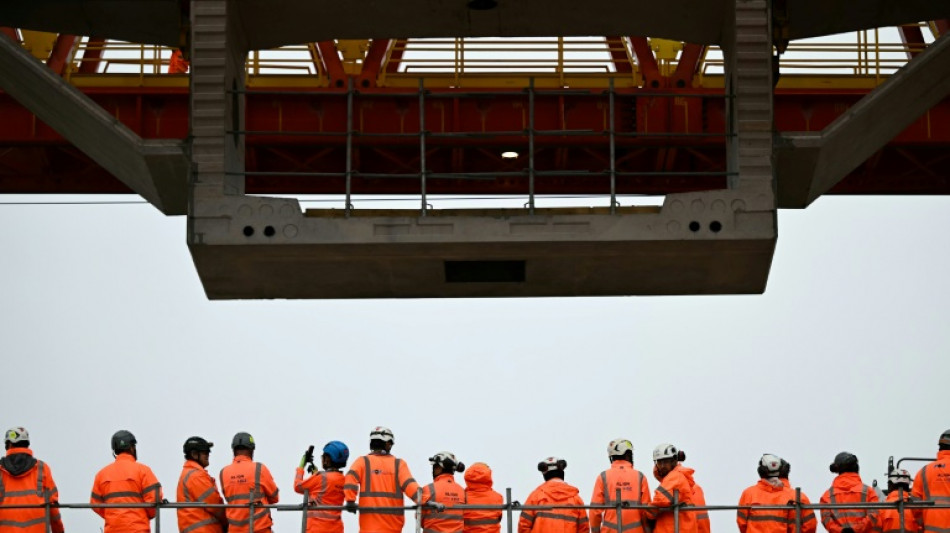
UK meets bridge milestone on new high-speed rail track / Photo: © AFP

 Saudi PIF Retains Top Sovereign Wealth Fund Brand Title for Third Year

 Phoenix Weekend Guide: Sangria Socials, Pie Markets, and New Brunch Spots

 Trent Perry’s Late Heroics Lift No. 7 UCLA Past Cal State Fullerton

 2027 Hyundai Elantra Review: Brutalist Design and Expanded Dimensions

 Malta Maritime Forum Study Reveals €1 Billion Economic Contribution Amid Growth Concerns

 China Condemns Chile-Belgium Joint Bid for High Seas Treaty Headquarters

Britain on Thursday finished building its longest-ever rail bridge after fitting the final segment of the Colne Valley Viaduct for the new high-speed HS2 train line, company bosses announced.
The curved 3.4 kilometre-long structure northwest of London is set to carry high-speed trains running to and from the capital at speeds of up to 320 kilometres per hour, HS2 Ltd said in a statement.
It surpasses in length the 3.3-kilometre Tay Bridge linking Fife and Dundee in Scotland, a record that stood since 1887.
"Lowering the Colne Valley Viaduct's final deck segment into place today marks the culmination of more than 10 years of planning, design and construction," said HS2 senior project manager Billy Ahluwalia.
The bridge is made of 1,000 pre-cast segments which support its 54 arches and that will carry the high-speed line up to 10 metres above land and water.
The HS2 project has been mired in controversy owing to spiralling costs that saw the previous Conservative government axe key legs of the railway planned for northern England.
Originally to have run between London in southeast England and Manchester in the north, the project was drastically altered last October.
That came after the project's costs almost trebled to more than an estimated £100 billion ($132 billion), in part owing to a surge in inflation.
The remaining route, linking London to Birmingham, is not expected to open until 2029 at the earliest -- and could still end up costing £67 billion, according to an official estimate made in February.
At the same time, parliament's cross-party Public Accounts Committee strongly criticised the scaled-down plans, claiming they delivered "very poor value for money".
High Speed 2 is Britain's second such fast track, after the line that carries Eurostar trains from London to the Channel Tunnel, which in turn links the country with France.
F.Wagner--VB

