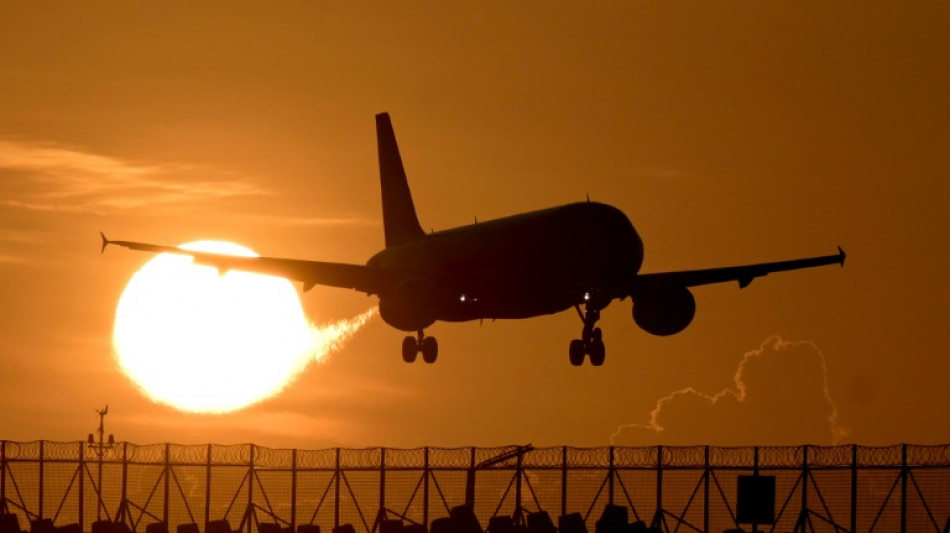
Flying's never been safer, says MIT study / Photo: © AFP/File

 Daily Horoscope November 20, 2026: Astrological Predictions for All Signs

 Desire Under the Elms review - a horror show that bruises more than it moves

 Saudi PIF Retains Top Sovereign Wealth Fund Brand Title for Third Year

 Phoenix Weekend Guide: Sangria Socials, Pie Markets, and New Brunch Spots

 Trent Perry’s Late Heroics Lift No. 7 UCLA Past Cal State Fullerton

 2027 Hyundai Elantra Review: Brutalist Design and Expanded Dimensions
Flying can be a nerve-wracking experience for many people -- but a new study out Thursday finds commercial air travel keeps getting safer, with the risk of death halving every decade.
The fatality rate fell to 1 per every 13.7 million passenger boardings globally in the 2018-2022 period, a major improvement from 1 per 7.9 million boardings in 2008-2017, according to a paper by researchers from the Massachusetts Institute of Technology (MIT).
It's also a far cry from the dawn of commercial air travel: fatalities per passenger were 1 per 350,000 boardings in 1968-1977.
"Aviation safety continues to get better," said MIT professor Arnold Barnett, who co-authored the research that appeared in the Journal of Air Transport Management, adding the chance of dying "continues to go down by a factor of two every decade."
Barnett compared the trend to "Moore's Law," the famous prediction by Intel founder Gordon Moore that the computing power of chips doubles roughly every 18 months.
From 1978-1987 the risk of dying was 1 per 750,000 boarding passengers; from 1988-1997 it was 1 per 1.3 million; and in 1998-2007, 1 per 2.7 million.
The last major commercial airline disaster in the United States was in 2009, when Colgan Air flight 3407 crashed, killing 50 people.
Barnett cautioned however that ongoing progress is not assured. Recent near-collisions on US runways this year have made headlines, while federal investigators have been pressing Boeing on why a door-plug aboard a 737 MAX 9 aircraft came off mid-flight on an Alaskan Airlines plane in January.
Headline numbers also obscure vast global disparities in air safety, with the study dividing countries into three tiers based on their safety records.
The top tier includes the United States, European Union countries and other European nations including Montenegro, Norway, Switzerland, and the United Kingdom. Australia, Canada, China, Israel, Japan and New Zealand round out this group.
Tier two consists of Bahrain, Bosnia, Brazil, Brunei, Chile, Hong Kong -- counted distinctly from China -- India, Jordan, Kuwait, Malaysia, Mexico, the Philippines, Qatar, Singapore, South Africa, South Korea, Taiwan, Thailand, Turkey and the United Arab Emirates.
The world's remaining countries fall into tier three. Encouragingly, although the risk of dying is far greater in these countries, their air travel fatalities per boardings were also cut roughly in half during the 2018-2022 period.
C.Bruderer--VB


