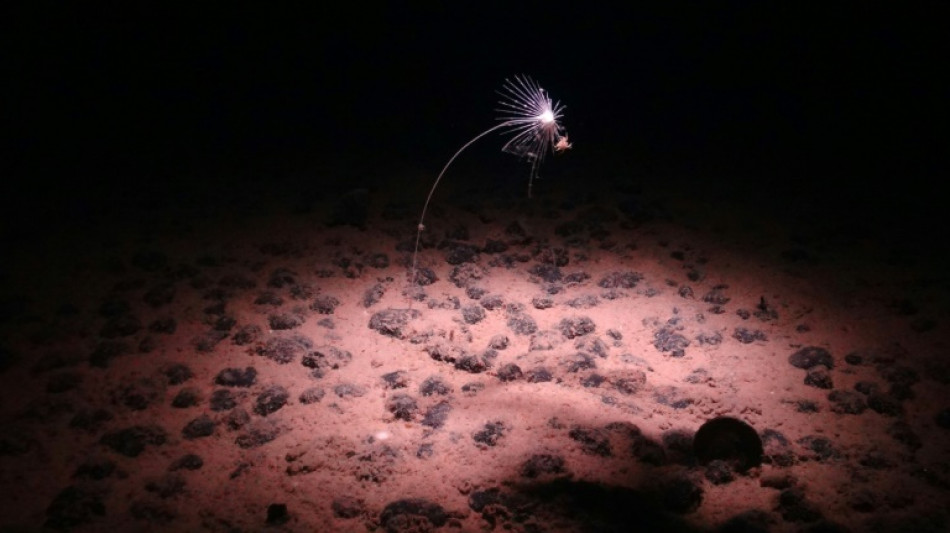
Deep ocean 'dark oxygen' find could rewrite Earth's history / Photo: © National Oceanography Centre / Smartex project (NERC)/AFP/File

 AI bosses head to White House as safety pressure builds

 Batista sacked as Costa Rica coach after six months

 Flooding, power cuts and evacuations as Hurricane Polo slams Mexico

 Dodgers eye three-peat, Red Sox face Yankees as MLB playoffs begin

 Certification of Boeing 737 MAX delayed by software bug

 Celine Dion wows Paris Fashion Week with surprise gig

 AMD buys firm founded by AI 'godmother' Fei-Fei Li

 Italy rebound in Turkey as France win late in Belgium

 Pope says concerns about AI 'should be taken seriously'

 Hurricanes to hoist title banner as NHL season begins

 Justice Alito steps aside from major US climate case

 Willis happy with England exile after retains Top 14 player award

 Spain housing protests keep heat on government as PM seeks new law

 Wissa spoils Zimbabwe homecoming as DR Congo win AFCON qualifier

 UK police release on bail five men held over airbase incident

 Ex-All Black Plummer 'sure' New Zealand will find Super Rugby solution

 Shein sees 1% revenue growth in first half of 2026

 Netherlands regrets Israel retaliation in settlements row

 Moscow seizes Russian assets of German food retailer Metro

 Bulgarian spirits inflamed by new rakia rules

 Documentary turns camera on architect Peter Zumthor

 UK police say releasing on bail five men held over airbase incident

 Trump admin finalizes reversal of US fuel economy standards

 US says no China arms sale plans after envoy cites Trump offer

 Dozens kidnapped in two weekend attacks in northern Nigeria

In the total darkness of the depths of the Pacific Ocean, scientists have discovered oxygen being produced not by living organisms but by strange potato-shaped metallic lumps that give off almost as much electricity as AA batteries.
The surprise finding has many potential implications and could even require rethinking how life first began on Earth, the researchers behind a new study said on Monday.
It had been thought that only living things such as plants and algae were capable of producing oxygen via photosynthesis -- which requires sunlight.
But four kilometres (2.5 miles) below the surface of the Pacific Ocean, where no sunlight can reach, small mineral deposits called polymetallic nodules have been recorded making so-called dark oxygen for the first time.
The discovery was made in the Clarion-Clipperton Zone (CCZ), an abyssal plain stretching between Hawaii and Mexico, where mining companies have plans to start harvesting the nodules.
The lumpy nodules -- often called "batteries in a rock" -- are rich in metals such as cobalt, nickel, copper and manganese, which are all used in batteries, smartphones, wind turbines and solar panels.
The international team of scientists sent a small vessel to the floor of the CCZ aiming to find out how mining could impact the strange and little understood animals living where no light can reach.
- No sunlight required -
"We were trying to measure the rate of oxygen consumption by the seafloor," lead study author Andrew Sweetman of the Scottish Association for Marine Science (SAMS) told AFP.
To do so, they used a contraption called a benthic chamber which snatched up a bunch of sediment.
Normally, the amount of oxygen trapped in the chamber "decreases as its used up by organisms as they respire," Sweetman said.
But this time the opposite happened -- the amount of oxygen increased. This was not supposed to happen in complete darkness where there is no photosynthesis.
This was so shocking that the researchers initially thought their underwater sensors must have been on the blink.
So they brought up some nodules to their ship to repeat the test. Once again, the amount of oxygen increased.
They then noticed how the nodules were carrying a startling electric change.
On the surface of the nodules, the team "amazingly found voltages almost as high as are in an AA battery," Sweetman said.
This charge could split seawater into hydrogen and oxygen in a process called seawater electrolysis, the researchers said.
This chemical reaction occurs at around 1.5 volts -- around the charge of a AA battery.
- 'Exciting' -
SAMS director Nicholas Owens said it was "one of the most exciting findings in ocean science in recent times".
The discovery of oxygen produced outside of photosynthesis "requires us to rethink how the evolution of complex life on the planet might have originated," he said in a statement.
"The conventional view is that oxygen was first produced around three billion years ago by ancient microbes called cyanobacteria and there was a gradual development of complex life thereafter," Owens added.
But the team's discovery showed that "life could have started elsewhere than on land," Sweetman said.
"And, if the process is happening on our planet, could it be helping to generate oxygenated habitats on other ocean worlds such as Enceladus and Europa and providing the opportunity for life to exist?" Sweetman asked.
The study was published in the journal Nature Geoscience.
The work was partly funded by Canada's The Metals Company, which is aiming to start mining the nodules in the CCZ next year.
P.Keller--VB