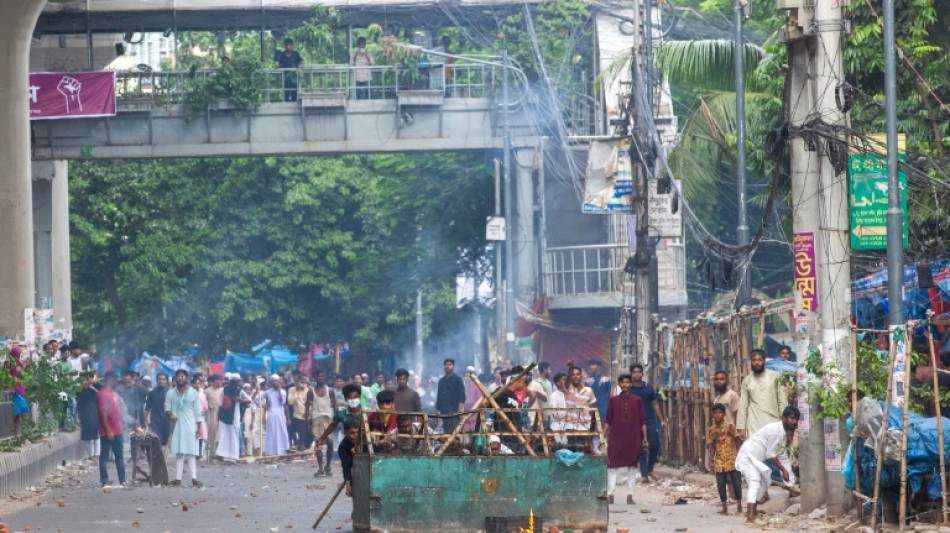
Bangladesh court winds back job quotas that sparked unrest / Photo: © AFP

 ALIX LASERS shareholders remove Michael Sobitsch as managing director in view of the circumstances

 Progressive Vision Wins Irish Healthcare Awards 2026 Innovation Prize for Office-Based Cataract Surgery

 Eight-Year-Old Georgia Wins Penrith Valley Public Speaking Competition

 Steven Berkoff on Memory and His New Autobiography 'Shouting At Night'

 Jimmy Carr Confirms 25-Year Estrangement From Father Amid Podcast Reflections

 Arizona Superintendent Tom Horne to Leave Office, Plans Law Practice and Charter School

Bangladesh's top court on Sunday pared back, but fell short of public demands to abolish, contentious civil service hiring rules that sparked nationwide clashes between police and university students that have killed 151 people.
What began as a protest against politicised admission quotas for sought-after government jobs snowballed this week into some of the worst unrest of Prime Minister Sheikh Hasina's tenure.
Soldiers are patrolling cities across Bangladesh after riot police failed to restore order, while a nationwide internet blackout since Thursday has drastically restricted the flow of information to the outside world.
The Supreme Court was due to decide next month on the legality of the recently reintroduced scheme that reserves more than half of government jobs for select applicants, but brought forward its verdict as the civil strife intensified.
It decided that a lower bench's order last month to reintroduce the scheme was "illegal", Bangladeshi Attorney General A.M. Amin Uddin told AFP.
Shah Monjurul Hoque, a lawyer involved in the case, told AFP that the court had also asked protesting students "to return to class" after issuing its verdict.
The ruling curtailed the number of reserved jobs, from 56 percent of all positions to seven percent, but fell short of meeting protester demands.
It reserved five percent of all government jobs for the children of "freedom fighters" from Bangladesh's 1971 liberation war against Pakistan, down from 30 percent.
One percent were reserved for tribal communities, and another one percent for people with disabilities or identifying as third gender under Bangladeshi law.
The remaining 93 percent of positions would be decided on merit, the court ruled.
The "freedom fighter" category in particular is a point of resentment for young graduates, with critics saying it is used to stack public jobs with loyalists to Hasina's ruling Awami League.
Students had called for the complete abolition of that category, along with other quotas for women and specific districts of the country.
- 'Our demand is one point' -
Opponents accuse Hasina's government of bending the judiciary to its will, and the premier had already hinted to the public this week that the court would issue a ruling favourable to student demands.
Hasina, 76, has ruled the country since 2009 and won her fourth consecutive election in January after a vote without genuine opposition.
Her government is accused by rights groups of misusing state institutions to entrench its hold on power and stamp out dissent, including by the extrajudicial killing of opposition activists.
But after the mounting crackdown and a rising death toll, it remains to be seen whether the court's verdict would mollify white-hot public anger.
"It's not about the rights of the students anymore," business owner Hasibul Sheikh, 24, told AFP at the scene of a Saturday street protest, held in the capital Dhaka in defiance of a nationwide curfew.
"Our demand is one point now, and that's the resignation of the government."
- 'Made the situation worse' -
With some 18 million young people in Bangladesh out of work, according to government figures, the quota scheme's reintroduction deeply upset graduates facing an acute jobs crisis.
Hasina inflamed tensions this month by likening protesters to the Bangladeshis who had collaborated with Pakistan during the country's independence war.
"Rather than try to address the protesters' grievances, the government's actions have made the situation worse," Crisis Group's Asia director Pierre Prakash told AFP.
Since Tuesday, at least 151 people, including several police officers, have been killed in clashes around the country, according to an AFP count of victims reported by police and hospitals.
- Curfew extended -
Police have arrested several members of the main opposition Bangladesh Nationalist Party (BNP) and Students Against Discrimination, the main protest organising group.
Bangladesh home minister Asaduzzaman Khan told AFP that the curfew imposed on Saturday would continue "until the situation improves".
He said that in addition to the torching of government buildings and police posts by protesters, arson attacks had left Dhaka's metro rail network inoperable.
"They are carrying out destructive activities targeting the government," Khan said, blaming the BNP and the Islamist party Jamaat for stoking the violence.
The US State Department warned Americans on Saturday not to travel to Bangladesh and said it would begin removing some diplomats and their families from the country due to the civil unrest.
D.Bachmann--VB

