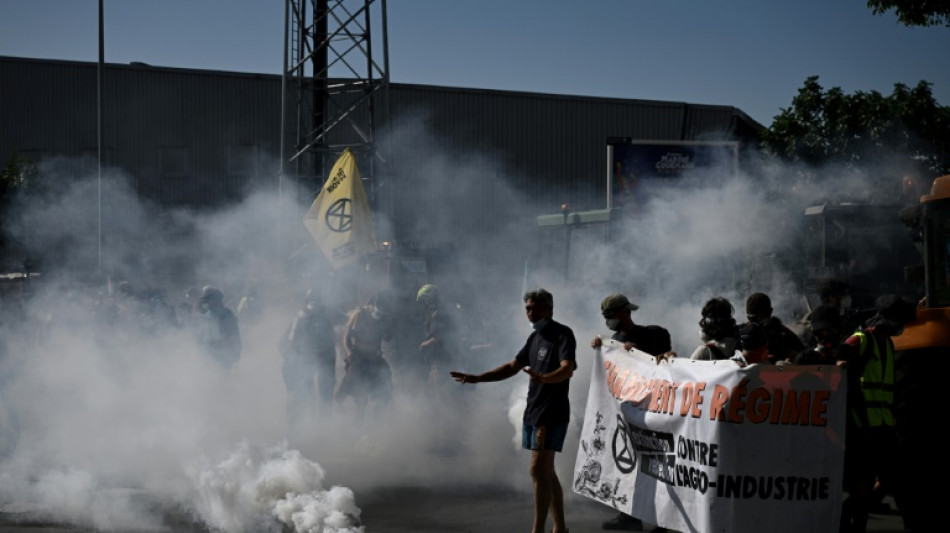
French police clear water demonstrators from port blockade / Photo: © AFP

 ALIX LASERS shareholders remove Michael Sobitsch as managing director in view of the circumstances

 Progressive Vision Wins Irish Healthcare Awards 2026 Innovation Prize for Office-Based Cataract Surgery

 Eight-Year-Old Georgia Wins Penrith Valley Public Speaking Competition

 Steven Berkoff on Memory and His New Autobiography 'Shouting At Night'

 Jimmy Carr Confirms 25-Year Estrangement From Father Amid Podcast Reflections

 Arizona Superintendent Tom Horne to Leave Office, Plans Law Practice and Charter School

French police removed demonstrators from the western port of La Rochelle with tear gas Saturday, as environmentalists and small farmers mobilised against massive irrigation reservoirs under construction.
Around 200 people had entered the La Pallice port terminal at dawn, including farmers with old tractors, setting up a street party with music and drinks outside a major grain trader's facility.
More than a dozen police vans and an armoured vehicle pushed them out during the morning in a cloud of tear gas, while other police vehicles blocked off access to the port.
The protest in the city on France's Atlantic coast was intended to show that new "reservoirs aren't being built to grow food locally, but to feed international markets," said Julien Le Guet, a spokesman for the Bassines Non Merci (Reservoirs, No Thanks) movement.
Activists charge that the reservoirs, set to be filled from aquifers in winter to provide summer irrigation, benefit only large farmers at the expense of smaller operations and the environment.
Several dozen are under construction in western France, with backers saying that without them farms risk vanishing as they suffer through repeated droughts.
Last year, mass clashes between thousands of demonstrators and police in Sainte-Soline, around 90 kilometres (56 miles) inland from La Rochelle, left two protesters in a coma and injured 30 officers.
France's top court later overturned an attempted government ban on the Soulevements de la Terre (Uprisings of the Earth, SLT) group involved in organising the protests.
Throughout this week more than 3,000 police have been deployed around a "Water Village" protest camp in Melle, a few kilometres from Sainte-Soline, with authorities warning of a risk of "great violence".
Organisers of two Saturday marches in La Rochelle itself -- banned by city authorities -- said they rallied around 6,000 people, with police numbering them at 3,500.
"Many individuals are equipped with balaclavas and protective masks," a police source told AFP, while the local prefecture warned that "several hundred radical individuals" were on the scene.
Some bus shelters, an insurance office and a supermarket were damaged and five people arrested by early afternoon.
The law enforcement response was "totally out of proportion," said Agnes Denis, who had travelled from Dijon in eastern France to join the protest with her partner.
"People's voices need to be heard, because if it's stopped every time we'll end up with a brawl, and that's not what we're here for," she added.
abo-jed-tsq-ni-tll/tgb/rlp
M.Schneider--VB

