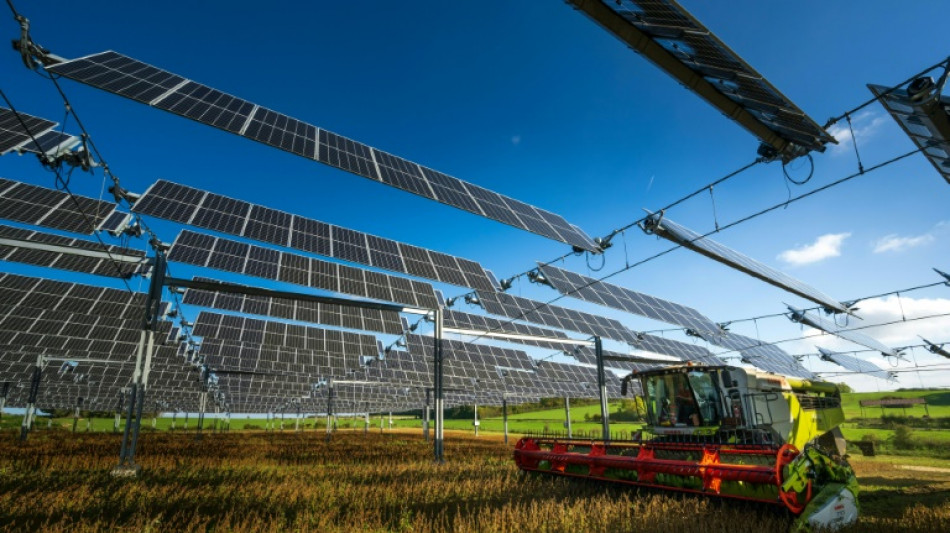
Renewable electricity to outstrip coal next year: IEA / Photo: © AFP/File

 ALIX LASERS shareholders remove Michael Sobitsch as managing director in view of the circumstances

 Progressive Vision Wins Irish Healthcare Awards 2026 Innovation Prize for Office-Based Cataract Surgery

 Eight-Year-Old Georgia Wins Penrith Valley Public Speaking Competition

 Steven Berkoff on Memory and His New Autobiography 'Shouting At Night'

 Jimmy Carr Confirms 25-Year Estrangement From Father Amid Podcast Reflections

 Arizona Superintendent Tom Horne to Leave Office, Plans Law Practice and Charter School

The amount of electricity produced from renewable sources worldwide is set to surpass output from coal-fired plants for the first time in 2025, the International Energy Agency said Friday.
The forecast comes as electricity demand is set to rise four percent this year and next, up from 2.5 percent in 2023.
That would be the highest annual growth since 2007, excepting spikes seen after the global financial crisis that began that year and during the Covid-19 recovery, the Paris-based agency said.
Soaring demand reflects "the growing role of electricity in our economies as well as the impacts of severe heatwaves," said Keisuke Sadamori, the IEA's director of energy markets and security.
Hydroelectric, solar, wind and other renewable sources are forecast to provide 35 percent of global supply next year, up from 30 percent in 2023, the agency said.
Solar alone is set to supply half the demand growth through 2025, with wind a further 25 percent.
Coal use is not expected to decline, however, as electricity use soars in China and India in particular, the IEA said.
Heatwaves across India are expected to lift electricity demand in the country by eight percent this year, while China's demand is expected to grow six percent.
European demand is set to climb 1.7 percent. In the United States, where mild weather saw demand decrease last year, electricity use is set to rise three percent this year -- not least as the development of artificial intelligence spurs the creation of massive data centres.
"It's encouraging to see clean energy's share of the electricity mix continuing to rise, but this needs to happen at a much faster rate to meet international energy and climate goals," Sadamori said in a statement.
He also urged officials to impose higher energy efficiency standards "to reduce the impacts of increased cooling demand on power systems".
S.Gantenbein--VB

