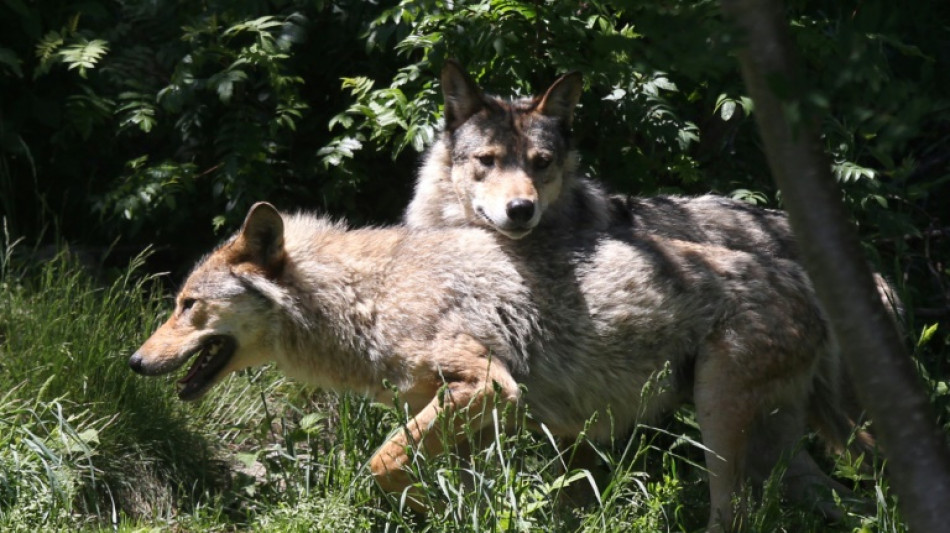
'Saint or devil': return of wolf stirs debate in Europe / Photo: © AFP

 Stocks move lower despite oil prices dropping

 AI driving up innovation investment: UN

 UN Security Council extends Haiti mission by 6 months

 Man Utd do not deserve medals if Man City stripped of titles: Rooney

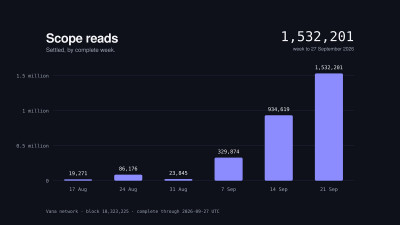 Vana Completes Expanded Staking as Part of the Vega Upgrade, Publishes Expanded VANA Token Economics

 Spain to cap gas price hikes, extend fuel discounts
 'We just need rain': Germany's Rhine river hits new low

 Yemen health system at 'breaking point': WHO

 Ireland undecided on second Israel match: coach

 France's Le Pen defiant after top ally hit by antisemitism claims

 Tom Cruise trades stunts for satire as toxic tycoon 'Digger'

 MEXC Unveils "WE SEE YOU" Brand Visual Refresh, Putting People Behind Every Trade in Focus

 Thai capital cleans up after deadly floods

 NATO, EU allies rally to Estonia after 'sabotage' blamed on Russia
 Families demand justice for Cameroon's 'nightmare' wave of murdered women
 Tebas says Man City should face 'most severe' sanctions if guilty of rule breaches

 Pochettino calls Man City success 'a period of deception'

 Settler attack on West Bank village injures Israeli forces, drawing rare rebuke

 Mystery over UK airbase scare after reports no explosives found

 Spanish govt races to adopt housing law under protest pressure

 Estonia slams Russian 'sabotage' after arson attack on defence company

 Slovenia sees surge in '.si' sites after Trump hypes 'super intelligence'

 'Like a dream' for An as Games organisers 'sorry' for latest mix-up
 Tokyo suffers longest streak of rainy days on record

 Indonesia charges train driver over crash that killed 16 women

Who's afraid of the big bad wolf?
Well, quite a few European governments, it seems.
Grey wolves were virtually exterminated in Europe a century ago but now, thanks to conservation efforts, numbers have rebounded.
The predator's population growth has triggered howls of protest from farmers and concern from conservationists.
In 2023, there were breeding packs of grey wolves in 23 countries of the European Union, with a total population estimated at around 20,300 animals, bringing the elusive creatures into more frequent contact with humans.
Last year, European Commission President Ursula von der Leyen lost her beloved pony Dolly to a wolf who had crept into its enclosure on her family's rural property in northern Germany.
Brussels's top official insists it is not a personal vendetta, but now she has wolves in her sights.
Several months after the attack von der Leyen warned that "the concentration of wolf packs in some European regions has become a real danger especially for livestock".
And the European Commission asked EU member states to revise wolves' conservation status, taking it from "strictly protected" to just "protected".
Despite protests from animal protection activists, this would allow hunting to resume under strict regulation.
France is one of a pack of countries trying to deal with the population explosion.
Wolves had disappeared in the country by the 1930s but began returning in the 1990s.
France has recently registered a drop in the predator's population, the first in almost 10 years, but the number of wolf attacks is also on the rise.
- 'All kinds of abuses' -
The estimated number of wolves in France last year stood at just over a thousand, down nine percent from 2022. Wolves can be killed to protect flocks, but only under very specific conditions.
Around 20 percent are killed each year, and the authorities would like to simplify culling procedures.
Now, many experts are concerned that wolves will again be under threat.
"If we weaken protection, it would be possible to hunt wolves without justification and this would open the door to all kinds of abuses," said Guillaume Chapron, a researcher at the Swedish University of Agricultural Sciences.
Luigi Boitani, professor of zoology at the University of Rome, said "thinking that removing wolves solves everything is actually a dream and will not work."
He said that the focus should be on preventing attacks via electric fences and guard dogs, among other measures.
Boitani pointed out that other animals such as wild boar, deer and birds cause far more costly damage than wolves.
In France, compensation for damage caused by wolves amounted to four million euros ($4.3 million) in 2022 -- compared with 65 million euros in damage caused by wild boars and deer.
Wolf hunting was institutionalised in the ninth century, when Frankish king Charlemagne, known as the Father of Europe, established the "louveterie", a special corps of hunters responsible for eradicating harmful animals, to protect people and livestock.
The institution has endured in France, with the lieutenants de louveterie now working as volunteers.
- Mythical creatures -
The wolf became a "strictly protected" species under the 1979 Bern Convention.
Chapron said the move enabled the animal to reclaim the continent, pointing to "a growing awareness that the environment was becoming important."
Saving the animals is "a success story, and we don't have many conservation success stories", he added.
The beast is a common motif in ancient mythology and children's fairy tales portray wolves as threatening creatures.
"Wolves have been and remain an object of fascination for many human societies", said Nicolas Lescureux, who studies human-animal relations at France's CNRS scientific research centre.
He pointed to the role of the predator in ancient legends including a she-wolf who saved the twin founders of Rome; Fenrir, the monstrous wolf of Scandinavian mythology and the blue wolf, the mythical progenitor of the Mongols.
"The close relationship between humans and wolves goes back a very long way since our current dogs are descended from populations of wolves -- this is the oldest form of animal domestication," said Lescureux.
That relationship "undoubtedly became more complicated" with the domestication of livestock such as sheep, goats, cattle and pigs around 10,000 years ago, he said.
Boitani, one of the world's leading authorities on wolves, said it was important to avoid "any fundamentalism" as society seeks to tackle the problem.
"The wolf is not a saint, a secret animal or a devil," he added.
I.Stoeckli--VB