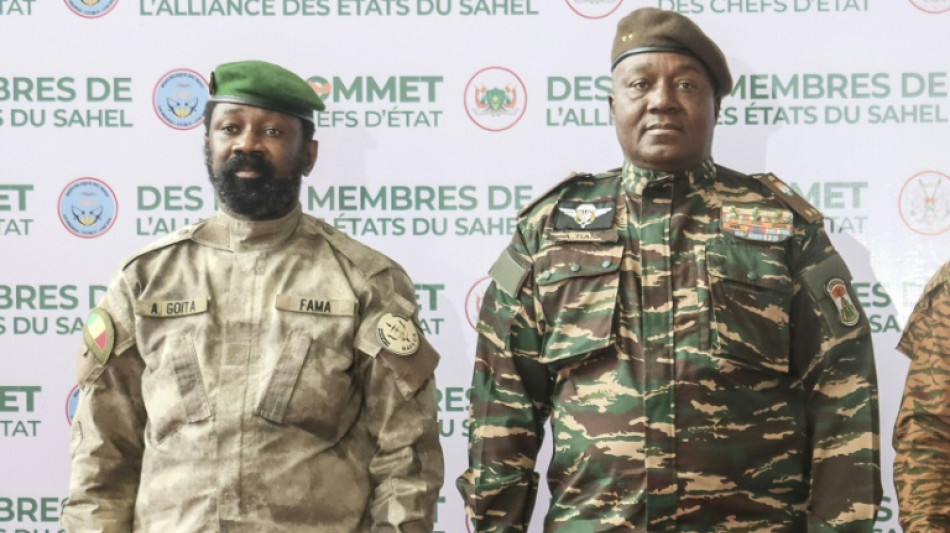
New Sahel bloc leaves West Africa more divided than ever / Photo: © AFP

 US government's new AI chatbot pulls back from debunking Trump

 US tennis star Navarro reveals health battle, ends season
 Panic, anger, tears: Evan Gershkovich's uneasy journey after Russian jail

 UK PM says 'strong indications' Iran involved in airbase incident

 Google restricts access to new AI model over safety concerns

 Watchdog clears former US Fed chief Powell in renovation probe

 Israel PM hails Indian pilot of rerouted flight for averting disaster
 Fury, Joshua kick off 'battle of Britain' in good spirits

 Ronaldo leaves Portugal training camp after coach says he is dropped

 Florence Pugh stars in 'East of Eden' adaption on Netflix

 Watchdog finds no criminal misconduct over US Fed renovations despite Trump probe

 In Manchester, City fans 'devastated' while rival fans call for relegation

 UK-France Channel migrant exchange deal scrapped: London

 Portugal boss denies 'incident' with Ronaldo

 Israel PM says one of the pilots of rerouted flight tried to crash plane

 Manchester City: Main points of damning judgement and possible sanctions

 Italy looking for 'identity' under Mancini says Scalvini
 The voices of Spain's housing camp protesters
 Romanian parliament rejects pro-EU PM candidate

 Court halts Tennessee's first execution of woman in 200 years

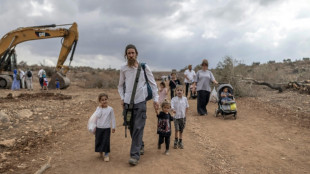 Israelis march between once-closed West Bank settlements
 'Welcome back,' says Macron, as UK PM opens door to EU return
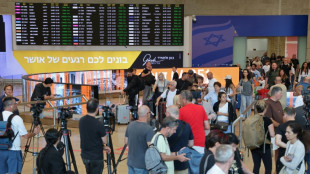 Israel PM says pilot of rerouted flight tried to crash plane

 Demuro hopes to deliver Japan a 'magical' Arc victory
 'Devastated' AI scandal author Orelien returns to Quebec
The creation of a Sahel confederation on Saturday plunged West Africa into an unprecedented crisis that could threaten the free movement of people and goods in the region.
Niger, Burkina Faso and Mali joined together to create the "Confederation of Sahel States" (AES) which will comprise some 72 million people.
The three countries said in January they were cutting ties with the Economic Community of West African States (ECOWAS) -- an organisation they accused of being manipulated by France, their former colonial ruler.
On the eve of ECOWAS's 50th anniversary, the bloc seems powerless to bring the Sahel countries back into its fold.
- Where does the crisis come from? -
The first tensions arose in 2020 and 2021 after the coups that brought Colonel Assimi Goita to power in Mali.
At the time, ECOWAS imposed heavy trade and financial sanctions on Bamako and suspended Mali from its membership.
The lifting of these sanctions in 2022 was not enough to warm relations especially as Bamako found an ally in neighbouring Burkina Faso, where two coups took place in 2022, and Niger, where a military leader took over last July.
For ECOWAS, Niger's coup was one coup too many.
It not only imposed sanctions against Niamey but also threatened military intervention for several weeks to restore deposed president Mohamed Bazoum.
This was enough to set the Sahel military governments on edge for good, as they have made sovereignty a cardinal point of their governance and accused ECOWAS of being subservient to France on which they have all turned their backs.
In January, all three announced they were leaving the West African organisation and on Saturday formalised their divorce by joining forces, despite the lifting of sanctions against Niamey in February.
- What impact on the population? -
On Sunday, ECOWAS warned against the "diplomatic and political isolation" of AES countries and the loss of millions of euros in investment.
Another concern is the worsening insecurity in the region, which is plagued by recurrent jihadist violence.
AES countries have long criticised ECOWAS for not helping them enough in the face of this scourge, and in March they set up their own joint force.
But the most concrete consequence could concern the free movement of goods and people within the region.
On Sunday, the head of the ECOWAS Commission, Omar Alieu Touray, warned that nationals of AES countries could in future have to apply for visas to travel to the rest of the region and face obstacles to the free establishment of businesses.
For Nigerien lawyer and political analyst Mahaman Bachar, this threat will not be enough to curb "the AES's desire to distance itself from ECOWAS", and "reciprocity" could be imposed by the Sahel countries.
"This would be the beginning of the break-up of the West African sub-regional institution and would be contrary to the ideals of the African Union," said Nigerien finance expert Boubacar Kado.
- Is the break-up irreversible? -
On Saturday, Niger's General Abdourahamane Tiani was quite clear on the subject.
"Our peoples have irrevocably turned their backs on ECOWAS," he said.
The three AES countries -- although deprived of access to the sea -- believe they can be self-sufficient within their confederation, pooling their resources in most of the key sectors of the economy.
As far as ECOWAS is concerned, there is no question of giving up.
Senegalese President Bassirou Diomaye Faye visited Burkina Faso and Mali in May and was appointed on Sunday as mediator with the AES countries.
"We cannot stand idly by. Our responsibility is to work to bring positions closer together, to reconcile them, to ensure that there can be a forum for dialogue", he said Sunday.
Faye called for "everything possible to be done to avoid the withdrawal of the three sister countries".
Ivorian political analyst Arthur Banga said Faye "has the freshness of a newly elected politician and certain connections (with the AES countries) in terms of revolution and change. He still has a tiny chance, but the trend is towards a break".
Nigerien lawyer and political analyst Bachar said negotiations will no longer be about returning to ECOWAS "but rather about how to salvage the furniture, how to establish mutually respectful relations between ECOWAS and the AES, which is now an entity in its own right".
- Can ECOWAS survive? -
At its summit on Sunday, the West African organisation acknowledged the risk of its "disintegration".
Burkina, Niger and Mali represent a market of 72 million inhabitants, almost a fifth of the regional bloc's population.
"ECOWAS has seen members leave in the past, like Mauritania (in 2000). Even with 12 countries, it remains powerful, notably with Nigeria, the most populous country in Africa, and Ivory Coast and Senegal," major economies in the region, Banga said.
L.Maurer--VB