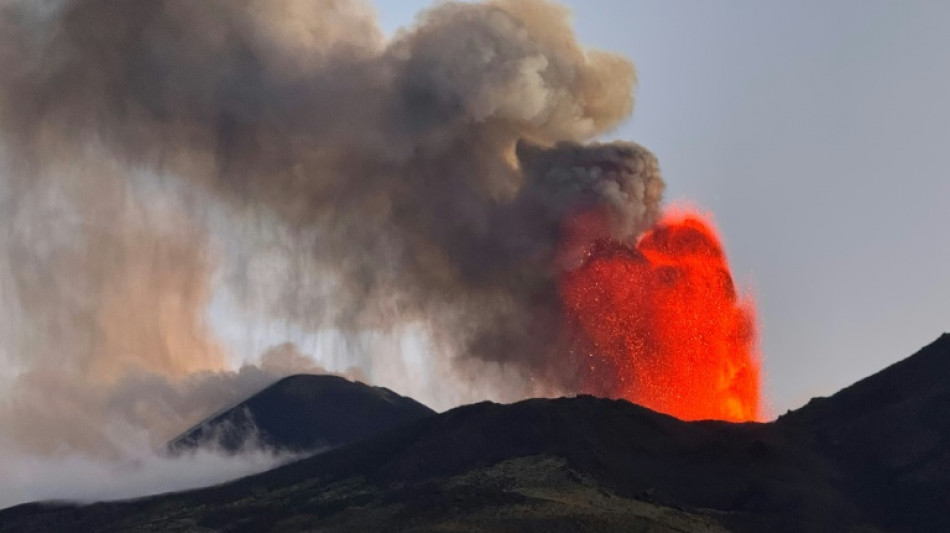
Flights suspended in Sicily's Catania as volcano erupts / Photo: © Etna Walk/AFP

 Pura Cyber Week Sale: 20% Off Fragrances and 30% Off Diffusers

 ALIX LASERS shareholders remove Michael Sobitsch as managing director in view of the circumstances

 Progressive Vision Wins Irish Healthcare Awards 2026 Innovation Prize for Office-Based Cataract Surgery

 Eight-Year-Old Georgia Wins Penrith Valley Public Speaking Competition

 Steven Berkoff on Memory and His New Autobiography 'Shouting At Night'

 Jimmy Carr Confirms 25-Year Estrangement From Father Amid Podcast Reflections
Catania airport on the Italian island of Sicily was closed on Friday after Mount Etna, the largest active volcano in Europe, erupted and spewed ash into the sky, disrupting air travel.
"The runway at Catania Airport is unusable due to volcanic ash fall: both arrivals and departures are suspended," the company managing the airport said in a statement.
Flights should resume at 3:00 pm (01:00 pm GMT), it said, asking travellers to check the status of their flights before heading to the airport.
Ash plumes shot up into the sky as high as 4.5 kilometres, Italy's National Institute of Geophysics and Volcanology (INGV) wrote on X, formerly Twitter, on Thursday.
Footage shared on social media Friday showed the streets of Catania's city centre covered in thick layers of black ash, slowing down traffic.
Mount Etna -- a soaring 3,324-metres high (10,905 feet) volcano -- has erupted multiple times in recent decades.
Over the last few days, its crater had started spitting out fountains of scorching lava and releasing ash that landed on Catania airport down below.
Italian authorities also issued a red warning for another volcano north of Sicily, Stromboli -- on the island of the same name -- whose eruption created ash clouds.
Mount Stromboli -- culminating at 920 metres and with a base reaching 2,000 metres below sea level -- is known for being one of the only nearly constantly active volcanoes in the world, according to the INGV.
Millions of passengers transit through Catania airport every year, connecting them to eastern Sicily, among Italy's most popular tourist hotspots.
D.Schlegel--VB


