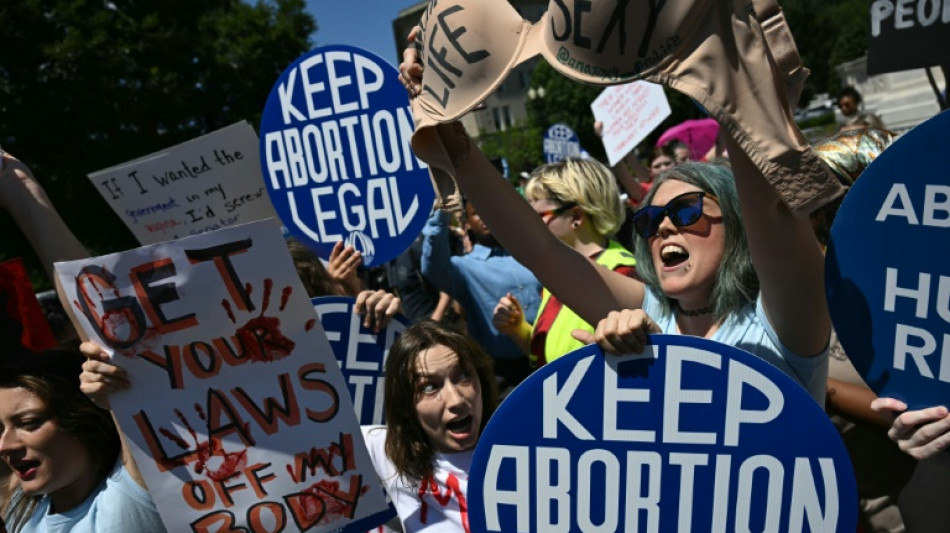
US abortion restrictions have unwanted knock-on effects: studies / Photo: © AFP

 Yamal on target as Spain hold off Czech Republic

 Latvian exit polls suggest pro-European choice

 Lula, Bolsonaro wrap up campaigns ahead of knife-edge election

 Tuchel hails 'complete' England after Croatia demolition

 Fury to invite Trump to lead ring walk before Joshua showdown

 Fashion industry in 'precarious moment', says Vivienne Westwood supremo

 Seventh heaven for England in Nations League rout of Croatia

 Storms, flooding cause chaos on Greek holiday island of Crete

 #IAmJaneDoe: online support campaign in US university rape case

 Brazil shine on Selecao's first visit to India

 Zverev sets up Djokovic quarter-final at China Open, Rybakina out

 Happier at home, Bordeaux hammer Lyon in Top 14

 Lula, Bolsonaro in final push for votes ahead of knife-edge election

 Boisterous fashion week barnstorms 'sleepy' Nigerian capital

 UAE investigators say flydubai co-pilot was planning 'terrorist act'

 Rahul smacks century in India v Windies ODI

 Daryz seeks to join exclusive club of dual Arc winners

 Russia warns diplomats to leave Kyiv over new strikes threat

 Olympic champ Zheng rebukes rowdy home crowd at China Open

 World No.1 Sinner pulls out of Shanghai Masters to delay return

 Red Bull's Verstappen grabs pole position for Bahrain GP

 India beat Pakistan in blockbuster as golfer Kim wins 'crazy' gold

 India beat arch-rivals Pakistan to win Asian Games cricket gold

 Ethiopia's Tigray rebels abandon regional capital as govt advances: journalist

 Tom Kim powers to Games gold and exemption from military service

Restrictions or outright bans on abortion implemented in some US states can have unexpected consequences like reduced access to contraceptives and higher infant mortality rates, two studies published this week warned.
The two studies come as the United States marks the second anniversary of the Supreme Court's historic decision to overturn constitutional protections on abortion, leaving each state to decide on the hotly contested issue.
The first study, published Wednesday in the Journal of the American Medical Association (JAMA), shows that in states where abortion is illegal, there is a corresponding significant drop in the number of birth-control and morning-after pills dispensed by pharmacies.
Birth-control pills, taken once a day, are the most widely used method of hormonal contraception in the country. The morning-after pill is an emergency contraceptive (EC), taken shortly after unprotected sex or when another method has failed.
For the study, researchers analyzed more than 143 million prescriptions written between March 2021 and October 2023.
They say the drop may be explained by the closing of family planning clinics where abortions were performed, and which also provided other reproductive health services, such as prescribing oral contraceptive pills (OCPs).
There is also confusion in some states as to whether morning-after pills remain legal, or are considered to be a method of abortion, the study said.
It noted that the US Food and Drug Administration (FDA) recently changed the label on one brand of morning-after pills to specify that it is not a means of abortion.
Other policies aimed at restricting access to contraception, such as authorizing pharmacists to decline to dispense such drugs if their use goes against their religious beliefs, could also be a factor, the experts said.
"Given the important role of OCPs and ECs in preventing pregnancy and the need for abortion, efforts to improve access may be needed, especially in states where legal abortion is no longer an option," researchers concluded.
- Family 'trauma' -
A second study published Monday in the same journal looked at how abortion restrictions have affected infant mortality rates.
It focused on a Texas law that came into effect in September 2021, which prohibited abortion after a fetal heartbeat could be detected -- putting about a six-week limit on the procedure, with no exceptions for congenital anomalies.
Researchers say that trends observed since the Texas law came into effect can inform what may also be happening in states where bans came after the 2022 Supreme Court ruling.
By reviewing death certificates, scientists noted a 12.9 percent increase in the number of deaths of babies under a year old in Texas from 2021 to 2022, as compared with a 1.8 percent rise when all states but Texas were considered.
Also from 2021 to 2022, researchers saw a 22.9 percent increase in Texas in the number of deaths of newborns that were linked to congenital illnesses -- the primary cause of infant mortality.
"These findings suggest that restrictive abortion policies may have important unintended consequences in terms of infant health and the associated trauma to families and medical costs," said Alison Gemmill, the study's main author and a professor at the Johns Hopkins Bloomberg School of Public Health.
Texas has since banned all abortions, except in cases where the mother's life is in danger.
But fear of prosecution has led some doctors in the Lone Star State to refuse to intervene even when patients experience serious complications during a pregnancy, according to testimony from women.
C.Bruderer--VB