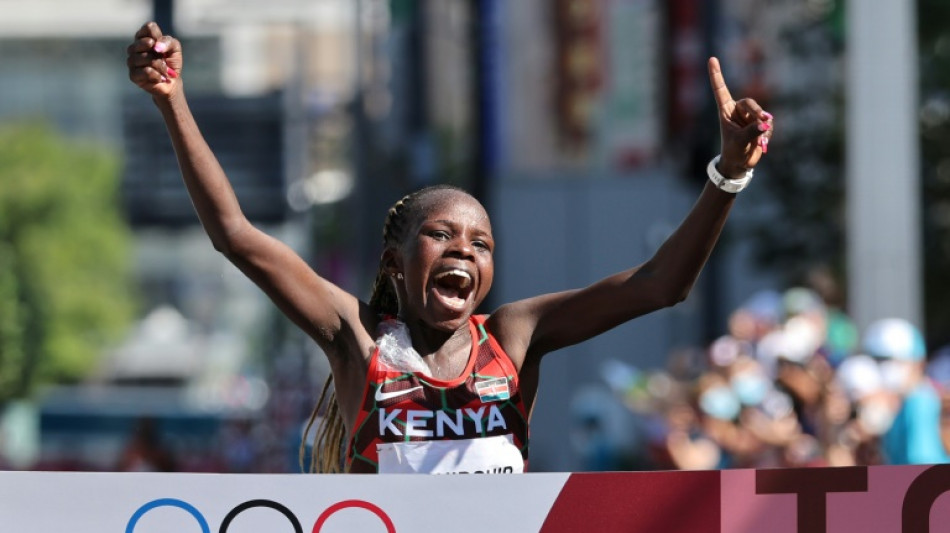
At Paris Olympics, women athletes finally reach parity / Photo: © AFP

 ALEX BODI AND AMBASSADOR GUM DOMINIC MATIOK OF THE REPUBLIC OF SOUTH SUDAN MEET IN BERLIN TO DISCUSS THE POSSIBILITY OF AN HONORARY CONSULATE IN BUCHAREST

 Lula, Bolsonaro wrap up campaigns ahead of Brazil's knife-edge vote
 Toulouse edge Castres in Top 14 derby
 Murakami homer propels White Sox to MLB playoff win over Guardians

 Israel targets top Hamas leader in deadly Gaza strike on anniversary

 Houthis say struck oil facility near Riyadh, as Saudis hit Sanaa
 AI needs safety layers like nuclear plants: ex-OpenAI engineer

 MVP Judge will miss Yankees' MLB playoff series against Rays
 New lizard species discovered in Peru

 Fernandes hails Portugal's 'greatest symbol' Ronaldo, calls for unity

 Grandidier-Nkanang double takes Pau to Top 14 summit despite Vannes fightback

 Trainer Scott gets perfect Arc boost with top notch double
 Ex-PM says Putin cannot admit 'mistake' over Ukraine
 Houthis say Saudi Arabia launches dozens of strikes on Yemen capital
 Qatar and Abu Dhabi F1 Grand Prix to go ahead - F1 boss

 South Korea lift gloom with smash-and-grab Games football gold
 Ireland news conference before Israel game cut short amid tensions

 Protests over housing flare in Spain after relief measures rejected
 Zverev thrashes Shang to set up Djokovic quarter-final at China Open

 Turkey football ref chief jailed pending trial for graft

 North Korea says test of intermediate-range strategic missile included use of AI
 Rampant Sayers leads Hong Kong to third men's rugby gold in a row

 Ethiopia's Tigray rebels abandon regional capital as govt advances
 Bulgaria's Tsar Samuel returns 'home' after 1,000 years
 'Glad it's over': Kim powers to Games gold and military exemption

Once seen as a "celebration of manly virtue" without women athletes, the modern Olympics will reach gender parity for the first time during this year's Paris Games, 128 years since its first edition.
When the ancient Greek event was revived by French aristocrat Pierre de Coubertin in the late 19th century, he saw it as a celebration of gentlemanly athleticism "with female applause as its reward."
In 1924, the last time the Olympics were held in Paris, just four percent of competitors were female and they were restricted to sports considered suitable for them, such as swimming, tennis and croquet.
"For the first time in Olympic history we are going to have gender parity on the field," Marie Sallois, IOC director in charge of gender equality, told journalists about the Paris 2024 Games on International Women's Day in March.
The milestone is the result of incremental jumps in female participation at each Games, mirroring broader societal trends in most parts of the world that have gradually opened up male-only domains from the board room to the voting booth.
"It took a very long time for us to finally get to 44 percent (of women) in London in 2012, the first edition at which women could take part in all the sports, then 48 percent in Tokyo (in 2021)," Sallois added.
- Men only -
The barriers for women were once so high that they were forced to compete in a rival "Women's Olympics" in the 1920s, before the event was absorbed by today's International Olympic Committee (IOC).
In 1928 in Amsterdam, they were allowed to compete in athletics for the first time, but the sight of exhausted female runners after the 800m final appalled male onlookers so much that they were excluded again.
Until 1968 -- forty years later -- women were barred from competing in any race of more than 200 metres, and even in 1976 women's events made up only a quarter of the Olympic programme.
Long considered unable to cope with the physical demands of the marathon, they were allowed to take part for the first time at the Los Angeles Games in 1984.
"We've come a long way over a relatively short space of time," the head of World Athletics, Sebastian Coe, said recently in Paris.
- Prime-time -
The Paris 2024 Olympics will not only feature as many women as men, it will also give greater prominence to women's events.
Instead of the men's marathon being the athletics event, leading up to the closing ceremony, it will be the women's event instead.
"We've made a lot of effort to organise the women's events to ensure they get visibility, meaning over the weekend when there are more viewers, or during prime-time," Sallois added.
For the opening ceremony, the IOC has also suggested each national delegation nominate two flag carriers, a man and a woman.
Sallois conceded elite sport still had lots of work to do to achieve genuine gender parity.
Among coaching staff at the last Olympics in Tokyo, just 13 percent of coaches were women.
Sports administration remains overwhelmingly male, including in national Olympic delegations and in the federations that run sports.
The IOC has never had a female leader and its membership -- made up of 106 delegates who vote on key decisions -- remains 59 percent male.
But the organisation has ensured gender parity on its internal commissions and the number of women members has increased significantly in recent years.
"The IOC needs to be a role model and set an example," Sallois added.
F.Stadler--VB