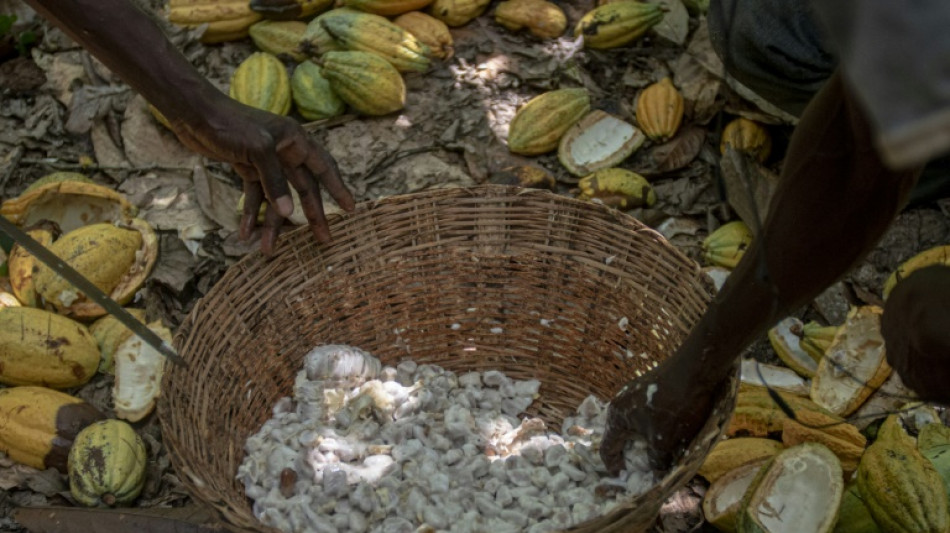
Ghana's cocoa farmers turn to smuggling as currency falls / Photo: © AFP/File

 ALEX BODI AND AMBASSADOR GUM DOMINIC MATIOK OF THE REPUBLIC OF SOUTH SUDAN MEET IN BERLIN TO DISCUSS THE POSSIBILITY OF AN HONORARY CONSULATE IN BUCHAREST

 Lula, Bolsonaro wrap up campaigns ahead of Brazil's knife-edge vote

 Toulouse edge Castres in Top 14 derby

 Murakami homer propels White Sox to MLB playoff win over Guardians

 Israel targets top Hamas leader in deadly Gaza strike on anniversary

 Houthis say struck oil facility near Riyadh, as Saudis hit Sanaa

 AI needs safety layers like nuclear plants: ex-OpenAI engineer

 MVP Judge will miss Yankees' MLB playoff series against Rays

 New lizard species discovered in Peru

 Fernandes hails Portugal's 'greatest symbol' Ronaldo, calls for unity
 Grandidier-Nkanang double takes Pau to Top 14 summit despite Vannes fightback

 Trainer Scott gets perfect Arc boost with top notch double

 Ex-PM says Putin cannot admit 'mistake' over Ukraine

 Houthis say Saudi Arabia launches dozens of strikes on Yemen capital

 Qatar and Abu Dhabi F1 Grand Prix to go ahead - F1 boss

 South Korea lift gloom with smash-and-grab Games football gold

 Ireland news conference before Israel game cut short amid tensions
 Protests over housing flare in Spain after relief measures rejected

 Zverev thrashes Shang to set up Djokovic quarter-final at China Open

 Turkey football ref chief jailed pending trial for graft
 North Korea says test of intermediate-range strategic missile included use of AI

 Rampant Sayers leads Hong Kong to third men's rugby gold in a row

 Ethiopia's Tigray rebels abandon regional capital as govt advances

 Bulgaria's Tsar Samuel returns 'home' after 1,000 years

 'Glad it's over': Kim powers to Games gold and military exemption

Ghanaian cocoa farmer Isaac Antwi says he has to smuggle his beans to Ivory Coast to sell them at a decent profit even as international prices for the commodity recently surged.
He is not the only farmer to have turned to illicit trade in the world's number two cocoa producer as the country's currency, the cedi, has fallen sharply and production costs have soared.
"With the cedi losing value every day, selling in Ghana just doesn't cut it," said Antwi, who lives in Suhum, in the Eastern Region, 74 kilometres (46 miles) from the capital, Accra.
"The prices are better across the border, and the stronger currency means I can feed my family and pay off my debts."
Ghana is emerging from one of it worst economic crisis in years after securing a $3 billion credit from the International Monetary Fund and restructuring most of its debt.
But the depreciation of the cedi, which has lost over 20 percent of its value against the dollar this year, has severely impacted the profitability of cocoa farming even as international prices topped $10,000 per tonne in March before receding in recent months.
Production costs have jumped, with fertilisers and other materials needed to farm becoming increasingly expensive.
Poor road networks have also inflated transportation costs, further squeezing farmers' margins.
Cocoa farmers are obliged to sell their produce to the state-run Ghana Cocoa Board or COCOBOD, which fixes prices to help protect farmers from market volatility.
In April, the government increased the cocoa price paid to farmers to $2,188 (33,120 cedi) per tonne, a 58.26 percent hike.
But this has not been enough to offset the rising costs and the lure of higher prices in Ivory Coast and Togo.
"If the government increased the cocoa price to match our neighbours, the smuggling would stop," said another Suhum farmer, Serwaa Adjei. "We need to survive."
- Smallholder farmers -
Ghana's cocoa sector, which accounts for about 10 percent of the nation's GDP, is heavily reliant on smallholder farmers.
These growers, however, have found themselves in an increasingly precarious situation.
Dennis Nyameke, a veteran farmer from the Western Region, explained the economics behind smuggling.
"A bag of cocoa sells for at least $137 in Ghana, but when we smuggle it to Ivory Coast, we can get close to $152," he said.
"With four children to care for, I can't afford to ignore that difference."
Despite efforts by the state-run COCOBOD to tackle these challenges, farmers say they are still struggling.
Fiifi Boafo, head of public affairs at COCOBOD, acknowledged the impact of smuggling, illegal mining and adverse weather conditions on cocoa production.
Illegal mining for gold, known locally as Galamsey, is rife in rural Ghana, impacting water supplies and keeping farmers from land.
"Illegal mining activities are cutting off farmers from their farms and polluting water bodies needed to irrigate cocoa farms," Boafo told AFP.
He said climate change had also impacted cocoa yields.
"We are doing a lot to improve the situation of the farmers. We are motivating cocoa farmers by paying them more for their produce," he said.
"But the economic pressures are immense, and we are fighting a tough battle."
Obed Owusu-Addai, a campaigner at EcoCare Ghana, a group that works for community rights, called for comprehensive reforms.
"The government must take urgent action to stabilise the cedi and support farmers with subsidies and better infrastructure," he said.
"It's not just about higher prices; it's about creating a sustainable environment for our farmers to thrive."
- Revenue falls -
The cocoa sector, also battling an outbreak of Cocoa Swollen Shoot Virus Disease, has seen a significant decline in production and revenue in recent years.
Ghana has lost harvests from nearly 500,000 hectares of land in recent years, according to COCOBOD, or about 29 percent of Ghana's total cocoa production area of 1.7 million hectares.
Ghana's struggles have global implications.
Industry experts estimate that over 100,000 tonnes of cocoa beans have been smuggled into Ivory Coast from Ghana since last year.
Smuggling, combined with other challenges, led to a $500-million drop in cocoa revenue in the first quarter of 2024, according to recent data released by the Bank of Ghana.
Boafo said Ghana's cocoa production is projected to reach 800,000 tonnes by year-end, reversing the significant losses of recent years.
With over one million people reliant on the cocoa industry in Ghana, the stakes are high.
"We're very optimistic," Boafo said.
N.Schaad--VB