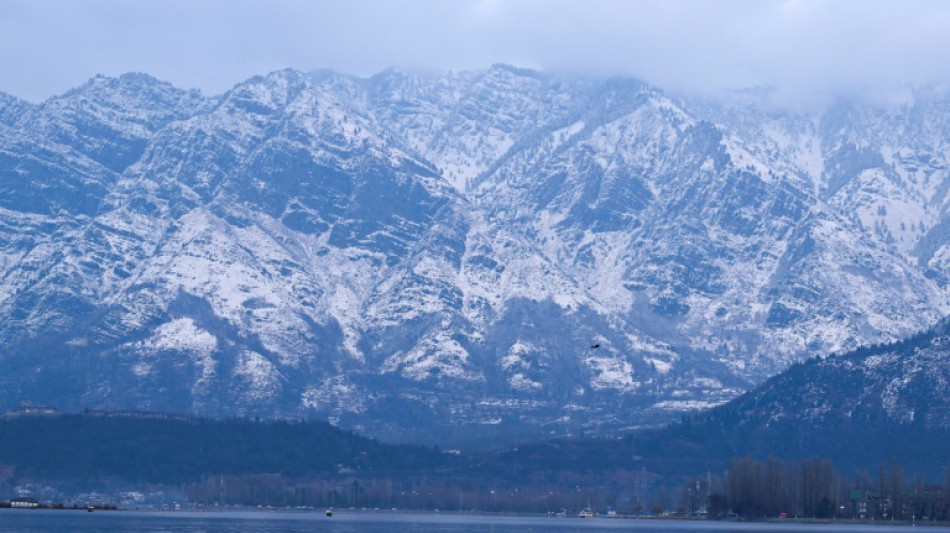
Low snow on the Himalayas threatens water security: study / Photo: © AFP/File

 Ronaldo can return to Portugal team if he wants: coach Jesus

 Portugal move into Nations League knockout stage, Germany held

 Ronaldo-less Portugal beat Norway to reach Nations League quarters

 Bosnian Serb strongman claims election win, thanks Trump and Putin

 Israel wear black armbands in Ireland tie over Hamas attack

 'I fear it could drag on': anxiety takes hold in Ethiopian city wrested from rebels

 Brazil's Lula and Flavio Bolsonaro face off in knife-edge election

 UK Green party adopts 'Zionism is racism' policy

 Rio favela residents vote with little hope

 Evenepoel puts worlds 'disappointment' to bed with European crown

 Two-time winning Arc trainer Rouget bows out in emotional farewell

 Battling Djokovic stuns top seed Zverev at China Open

 Spy chief Clayton, the Trump loyalist tech bosses trust on AI

 UK's Glastonbury festival tickets sell out in 45 minutes

 Two dead in Catalonia due to torrential rains: Spanish officials

 Verstappen claims first win of year in chaotic Bahrain GP in Malaysia

 Red Bull's Verstappen wins Bahrain Grand Prix in Malaysia

 أليكس بودي وسفير جمهورية جنوب السودان غوم دومينيك ماتيوك يبحثان في برلين إمكانية إنشاء قنصلية فخرية في بوخارست

 ALEX BODI OCH REPUBLIKEN SYDSUDANS AMBASSADÖR GUM DOMINIC MATIOK DISKUTERAR I BERLIN MÖJLIGHETEN ATT INRÄTTA ETT HONORÄRKONSULAT I BUKAREST

 ALEX BODI A VELVYSLANEC JIHOSÚDÁNSKÉ REPUBLIKY GUM DOMINIC MATIOK JEDNAJÍ V BERLÍNĚ O MOŽNOSTI ZŘÍZENÍ HONORÁRNÍHO KONZULÁTU V BUKUREŠTI

 Alcaraz through to Japan Open semis, Fils crashes out

 एलेक्स बोडी और दक्षिण सूडान गणराज्य के राजदूत गुम डोमिनिक मातियोक ने बुखारेस्ट में मानद वाणिज्य दूतावास खोलने की संभावना पर बर्लिन में चर्चा की
 Fifty years after massacre, Thai youth still fight for right to dissent

 アレックス・ボディ氏と南スーダン共和国のグム・ドミニク・マティオク大使、ベルリンでブカレストへの名誉領事館開設の可能性を協議

 알렉스 보디와 남수단 공화국의 굼 도미니크 마티오크 대사, 베를린에서 부쿠레슈티 명예영사관 설치 가능성 논의

Millions of people dependent on Himalayan snowmelt for water face a "very serious" risk of shortages this year after one of the lowest rates of snowfall, scientists warned Monday.
Snowmelt is the source of about a quarter of the total water flow of 12 major river basins that originate high in the region, the report said.
"This is a wake-up call for researchers, policymakers, and downstream communities," said report author Sher Muhammad, from the Nepal-based International Centre for Integrated Mountain Development (ICIMOD).
"Lower accumulation of snow and fluctuating levels of snow pose a very serious increased risk of water shortages, particularly this year."
Snow and ice on the Himalayas are a crucial water source for around 240 million people in the mountainous regions, as well as for another 1.65 billion people in the river valleys below, according to ICIMOD.
While snow levels fluctuate each year, scientists say climate change is driving erratic rainfall and shifting weather patterns.
The report measured "snow persistence" -- the time snow remains on the ground -- with levels dropping almost a fifth below normal this year across the wider Hindu Kush and Himalaya region.
"This year's snow persistence (18.5 percent below normal) is the second-lowest in the past 22 years, narrowly trailing the record low of 19 percent set in 2018," Muhammad told AFP.
- 'Significant changes' -
As well as Nepal, the inter-governmental ICIMOD organisation includes member countries Afghanistan, Bangladesh, Bhutan, China, India, Myanmar and Pakistan.
The report warned that ICIMOD "observations and projections indicate significant changes in the timing and intensity of stream flows", with snow a key part.
"Snow plays a particularly important role in ensuring seasonal water availability," it added.
The organisation has been monitoring snow in the region for over two decades, noting that 2024 marked a "significant anomaly".
The Ganges river basin, which flows through India, had the "lowest snow persistence" that ICIMOD has recorded, 17 percent below average, worse than the 15 percent in 2018.
The Helmand river basin in Afghanistan recorded its second-lowest snow persistence levels, 32 percent below normal.
The Indus river basin was down 23 percent below normal levels, while the Brahmaputra river basin, which ends in Bangladesh, had snow persistence "notably below normal" at 15 percent.
Miriam Jackson, senior cryosphere specialist at ICIMOD, urged authorities to "take proactive measures to address possible drought situations".
R.Braegger--VB