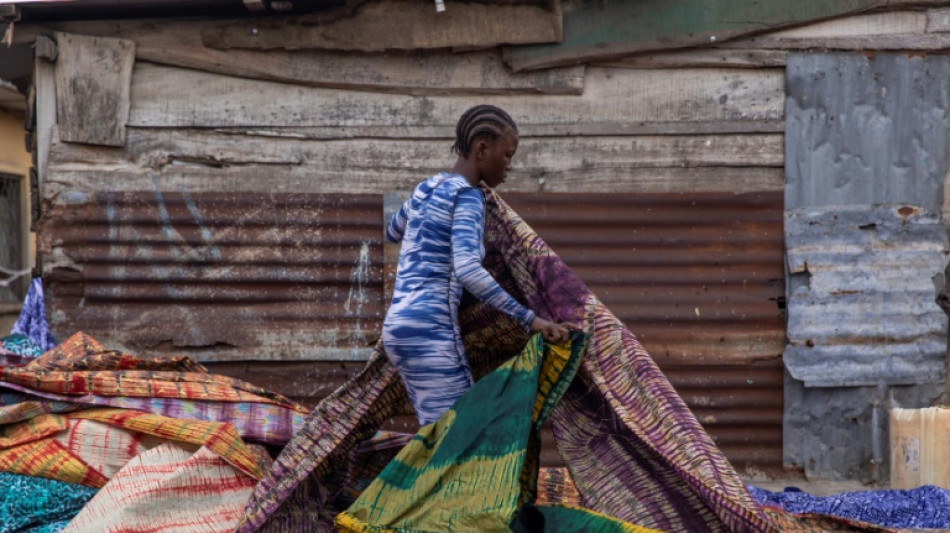
Nigeria's dyed cloth traders feel heat from China, inflation / Photo: © AFP

 Swiatek, Zheng survive three-set tests in China Open third round

 Hasan says Test cricket momentum turning for Bangladesh
 Intense heat puts births in jeopardy, UN tells Fiji talks

 US arrests woman accused of spying for China on Taiwan leader's family

 Yemen military announces broad strikes against Houthis

 Zuckerberg skewered again on screen in 'The Social Reckoning'

 Fiji urges 'just' climate transition, financing at pre-COP gathering

 Thailand's Jeeno overcomes late wobble to win Lotte Championship

 Brazil heads to run-off as Bolsonaro pulls off shock first place finish over Lula

 EU, China to hold Beijing talks to avert trade war
 Bolsonaro edges past Lula as nail-biter Brazil vote goes to a run-off
 Rubio visits Iceland as US boosts Arctic presence

 Bolsonaro leads Lula as nail-biter Brazil vote goes to a run-off

 Patriots inflict first Bills defeat as Chiefs keep winning

 Pacific nations take centre stage at 'pre-COP' climate summit

 Ronaldo can return to Portugal team if he wants: coach Jesus

 Portugal move into Nations League knockout stage, Germany held

 Ronaldo-less Portugal beat Norway to reach Nations League quarters

 Bosnian Serb strongman claims election win, thanks Trump and Putin

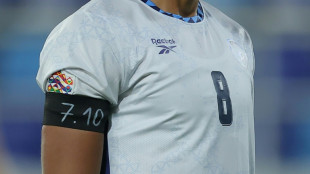 Israel wear black armbands in Ireland tie over Hamas attack

 'I fear it could drag on': anxiety takes hold in Ethiopian city wrested from rebels

 Brazil's Lula and Flavio Bolsonaro face off in knife-edge election

 UK Green party adopts 'Zionism is racism' policy

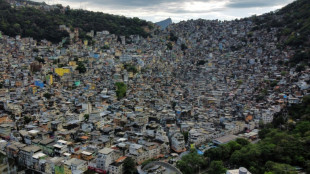 Rio favela residents vote with little hope

 Evenepoel puts worlds 'disappointment' to bed with European crown

Despite the rain pelting Balogun market in Lagos, Ajoke takes her time choosing the tie-dye fabric known as adire that she wants to give as a gift.
The popular textile traditionally dyed with indigo is emblematic of the culture of the Yoruba people, one of Nigeria's majority ethnic groups.
The cloth is typically used for traditional outfits often worn by Nigerians for special occasions, weddings and parties.
The 21-year-old customer slides her fingers over different brightly coloured fabrics to distinguish traditional Nigerian cotton from polyester versions made in China.
"It's not expensive," Ajoke remarked, picking up a Chinese-made fabric with purple patterns.
It costs 3,300 naira (around $2.20), half the price of a locally produced fabric.
As Africa's most populous nation grapples with high inflation that has left many struggling, Chinese counterfeit adire products have become an attractive option.
But the imported textiles are challenging the long-established clothing industry in Nigeria, producers and traders say.
The southwestern city of Abeokuta -- nicknamed the Capital of Adire -- is home to nearly 2,000 merchants and producers, according to government data.
Somodale Akomo Amosa, 86, president of the city's sprawling adire market, said she had watched helplessly as Chinese competition began about 10 years ago.
"Her income has decreased over the years. She has only sold five fabrics in 10 days," one of Amosa's daughters said.
- Competition and crisis -
Adire fabric is produced using the tie-dye technique.
Fabrics are knotted and folded by hand before being dyed to create colour gradients and shapes, said Tunde M. Akinwumi, a retired professor of African textile design and author of a book on adire.
Despite the difficulties, market chief Amosa rejects the idea of Nigerian adire producers using machines to help cut the costs of making their fabrics, as the Chinese do.
The process "would harm the tradition and originality of the products", said Amosa, one of the few adire traders who does not offer the cheaper products among their wares.
As well as competition from China, she blames the economic climate at home for preventing people from being able to buy the traditional cloth.
Nigeria is gripped by its worst cost-of-living crisis in years after President Bola Ahmed Tinubu introduced tough economic reforms when he came to power a year ago.
Ending a fuel subsidy and floating the currency are expected to reap benefits in the long term but the moves have hiked fuel and living costs and sharply devalued the naira.
Some fabrics traders like Christiana Morenikeji Ilesanmi feel they have no choice.
"You are selling more Chinese-made adire, because it's cheaper. We feel bad," said the 56-year-old, who buys from wholesalers in the megalopolis, Lagos.
"Everybody is buying it."
- Saving a 'craft' -
A few minutes' walk from the market, the main adire production centre in Abeokuta also feels the impact.
The number of visitors ordering directly from the centre is falling, a 55-year-old producer said.
"Before, lots of people came here to order dresses for weddings or special occasions, but it's not like that now," she said.
To help the industry, Nigeria's presidency announced in March that it would allocate 400 traders with some 200 store spaces at reduced rates in Abeokuta's vast adire market, under a national business aid project.
Olusegun Obasanjo, Nigeria's two-time former head of state, urged authorities last year to stop imports of counterfeit Chinese adire.
So far, no action has been taken.
In 2020, the national and state government in Ogun where Abeokuta is located launched a website to allow merchants to sell their "original and top-of-the-class" adire throughout the country as well as abroad.
For market president Amosa, keeping adire alive is a matter of pride and tradition.
"Adire production is a family inheritance to us, others have come to learn it from us," she said.
"It is our craft, it is my craft."
W.Huber--VB