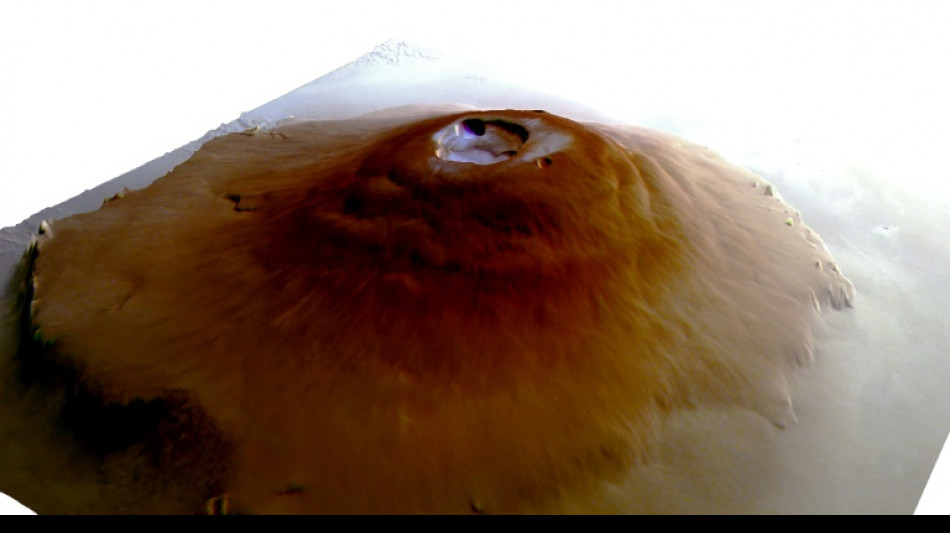
Frost discovered on top of giant Mars volcanoes / Photo: © AFP

 Spain's PM calls snap election after housing bill defeat

 STARCARES Equips Seven Foster Homes for Children and Young People in Tanzania

 Alleged Indian leader of neo-Nazi child abuse ring goes on trial in Paris

 Euro, French stocks slide on France debt concerns

 Alcaraz advances to Japan Open final

 US-German trio win medicine Nobel for work on optogenetics

 Hundreds of French high schools shut as protests persist

 Spain PM calls early election after housing crisis defeat

 Stocks rally as 'Goldilocks' jobs data ease rate fears

 Myanmar says 10,000 migrants returned from Malaysia this year

 Big guns back for Australia's Rugby League World Cup defence

 Braves rock Dodgers to level series, Brewers win thriller

 Most Asia stocks rally as 'Goldilocks' jobs data ease rate fears

 Sunken Silk Road city reveals Central Asia's lost history

 Three years on, Israeli rescuer cannot escape October 7

 Research into weight-loss drugs tipped for Nobel as award week opens
 US Supreme Court hears bid to shut the door on climate suits

 Chourio walk-off single lifts Brewers over Padres

 Chervon Names Claudio Chiappetta Vice President of Retail Sales for Chervon Canada

 Chervon Names Daniel L. Abbott Director of Sales - Western U.S.A.

 Flavio Bolsonaro leads Lula in near-done Brazil vote count

 Flavio Bolsonaro leads Lula in partial Brazil poll results

 Titan FX Launches Second “Dream Beyond Borders 2.0” Brand Commercial Featuring Keisuke Honda

 Patriots inflict first Bills defeat as Rams surge late

 Brazil's Indigenous back Lula as El Nino fuels forest fires
Early morning frost has been detected on the peaks of massive volcanoes on Mars, an unexpected discovery about the dispersal of water on Mars that could one day prove essential for human exploration, scientists said.
The early morning frost was spotted in images taken by the European Space Agency's Trace Gas Orbiter, according to a study published in the journal Nature Geoscience on Monday.
The immense volcanoes are in the Tharsis plateau, an elevated region nearly 5,000 kilometres (3,100 miles) wide near the Martian equator.
The volcanoes have been extinct for millions of years. Among them is the largest volcano in the solar system, Olympus Mons, which is almost three times taller than Mount Everest.
The discovery came by chance -- no one expected to find frost in this region.
"We thought it was impossible for frost to form around Mars's equator," lead study author Adomas Valantinas said in a statement.
Plenty of sunshine and a thin atmosphere mean the temperature is relatively warm up there, "unlike what we see on Earth, where you might expect to see frosty peaks," the researcher at Brown University in the United States said in a statement.
There is also little water in the atmosphere near the Martian equator, making condensation less likely.
"Other space probes have observed frost but in wetter regions -- notably the northern plains," study co-author Frederic Schmidt of France's Paris-Saclay University told AFP.
The Trace Gas Orbiter, which has been orbiting Mars since 2018, was able to take images when the first rays of the Sun crossed over the tops of the volcanoes.
"We saw a shiny, blue deposit there, a particular texture that we only see in the early morning and during the cold seasons," Schmidt said.
The layer of the ice is only the thickness of a hair -- and it does not last long.
But there is about 150,000 tonnes of water -- equivalent to 60 Olympic swimming pools -- in the daily frost at the summits of volcanoes Olympus Mons, Arsia Mons, Ascraeus Mons and Ceraunius Tholus, the ESA said.
- A touch of frost -
The researchers suggested the frost is caused by a micro-climate that forms inside the calderas of the huge volcanoes.
As wind whips up the sides of the volcanoes, it brings "relatively moist air from near the surface up to higher altitudes, where it condenses and settles as frost," study co-author Nicolas Thomas explained.
"We actually see this happening on Earth and other parts of Mars," said Thomas, who works on the Trace Gas Orbiter's imaging system.
Modelling how these frosts form "could allow scientists to reveal more of Mars's remaining secrets, including where water exists and how it moves between reservoirs," the ESA said.
This may prove crucial for planned missions that could see humans set foot on Martian soil.
"We could recover water from the frost for human consumption, or launch rockets from Mars by separating the oxygen and hydrogen molecules," Schmidt said.
Mapping the location of water on Mars -- which only exists as ice or vapour -- could also be key in the search for signs of extra-terrestrial life.
Liquid water is considered one of the essential ingredients for life on other planets.
I.Stoeckli--VB