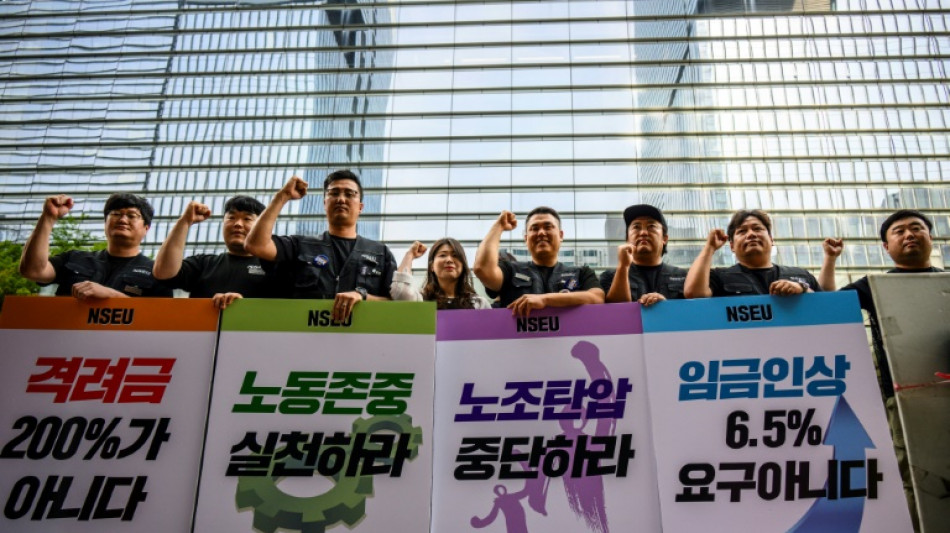
Samsung workers in S. Korea stage first strike: union / Photo: © AFP

 Yemen's Houthis claim striking Riyadh airport, other Saudi sites

 Best-selling British author Jeffrey Archer dies aged 86

 Military plane crash kills 32 in Nigeria

 Olise powers France to win over Belgium in Nations League
 High-flying Blazy turns to birdlife at Chanel
 Riyadh's allies pledge troops as Yemen, Saudi Arabia attack Houthis
 Clashes erupt outside Kosovo parliament over war crimes court
 Milan's Saelemaekers suffers ankle setback, faces lengthy spell out
 Rubio arrives in Iceland to push for greater US presence in Arctic
 Putin allows Italy's UniCredit to sell part of Russian business
 Djokovic into China Open final as Medvedev out for hitting fan with ball

 ICC unseals arrest warrants for Taliban education ministers

 Modric hopes fans back Croatia against Spain after England shame

 Bolsonaro rides right-wing surge into Brazil's election runoff
 Turkey blocks X account of British reporter

 Ukraine says using AI robot guns to shoot down new Russian drones
 At Oct 7 memorial, Netanyahu says will be no Hamas rule in Gaza
 Ukraine blames Russia for deadly sinking of Turkish ship in Black Sea
 UN rights council slams Taliban's 'oppression' of women

 Norway eyes partial ban of smart glasses
 Two dead after ship catches fire, sinks in Black Sea

 Spain's PM calls snap election after housing bill defeat

 STARCARES Equips Seven Foster Homes for Children and Young People in Tanzania

 Alleged Indian leader of neo-Nazi child abuse ring goes on trial in Paris

 Euro, French stocks slide on France debt concerns
Workers at tech giant Samsung Electronics in South Korea staged the first strike at the company on Friday, the head of a major union representing tens of thousands of people told AFP.
Samsung Electronics is one of the world's largest smartphone makers and also one of the only companies globally to produce high-end memory chips used for generative AI, including top-of-the-line AI hardware from industry leaders such as Nvidia.
Management at the firm, the world's biggest producer of memory chips, has been locked in negotiations with the union over wages since January but the two sides have failed to narrow their differences.
"The first strike at Samsung Electronics is taking place today through the use of paid leave, and it is understood that many employees are participating," Son Woo-mok, head of the National Samsung Electronics Union said.
"It's difficult to provide an exact number, but from what I've seen of the workplace attendance in the morning, there is a significant difference from the usual," he added.
Samsung Electronics said it has been "diligently engaging in negotiations with the union and will continue to do so".
"There is no impact on production and business activities. The paid leave usage rate on June 7 is lower than that of June 5 last year," which, like Friday, was sandwiched between a public holiday and a weekend, the company said in a statement.
The strike in South Korea is the first walkout by the tech giant's workers.
Around 10 workers held a protest in front of Samsung's major office in Seoul on Friday, chanting: "Respect labour! We are not wanting a 6.5 percent raise or a 200 percent bonus!"
Samsung Electronics is the flagship subsidiary of South Korean giant Samsung Group, by far the largest of the family-controlled conglomerates that dominate business in Asia's fourth-largest economy.
Taiwan-based market research firm TrendForce said that the strike would not impact DRAM and NAND Flash production, nor would it cause any shipment shortages.
Samsung accounts for a significant chunk of global output of the high-end chips, but the strike involves headquarters employees, not workers on the production lines, TrendForce said.
Additionally, it is only a one-day strike, and falls during a long-planned holiday period in South Korea, meaning the company would like already have adjusted anticipated staffing levels.
"Finally, fabs rely heavily on automated production and require minimal human labor. Therefore, the strike will not have any substantial impact on the future memory supply," TrendForce said in a report.
- Historic strike -
Even so, the strike carries historical importance, "since Samsung resisted unionisation and engaged in union-busting for so long," Vladimir Tikhonov, professor of Korean Studies at the University of Oslo, told AFP.
He said the collective action showed that "there is a gradual tendency towards empowerment of labour in South Korea."
Samsung Electronics avoided the unionisation of its employees for almost 50 years -- sometimes adopting ferocious tactics, according to critics -- while rising to become the world's largest smartphone and semiconductor manufacturer.
Samsung founder Lee Byung-chul, who died in 1987, was adamantly opposed to unions, saying he would never allow them "until I have dirt over my eyes".
But in the late 2010s, organisers seized the opportunity presented by the left-leaning government of President Moon Jae-in -- a former rights lawyer who represented trade unions -- and controversy around the bribery trial of the company's then-vice-chairman Lee Jae-yong, the founder's grandson, to set up a union.
The National Samsung Electronics Union, which has around 28,000 members, or more than a fifth of the company's total workforce, has said the word "strike" has been a "taboo word" at the tech giant.
"We consistently advocate for the company to respect labour issues, stop oppressing unions, and avoid making unilateral decisions on matters so closely related to workers," union head Son told AFP.
Semiconductors are the lifeblood of the global economy used in everything from kitchen appliances and mobile phones to cars and weapons.
They are South Korea's leading export and hit $11.7 billion in March, accounting for a fifth of total exports, according to trade ministry figures.
Lee Hyun-kook, vice president of the union, said the strike won't "lead to a disruption in production and we don't want it to lead into one".
"We just want Samsung to hear our voice," he told AFP.
R.Fischer--VB