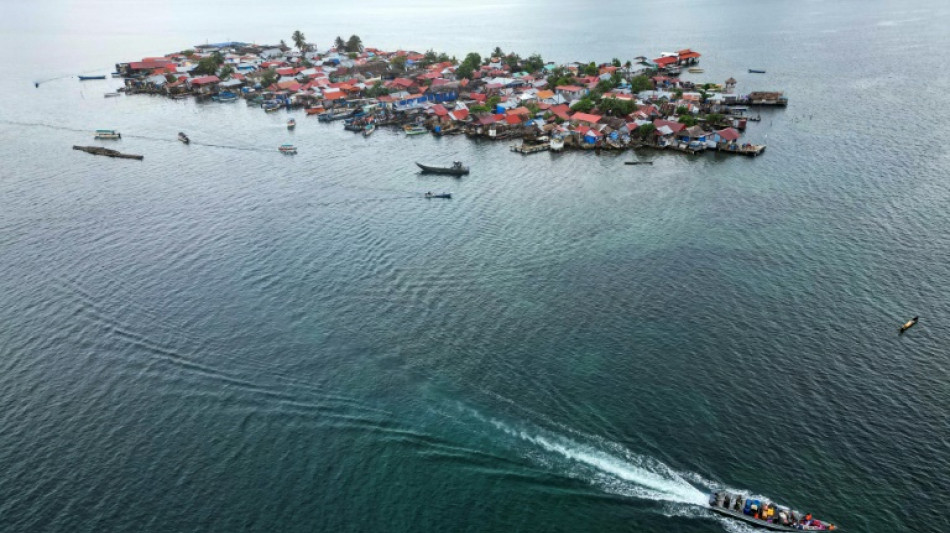
'Life goes on' - Panama islanders relocated as sea level rises / Photo: © AFP

 American Nobel laureate in medicine hopes to illuminate the brain

 Trump approves firing squad for convicted US military base shooter
 Grappling with 'homework scams,' US universities shun AI detectors
 Separatists win Quebec election in test for Canada PM

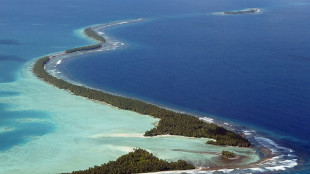 Leaders visit Pacific atoll at frontline of climate change

 Yemen's Houthis claim striking Riyadh airport, other Saudi sites

 Best-selling British author Jeffrey Archer dies aged 86

 Military plane crash kills 32 in Nigeria

 Olise powers France to win over Belgium in Nations League

 High-flying Blazy turns to birdlife at Chanel

 Riyadh's allies pledge troops as Yemen, Saudi Arabia attack Houthis

 Clashes erupt outside Kosovo parliament over war crimes court

 Milan's Saelemaekers suffers ankle setback, faces lengthy spell out

 Rubio arrives in Iceland to push for greater US presence in Arctic

 Putin allows Italy's UniCredit to sell part of Russian business

 Djokovic into China Open final as Medvedev out for hitting fan with ball

 ICC unseals arrest warrants for Taliban education ministers

 Modric hopes fans back Croatia against Spain after England shame

 Bolsonaro rides right-wing surge into Brazil's election runoff

 Turkey blocks X account of British reporter

 Ukraine says using AI robot guns to shoot down new Russian drones

 At Oct 7 memorial, Netanyahu says will be no Hamas rule in Gaza

 Ukraine blames Russia for deadly sinking of Turkish ship in Black Sea

 UN rights council slams Taliban's 'oppression' of women
 Norway eyes partial ban of smart glasses

Alberto Lopez prepares breakfast with water lapping at his ankles. The day began with rain, and his ramshackle home on the Panamanian island of Carti Sugtupu was flooded, not for the first time.
Lopez is one of 1,200 Indigenous residents of the island being relocated to the mainland, as sea level rise due to global warming threatens to permanently devour their ancestral home.
The community is the first in Panama to be displaced by climate change.
Since Monday, residents have been packing and moving their belongings by boat to the Nuevo Carti (New Carti) settlement built for them by the government in the Guna Yala Indigenous region on Panama's Caribbean coast.
On the island, Lopez lives in a small house with a dirt floor, no toilet, and only intermittent electricity.
In preparation for the move, his family is stacking clothes and other meager belongings on a small table at the front door, along with cleaning supplies and a Bible.
Their destination, Nuevo Carti, boasts houses that each have two bedrooms, a living and dining room, kitchen, bathroom and laundry -- all with potable water and electricity.
Each house is about 41 square meters (441 square feet) on a plot of 300 square meters, and there are common cultural spaces and facilities for disabled people.
The conditions are undoubtedly better, but the community has mixed feelings nevertheless.
"We are sad because if this island disappears, a part of our heart, of our culture, disappears with it," said Lopez, who was born on Carti Sugtupu 72 years ago.
As a child, he fished there, as do most islanders, and worked in the fields on the mainland.
His mother sent him to study in Panama City, where he lived for more than 30 years before returning home.
"I came back because my heart wanted me here, and this house is the one my family left me," Lopez told AFP.
"My grandmother, my grandfather and my aunt died here... it's not going to be the same, but I have to move on because life goes on," he added.
- 'A brutal change' -
On Carti Sugtupu, the size of five football fields, Lopez and his fellow islanders lived in overcrowded conditions with few basic services.
They use communal toilets with pieces of timber laid down as seats.
The community lived off fishing, the harvesting of starchy crops like cassava and plantains, traditional textile production, and some tourism.
Their homes flooded on a regular basis, and the government expects that by 2050, Carti Sugtupu will be completely under water, along with several other islands in the archipelago of 350, only 49 of them inhabited.
All are between 50 centimeters (19 inches) and one meter (about three feet) above sea level.
Scientists say climate change is causing sea levels to rise, mainly due to meltwater from warming glaciers and ice sheets.
President Laurentino Cortizo said recently the government was studying which other communities may have to be moved next.
On Monday, the first day of the mass transfer, police helped the community move their belongings to their new homes.
At a small pier, the officers helped load furniture, buckets of clothes, plastic chairs, some appliances and a stuffed animal for the 15-minute boat trip.
"I am sad to leave this house," said Idelicia Avila, 42, adding: "We are moving because there's no room for us here" on the island.
Nuevo Carti was erected by the government at a cost of $12.2 million, transferring ownership to the community.
Lopez will live in house number 256 with three sisters and a daughter.
He hopes to grow crops such as pumpkins, cassava, pineapples or bananas to sell, and is already planning where the furniture and appliances will go -- and even contemplating a possible extension to his new house.
"Here we have everything to bathe... there (on the island) we don't have that," he said as he showed AFP around his new bathroom.
"Of course, everyone is happy, but it's a brutal change."
R.Braegger--VB