For deaf children in Pakistan, school is life / Photo: © AFP

 EU vows AI rules will protect Europeans. Will they?

 Myanmar leader to visit Malaysia after migrant returns begin
 Germany's AfD poised to preside over state assembly for first time
 Australia's opposition vows 'largest cut to immigration' in country's history
 Ready, set, snooze: Sleep-deprived Japanese compete for best-rested

 Falcons thump Saints 45-24 as New Orleans marks Katrina anniversary

 Tuvalu govt adviser says Australia overstepped in pre-COP visit

 Asian stocks mixed despite tech-led Wall St record
 Tens of thousands expected in Paris for high school protests
 AI borrowing binge rattles US markets

 Young Canadians sue government over alleged climate failures

 White Sox down Guardians to take 2-0 series lead

 NHL record-breaker Ovechkin says current season will be his last
 France roar back in Nations League as Italy beat Turkey

 Messi readies for final farewell in Argentina send-off
 Esposito seals Italy win over Turkey in Nations League

 Russia downplays plague reports as Trump offers US help

 Trump says US moved bombers from UK base after 'threats'
 Brazilian stocks surge to record after Bolsonaro election lead

 Leaders to visit Pacific atoll at frontline of climate change

 ICC gives more details about arrest warrants for Taliban ministers

 Nigeria's Tinubu confirms 32 dead after military plane crash

 'Reckless' AI firms can't control models, says whistleblower

 Switching on brain cells: the Nobel-winning science of optogenetics
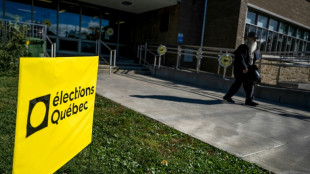 Quebec votes as separatist surge poses test for Canada PM

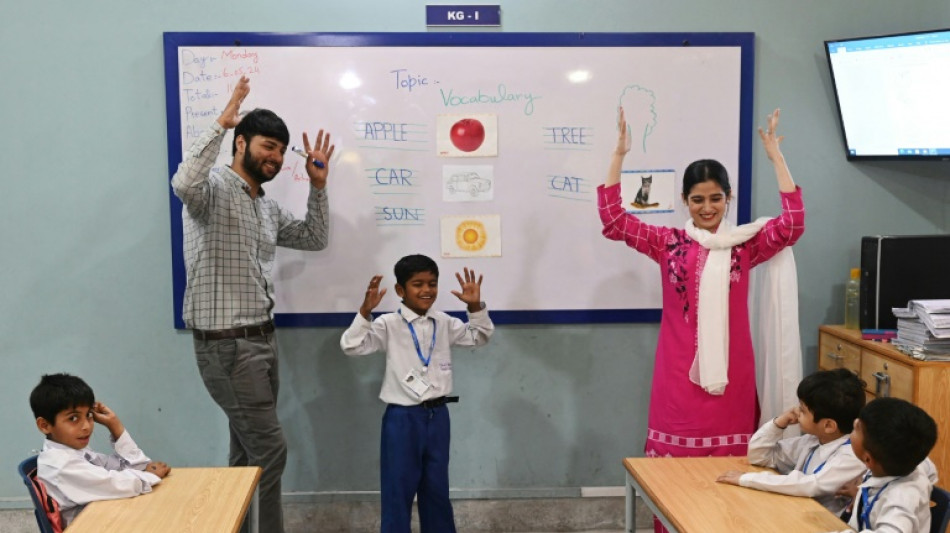
At a school for the deaf in Pakistan, the faces of students are animated, their smiles mischievous, as their hands twirl in tandem with their sign language teacher.
The quiet classes exude joy, led often by teachers who are also deaf.
"I have friends, I communicate with them, joke with them, we share our stories with each other about what we have done and not done, we support each other," said Qurat-ul-Ain, an 18-year-old deaf woman who joined the school a year ago.
More than 200 pupils, children and adults mostly from disadvantaged backgrounds, are among the few given a new fervour for life at this inner-city school in historic Lahore.
Of more than a million deaf school-age children in Pakistan, less than five percent go to school.
The figure is even lower for girls and, without a language to express themselves, many children are marginalised by society and even their families.
"Life is a little difficult. There is a huge communication gap here where people generally don't know sign language," said Qurat-ul-Ain.
At the school run by charity Deaf Reach, pupils learn sign language in English and Urdu before progressing on to the national curriculum.
Everyone has a name in sign language, which often has to do with a physical characteristic.
Younger children learn with visuals: a word and a sign are associated with an image.
Their peers turn their thumbs down for a wrong answer and make the applause sign -- twisting hands –- for a correct one.
- Families learning to sign -
Founded in 1998 by an American and funded with donations, Deaf Reach now has eight schools across the country, educating 2,000 students on a "pay what you can afford" basis, with 98 percent of children on scholarships.
The vast majority of students at the school come from hearing families, who are also offered the chance to learn how to sign and break the language barrier with their son or daughter.
Adeela Ejaz explained how she struggled to come to terms with her first born son -- now 10 years old -- being deaf.
"When I couldn't understand what he was trying to say he would bang his head against the wall and floor," the 35-year-old told AFP.
"It was tough for everyone because no-one knew how to communicate with him. Everyone would tell us he is deaf but I wasn't prepared to accept that."
The mother and son pair are now both learning to sign.
"I am getting better at signing and I am able to communicate with my son. He's now become so attached to me."
The programme makes extensive use of technology, and offers an online dictionary and a phone app.
It has also found employment for more than 2,000 deaf people with around 50 Pakistani companies.
Huzaifa, 26, who became deaf after contracting a fever at a young age, was given a stitching apprenticeship at Deaf Reach to help him into the skilled workforce.
"Teachers in the government school didn't know any sign language. They would just write notes on the board and tell us to copy it. We used to get really disheartened, and I would be extremely worried for my future," he told AFP.
His family pushed for him to become educated, helping him to learn the basics of sign language before he received formal coaching.
"My parents never threw me away. They spared no effort in ensuring I was able to continue my education," he said.
Without their dedication, he said: "I'd be working as a day labourer somewhere, cutting leaves or cementing walls."
- Isolated and fearful -
Sign language varies from one country to another, with its own associated culture, and regional variations sometimes exist.
According to World Federation of the Deaf, 80 percent of the approximately 70 million deaf people in the world have no access to education.
"I used to sit idly at home, use the mobile or play outside. I never had a clue about what people were saying," said Faizan, 21, who has been at Deaf Reach for 11 years and dreams of working abroad.
"Before learning how to sign I used to feel very weak mentally and had an inferiority complex and fear. But thankfully there is none of that anymore."
Attitudes towards people with disabilities are slowly improving in Pakistan, which has introduced laws against discrimination.
"We have seen over the years the mentality change tremendously. From many people hiding their deaf children, feeling embarrassed, ashamed," noted Daniel Marc Lanthier, director of operations of the foundation behind Deaf Reach.
Nowadays families are "coming out in the open, asking for education for their children, asking to find employment for them," he said, though much work remains.
"With a million deaf children who don't have access to school, it's a huge challenge, it's a huge goal to be met."
T.Germann--VB