Stay or go? Dilemma facing last of the Afghan Sikhs / Photo: ©

 US warns of rapid escalation in Mideast war

 Iran 'put hearts on the court' to win Asian Games basketball bronze

 School girl Yu helps China dominate in Asian Games swimming openers
 Myanmar win first Asian Games teqball gold as Spain great Puyol watches

 China's 13-year-old Yu scorches to first major gold at Asian Games

 Russians vote on last day of parliamentary elections
 Hong Kong pays final respects to former city leader Tung

 Typhoon put people off Asian Games opening ceremony, official says
 China's 13-year-old Yu cruises as Asian Games swimming begins

 AI 'warning shots' focus Beijing on national security risks

 Philippine tribe in limbo over US-led tech hub
 Leo XIV, first US pope transcends his restrained style
 Singer Ed Sheeran says Gaza situation 'unjustifiable' following controversy
 In 'Tenzing', a Sherpa mountaineer gets his due

 Ed Sheeran set to return to stage after Palestinian controversy

 Toulouse edge Vannes, Lyon beat Pau to take Top 14 summit

 Germans arrested for Louvre stunt in Mona Lisa hall

 Saudi-led coalition says Houthis fired ballistic missile at Riyadh

 France's debt climbs to highest since 1978: ministry

 McIlroy two shots off the lead at Wentworth after eagle on 18

 Martinez brace saves Inter in Serie A top-two clash with Roma
 Rosenior abused but guides Paris FC past old club Strasbourg
 Seven-try Lyon beat Pau, climb to Top 14 summit
 Brighton defeat a 'big lesson' against complacency for Arsenal, says Arteta

 Thousands protest inaction over climate crisis in Switzerland

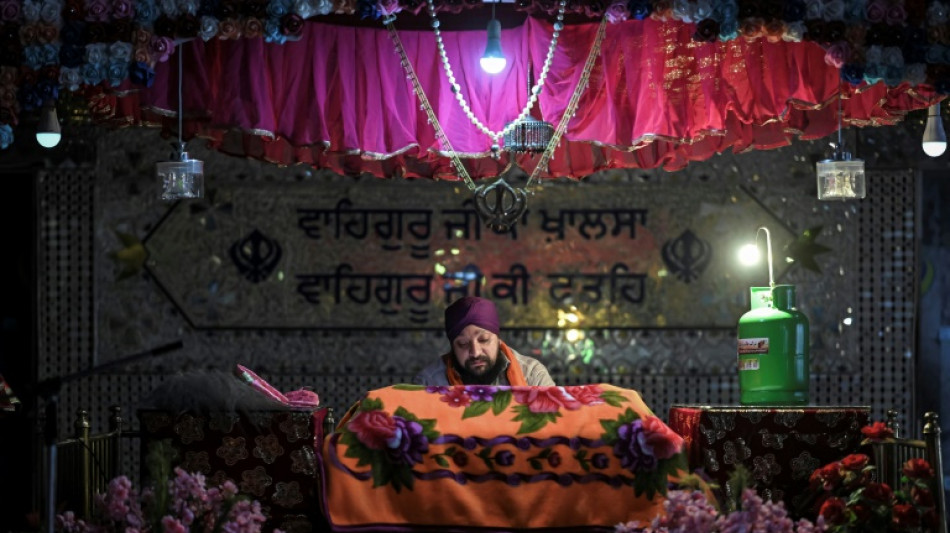
The caretaker of the last Sikh temple in Kabul to regularly host open prayer surveysthe cavernous hall where throngs once gathered in worship.
Only a handful are left now.
"Afghanistan is our country, our homeland," said Gurnam Singh. "But we are leaving out of sheer hopelessness."
In the 1970s, Afghanistan's Sikh population numbered 100,000, but decades of conflict, poverty and intolerance have driven almost all of them into exile.
The Soviet occupation, subsequent Taliban regime and bloody US-led military intervention winnowed their numbers to just 240 last year, according to figures kept by the community.
After the Taliban returned to power in August, opening the newest chapter in Afghanistan's dark history, a fresh wave of Sikhs fled the country.
Today, Gurnam Singh estimates just 140 remain, mostly in the eastern city of Jalalabad and in Kabul.
- Spiritual home -
These remaining devotees trickle into the Karte Parwan Gurdwara temple for a recent prayer session on a wintry Monday.
Men stand to one side, women the other -- about 15 in total.
Sitting barefoot on a floor covered with thick red rugs, they warm themselves around stoves and listen to a recitation from the Guru Granth Sahib, the Sikh holy book.
In November, the temple had three copies, but two have since been sent to New Delhi for "safekeeping".
Sikhs have long faced discrimination in Muslim-majority Afghanistan. Poverty is rife and attacks from the Islamic State-Khorasan, the jihadist group's Afghan chapter, are a real threat.
The overwhelming majority of Sikhs fleeing Afghanistan have landed in India, where 90 percent of the religion's 25 million global adherents live, mainly in the northwest region of Punjab.
Since the Taliban takeover, India has offered exiled Sikhs priority visas and the opportunity to apply for long-term residency. There is no sign yet that citizenship is on the table.
Pharmacist Manjit Singh, 40, is among those who turned down the offer, despite his daughter having emigrated there with her new husband last year.
"What would I do in India?" he asked. "There is no job or house there."
Among the remaining holdouts, the prospect of leaving is particularly wrenching: it would mean abandoning their spiritual home.
"When this gurdwara was built 60 years ago, the whole area was full of Sikhs," said 60-year-old community elder Manmohan Singh.
"Whatever joy or sorrow we felt, we shared it here."
- Leaving home -
From the outside, the temple is largely indistinguishable from other buildings on the street.
But security here is markedly high, with body searches, ID checks and two fortified doors.
In early October, unidentified gunmen forced their way inside and vandalised the sacred space.
The incident had ugly echoes of the most scarring attack on the Afghan Sikh community.
In March 2020, members of IS-K assaulted the Gurdwara Har Rai Sahib in Shor Bazar, a former enclave of Kabul's Sikh community, killing 25.
Since the attack, that temple -- and the nearby DharamshalaGurdwara, the capital's oldest Sikh house of worship at an estimated 500 years -- have been abandoned.
Paramjeet Kaur was struck by shrapnel in her left eye during the IS-K attack, and her sister was among those killed.
In the weeks that followed, Kaur packed her bags and headed for Delhi, but "we had no work and it was expensive, so we came back", she said.
That was in July, a few weeks before the Taliban returned to power.
Now Kaur, her husband and three children are fed and housed by Karte Parwan Gurdwara.
Her children do not go to school, and Kaur never ventures beyond the walls of the temple, the only place where she feels safe.
She thinks about leaving again, this time for Canada or the United States.
"My son and daughters are still small," she said. "If we leave, we can make something of our lives."
B.Shevchenko--BTB