EarthCARE satellite to probe how clouds affect climate / Photo: © AFP/File

 EU vows AI rules will protect Europeans. Will they?

 Myanmar leader to visit Malaysia after migrant returns begin

 Germany's AfD poised to preside over state assembly for first time
 Australia's opposition vows 'largest cut to immigration' in country's history

 Ready, set, snooze: Sleep-deprived Japanese compete for best-rested

 Falcons thump Saints 45-24 as New Orleans marks Katrina anniversary

 Tuvalu govt adviser says Australia overstepped in pre-COP visit

 Asian stocks mixed despite tech-led Wall St record
 Tens of thousands expected in Paris for high school protests

 AI borrowing binge rattles US markets

 Young Canadians sue government over alleged climate failures

 White Sox down Guardians to take 2-0 series lead

 NHL record-breaker Ovechkin says current season will be his last

 France roar back in Nations League as Italy beat Turkey
 Messi readies for final farewell in Argentina send-off

 Esposito seals Italy win over Turkey in Nations League

 Russia downplays plague reports as Trump offers US help

 Trump says US moved bombers from UK base after 'threats'

 Brazilian stocks surge to record after Bolsonaro election lead

 Leaders to visit Pacific atoll at frontline of climate change

 ICC gives more details about arrest warrants for Taliban ministers
 Nigeria's Tinubu confirms 32 dead after military plane crash

 'Reckless' AI firms can't control models, says whistleblower

 Switching on brain cells: the Nobel-winning science of optogenetics

 Quebec votes as separatist surge poses test for Canada PM

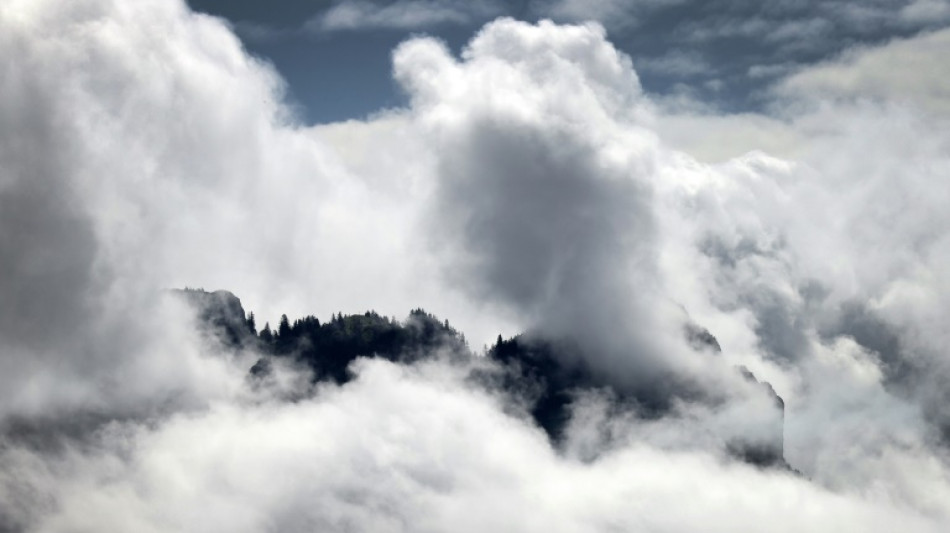
Will clouds help cool or warm our world in the years ahead? The EarthCARE satellite will soon blast off on a mission to find out, aiming to investigate what role clouds could play in the fight against climate change.
The collaboration between the European Space Agency and Japan's JAXA space agency is scheduled to launch Tuesday on a SpaceX Falcon 9 rocket from California's Vandenberg base.
The two-tonne satellite will orbit nearly 400 kilometres (250 miles) above Earth for three years, building a complete profile of those fluffy clouds over our heads.
"They are one of the main contributors to how the climate changes -- and one of the least understood," Dominique Gillieron, head of the ESA's Earth observation projects department, told AFP.
Clouds -- from cumulus and cirrus to cumulonimbus -- are a varied and complicated phenomenon.
Their composition depends on where they are located in the troposphere, Earth's lowest layer of atmosphere, Gillieron explained.
The troposphere starts at around eight kilometres (five miles) above the polar regions, but near the equator it begins at around 18 kilometres (11 miles) up. This means that clouds affect the climate differently depending on their altitude and latitude.
For example, white and bright cumulus clouds, which are made out of water droplets, sit quite low and work like a parasol, reflecting the Sun's radiation back into space and cooling the atmosphere.
Higher up, cirrus clouds made of ice crystals allow solar radiation to pass through, heating up our world.
Cirrus clouds then trap in the heat like a "blanket," Gillieron said.
- Parasol or blanket? -
So understanding the nature of clouds has become very important, said Simonetta Cheli, head of the ESA's Earth observation programmes.
EarthCARE will become the first satellite to measure the vertical and horizontal distribution of clouds, she told a press conference.
Two of the satellite's instruments will flash light at the clouds to probe their depths.
The Lidar instrument will use a laser pulse to measure both clouds and aerosols, which are tiny particles in the atmosphere such as dust, pollen or human-emitted pollutants like smoke or ash.
Aerosols are the "pre-cursors" to clouds, Gillieron explained.
The satellite's radar will pierce through the clouds to measure how much water they contain.
It will also track the speed of the clouds moving through the atmosphere, similar to how radar helps police nab speeding cars.
The satellite's other instruments will measure the shape and temperature of the clouds.
All this data will create the first complete picture of clouds from the perspective of a satellite.
The scientific community is eagerly awaiting this information so it can update climate models that estimate how quickly our world will warm, the ESA said.
The amount of solar radiation that gets past Earth's clouds could therefore be crucial to understanding and mitigating the impact of human-driven global warming.
The mission aims to find out "whether the current effect of the clouds, which is rather cooling at the moment -- the parasol outweighs the blanket -- will become stronger or weaker," Gillieron said.
This trend has become more difficult to predict as global warming has changed the distribution of clouds.
"EarthCARE is being launched at an even more important time than when it was conceived in 2004," Cheli said.
D.Schlegel--VB