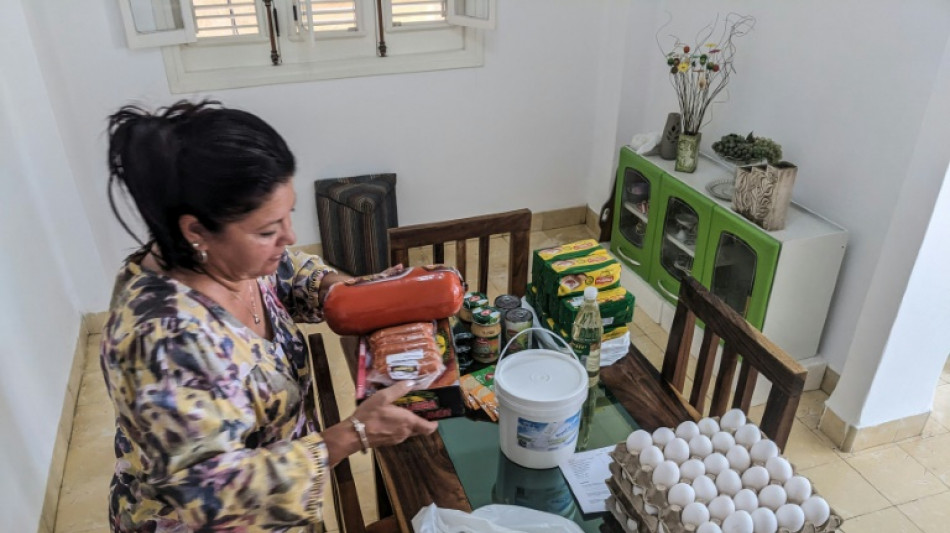
With little to buy, Cubans abroad send home food, not money / Photo: © AFP

 EU vows AI rules will protect Europeans. Will they?

 Myanmar leader to visit Malaysia after migrant returns begin

 Germany's AfD poised to preside over state assembly for first time

 Australia's opposition vows 'largest cut to immigration' in country's history

 Ready, set, snooze: Sleep-deprived Japanese compete for best-rested

 Falcons thump Saints 45-24 as New Orleans marks Katrina anniversary

 Tuvalu govt adviser says Australia overstepped in pre-COP visit

 Asian stocks mixed despite tech-led Wall St record

 Tens of thousands expected in Paris for high school protests

 AI borrowing binge rattles US markets

 Young Canadians sue government over alleged climate failures

 White Sox down Guardians to take 2-0 series lead

 NHL record-breaker Ovechkin says current season will be his last

 France roar back in Nations League as Italy beat Turkey

 Messi readies for final farewell in Argentina send-off

 Esposito seals Italy win over Turkey in Nations League

 Russia downplays plague reports as Trump offers US help

 Trump says US moved bombers from UK base after 'threats'

 Brazilian stocks surge to record after Bolsonaro election lead

 Leaders to visit Pacific atoll at frontline of climate change

 ICC gives more details about arrest warrants for Taliban ministers

 Nigeria's Tinubu confirms 32 dead after military plane crash

 'Reckless' AI firms can't control models, says whistleblower

 Switching on brain cells: the Nobel-winning science of optogenetics

 Quebec votes as separatist surge poses test for Canada PM

Maria Paez feels relieved after receiving a package of food items including eggs, ham, and yogurt from her children in Miami -- bought online and shipped to Havana.
These days, with a severe economic crisis and food shortages, Cubans abroad increasingly prefer to send care packages to family back home, rather than cash transfers.
"Receiving these types of products is a relief for us" and, "in terms of spending money, the savings are substantial," Paez, a 59-year-old mathematics graduate told AFP.
"Receiving eggs is very important" because "it is a guaranteed breakfast," added Paez, who has lived alone with her husband since their two children emigrated to the United States.
In total, she received 18 products, a lifeline in Cuba which is facing its worst economic crisis in three decades, with shortages of food, medicine and fuel.
After several years of double-digit inflation, a carton of 30 eggs now costs 3,300 pesos ($27,50) on the communist island, where the average salary is 4,800 pesos.
Cuba's bleak economic circumstances have pushed some five percent of the population to flee in recent years.
Online stores offering the delivery of essential products to Cuba have flourished as demand rises.
Most are based in the United States -- home to two million Cubans -- but they have also cropped up in Mexico, Canada, and Spain.
Every day dozens of delivery vans and private vehicles can be seen on the streets of Cuba distributing packages of food items that are in short supply, or whose prices have skyrocketed since the government authorized private-owned stores in 2021.
- They 'don't want money' -
At one such delivery service in the US city of Hialeah, near Miami, which has a large Cuban population, Luis Manuel Mendez, 59, told AFP he sends food, medicine and school supplies to the two children he left behind when he emigrated a year-and-a-half ago.
"Things in Cuba are very expensive," so "it is much more feasible to buy it here and send it," said Mendez.
His children "don't want money, what they want is for me to send them basic necessities."
Nearby, there is a constant stream of people carrying bags to another agency which coordinates the sending of food packages to Cuba.
Maribel Ruiz, 62, said she helps out an aunt and cousins back home.
"The problem is that you send the money, but there is nothing to buy in the stores there. You have to send them packages of medicine, food, clothes, everything."
Cuba has been battling sky-high inflation and shortages since the pandemic -- which hit tourism hard -- plus a tightening of US sanctions in 2021, combined with structural weaknesses in the economy.
According to the Havana Consulting Group, based in Miami, remittances from the United States to Cuba reached a record $3.7 billion in 2019, becoming the country's second source of income after the export of medical services, and above tourism.
Cuban economist Emilio Morales, who chairs the consultancy, said this figure has since dropped "from $2 billion in 2022 to $1,9 billion in 2023."
Morales said emigrants also increasingly prefer "to invest large sums of money in getting their families" out of the country or pay online companies to send packages to their door.
O.Schlaepfer--VB