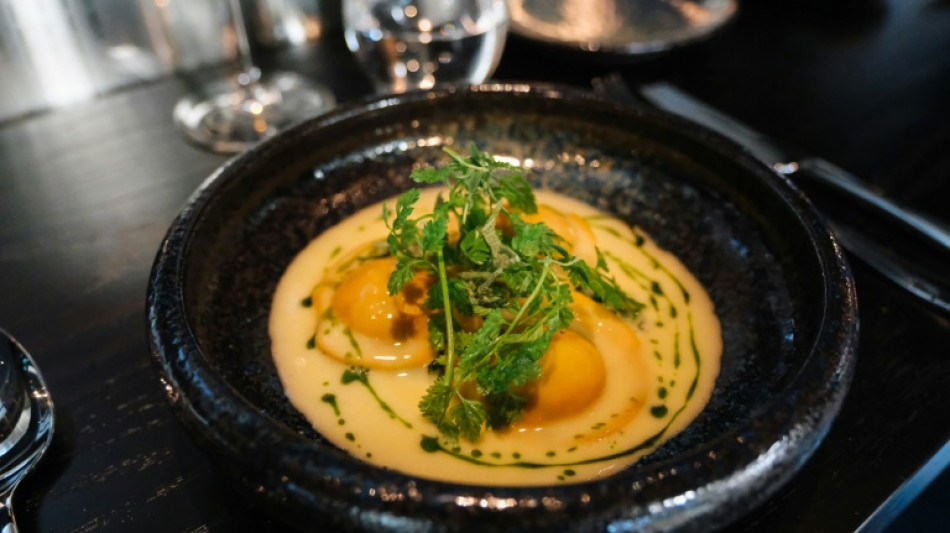
Finland's wizards making food out of thin air / Photo: © AFP

 EU vows AI rules will protect Europeans. Will they?
 Myanmar leader to visit Malaysia after migrant returns begin
 Germany's AfD poised to preside over state assembly for first time
 Australia's opposition vows 'largest cut to immigration' in country's history
 Ready, set, snooze: Sleep-deprived Japanese compete for best-rested

 Falcons thump Saints 45-24 as New Orleans marks Katrina anniversary

 Tuvalu govt adviser says Australia overstepped in pre-COP visit
 Asian stocks mixed despite tech-led Wall St record
 Tens of thousands expected in Paris for high school protests

 AI borrowing binge rattles US markets

 Young Canadians sue government over alleged climate failures

 White Sox down Guardians to take 2-0 series lead

 NHL record-breaker Ovechkin says current season will be his last
 France roar back in Nations League as Italy beat Turkey

 Messi readies for final farewell in Argentina send-off

 Esposito seals Italy win over Turkey in Nations League

 Russia downplays plague reports as Trump offers US help

 Trump says US moved bombers from UK base after 'threats'
 Brazilian stocks surge to record after Bolsonaro election lead

 Leaders to visit Pacific atoll at frontline of climate change

 ICC gives more details about arrest warrants for Taliban ministers

 Nigeria's Tinubu confirms 32 dead after military plane crash

 'Reckless' AI firms can't control models, says whistleblower

 Switching on brain cells: the Nobel-winning science of optogenetics

 Quebec votes as separatist surge poses test for Canada PM

At a factory in Finland, the "farmers of the future" are making a new food protein by feeding a microbe air and electricity, proving that protein can be produced without traditional agriculture.
Livestock farming is one of the main culprits in greenhouse gas emissions, the primary cause of global warming.
Cellular agriculture, where food or nutrients are grown from cell cultures, is increasingly seen as a green alternative to animal agriculture.
Lab-grown meat, eggs and milk have made headlines in recent years, with scientists using animal cell cultures -- a process some have criticised as unnatural, highly processed, energy-consuming and costly.
But at Solar Foods' recently opened factory outside Helsinki, scientists are using new technology to grow protein out of cells using air and electricity.
By feeding a microbe with carbon dioxide, hydrogen and some minerals, and powering the process with electricity from renewable sources, the company has managed to create a protein-rich powder that can be used as a milk and egg substitute.
"We can source our main feedstock for the microbe from the air," Solar Foods chief executive Pasi Vainikka told AFP, as he gave a tour of the company's new facilities near Helsinki.
"We have started the production of the world's most sustainable protein."
Founded by Vainikka and Juha-Pekka Pitkanen in 2017, Solar Foods launched the "world's first factory growing food out of thin air" in April.
"Much of the animal-like protein of today can actually be produced through cellular agriculture and we can let agricultural land re-wild and thereby build carbon stock," Vainikka said, referring to the process whereby forests and soil absorb and store carbon.
One kilo of the new protein, dubbed "solein", emits 130 times less greenhouse gases than the same amount of protein produced by beef production in the European Union, a 2021 scientific study claimed.
Vainikka navigates his way through the factory's laboratory and into the control room, where a dozen people at computer screens monitor the production process.
"These are our future farmers," Vainikka said.
- Part of the solution -
Transforming food production and consumption is at the heart of combating the climate crisis and preventing biodiversity loss, according to Emilia Nordlund, head of industrial biotechnology and food research at the VTT Technical Research Centre.
Yet current projections show the consumption of meat is expected to increase in coming years.
"Industrial food production, especially livestock production, is one of the biggest causes of greenhouse gas emissions (and) the biggest cause of biodiversity loss, eutrophication and freshwater usage," she said.
New food production technologies can help cut emissions and "decentralise and diversify food production", Nordlund said.
"However, at the same time, we must improve the existing food production methods to make them more sustainable and resilient," she added.
Fermentation technology used to produce different nutrients, such as proteins, has been around for decades.
But the field has expanded significantly in recent years with new technological solutions and research projects emerging worldwide.
- Slow progress -
Some of the most active start-up hubs focusing on cellular agriculture are in the United States, the United Kingdom, Germany, the Netherlands and Israel, Nordlund said.
"We are in a crucial phase as we will see which start-ups will survive," she said, adding that stalling bureaucracy was slowing cellular agriculture's take-off in the EU.
Dressed in protective gear to prevent bacteria contamination in the factory, Vainikka showed off a giant steel tank in a shiny production hall.
"This is a fermenter holding 20,000 litres," he said, explaining that the microbe multiplies inside the tank as it gets fed the greenhouse gas.
Liquid containing the microbes is continuously extracted from the tank to be processed into the yellowish protein-rich powder with a flavour described as "nutty" and "creamy".
"The fermenter produces the same amount of protein per day as 300 milking cows or 50,000 laying hens," Vainikka said.
That equals "five million meals' worth of protein per year".
For now, the main purpose of the small Finnish plant employing around 40 people is to "prove that the technology scales", so it can attract the necessary investments pending European regulatory approval.
While the protein has been cleared for sale in Singapore where some restaurants have used it to make ice cream, it is still awaiting classification as a food product in the EU and the United States.
To have any real impact, the aim is to "build an industrial plant 100 times the size of this one", Vainikka said.
R.Flueckiger--VB